


Comment
doi: 10.1158/1078-0432.CCR-14-0721.
Epub 2014 Jun 11.
CARTs on the road for myeloma
Affiliations
- PMID: 24919574
- PMCID: PMC4119563
- DOI: 10.1158/1078-0432.CCR-14-0721
Item in Clipboard
Comment
CARTs on the road for myeloma
Clin Cancer Res.
.
Abstract
Chimeric antigen receptors redirect T cells to surface antigens. Discovery and validation of appropriate target antigens expands the possible indications for chimeric-antigen receptor (CAR) T cells. CS1 is expressed at high levels by multiple myeloma cells, but also to some extent on other lymphocytes. CS1 may be a viable target for CAR T cells in multiple myeloma.
©2014 American Association for Cancer Research.
Figures
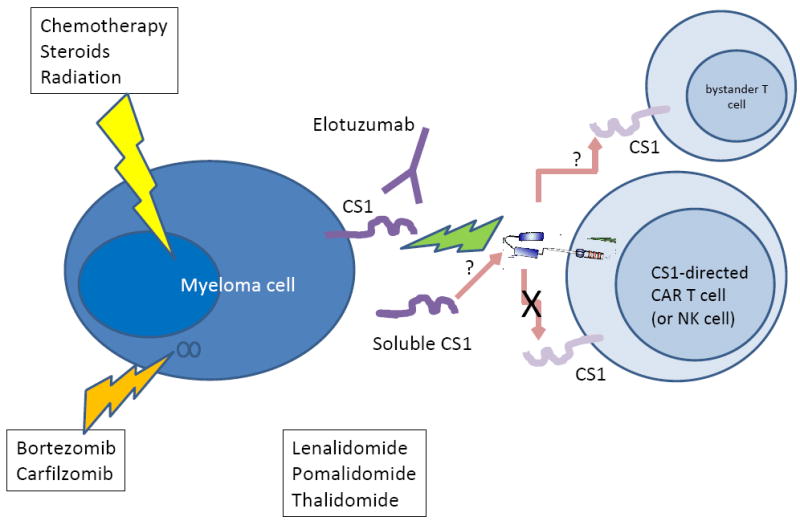
Myeloma is currently treated with combinations of chemotherapy, steroids, and
radiation. Novel drugs include proteasome inhibitors such as bortezomib and
carfilzomib, and immunomodulatory agents such as thalidomide, lenalidomide, and
pomalidomide. Elotuzumab is a monoclonal antibody targeting the glycoprotein CS1
that has been shown to have activity in combination with novel drugs. CS1 is
expressed on myeloma cells and on other lymphocyte subsets, including T cells
and NK cells; it is also shed into the circulation. Chimeric antigen receptors
(CARs) targeting CS1 and introduced into T cells (or NK cells) can kill
CS1-expressing myeloma cells, but do not appear to mediate T cell intrinsic
suicide. Outstanding questions are whether CS1-directed T cells will have subtle
fratricide effects on bystander T cells, and whether soluble CS1 will inactivate
the CS1 CARs.
Comment on
-
Genetic modification of T cells redirected toward CS1 enhances eradication of myeloma cells.Clin Cancer Res. 2014 Aug 1;20(15):3989-4000. doi: 10.1158/1078-0432.CCR-13-2510. Epub 2014 Mar 27. Clin Cancer Res. 2014. PMID: 24677374 Free PMC article.
References
-
- Terakura S, Goto T, Hanajiri R, Imahashi N, Shimada K, Nishida T, et al. Anti-CD20 Chimeric Antigen Receptor Transduced T Cells Can Recognize Very Low Antigen Expression: Determination Of The Lower Threshold Required To Activate The CAR-T Cells. Blood. 2013;122:4493.
-
- Lamers CH, Sleijfer S, Vulto AG, Kruit WH, Kliffen M, Debets R, et al. Treatment of metastatic renal cell carcinoma with autologous T-lymphocytes genetically retargeted against carbonic anhydrase IX: first clinical experience. Journal of Clinical Oncology. 2006;24:e20–2. - PubMed
Publication types
MeSH terms
Substances
Grants and funding
LinkOut - more resources
Full Text Sources
Other Literature Sources
Medical
Miscellaneous
