


Prevalence of anxiety disorders among Finnish primary care high utilizers and validation of Finnish translation of GAD-7 and GAD-2 screening tools
- PMID: 24920316
- PMCID: PMC4075021
- DOI: 10.3109/02813432.2014.920597
Prevalence of anxiety disorders among Finnish primary care high utilizers and validation of Finnish translation of GAD-7 and GAD-2 screening tools
Abstract
Objective: To analyse the prevalence of GAD and other anxiety disorders, as well as sensitivity and specificity of GAD-7 among high utilizers of health care.
Setting: Four municipal health centres in Northern Finland.
Subjects: A psychiatric interview was conducted for 150 high utilizers of health care.
Main outcome measures: Prevalence of GAD as well as sensitivity and specificity of GAD-7.
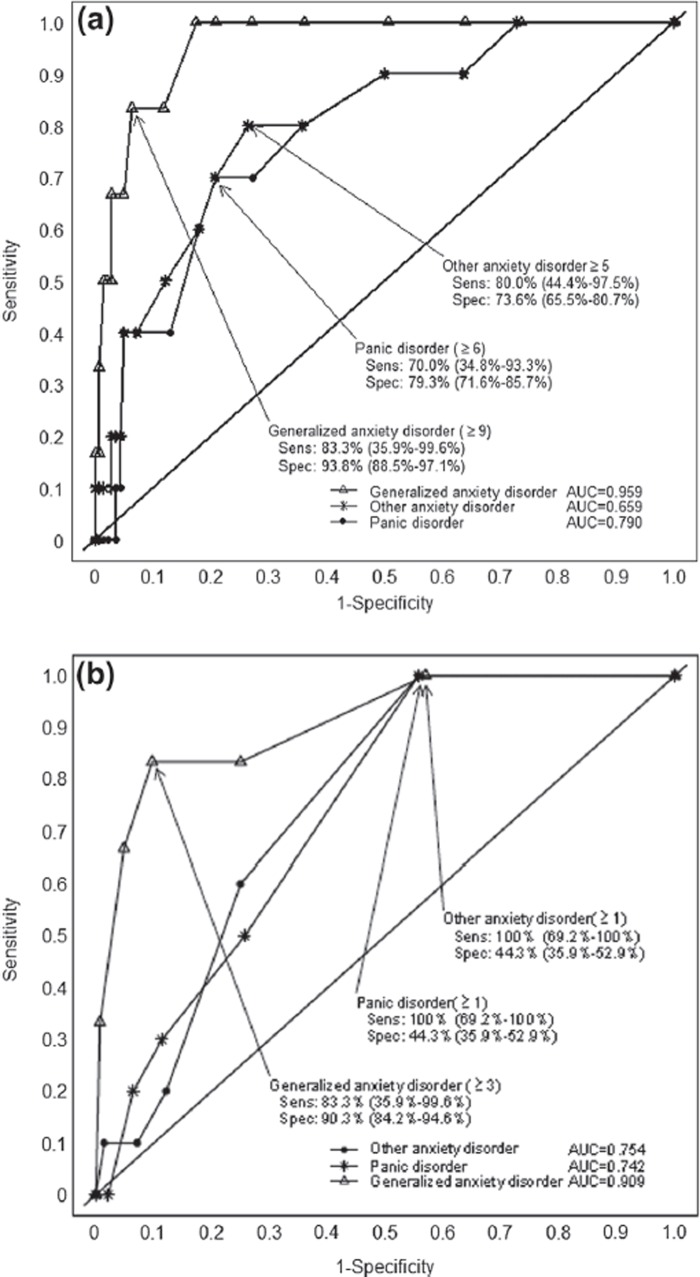
Results: The prevalence of GAD was 4% in this study group of Finnish high utilizers of health care. The sensitivity of GAD-7 was 100.0% (95% CI 54.1-100.0) and the specificity of GAD-7 was 82.6% (95% CI 75.4-88.4) with a cut-off point of 7 or more.
Conclusion: GAD is rather common among high utilizers of primary care, although the prevalence of 4% is lower than that previously reported. GAD-7 is a valid and useful tool for detecting GAD among primary health care patients.
Keywords: Anxiety disorders; Finland; general practice; generalized anxiety disorder; high utilizers of health care; panic disorder; screening.
Figures

References
-
- Wittchen HU, Hoyer J. Generalized anxiety disorder: Nature and course. J Clin Psychiatry. 2001;62((Suppl 11)):15–19. discussion 20–1. - PubMed
-
- Wittchen HU, Zhao S, Kessler RC, Eaton WW. DSM-III-R generalized anxiety disorder in the National Comorbidity Survey. Arch Gen Psychiatry. 1994;51:355–64. - PubMed
-
- Maier W, Gansicke M, Freyberger HJ, Linz M, Heun R, Lecrubier Y. Generalized anxiety disorder (ICD-10) in primary care from a cross-cultural perspective: A valid diagnostic entity? Acta Psychiatr Scand. 2000;101:29–36. - PubMed
-
- Lieb R, Becker E, Altamura C. The epidemiology of generalized anxiety disorder in Europe. Eur Neuropsychopharmacol. 2005;15:445–52. - PubMed
-
- Munk-Jorgensen P, Allgulander C, Dahl AA, Foldager L, Holm M, Rasmussen I, et al. Prevalence of generalized anxiety disorder in general practice in Denmark, Finland, Norway, and Sweden. Psychiatr Serv. 2006;57:1738–44. - PubMed
Publication types
MeSH terms
LinkOut - more resources
Full Text Sources
Other Literature Sources
Medical
