


Refining the Neuberger model: Uracil processing by activated B cells
- PMID: 24920531
- PMCID: PMC4126077
- DOI: 10.1002/eji.201444813
Refining the Neuberger model: Uracil processing by activated B cells
Abstract
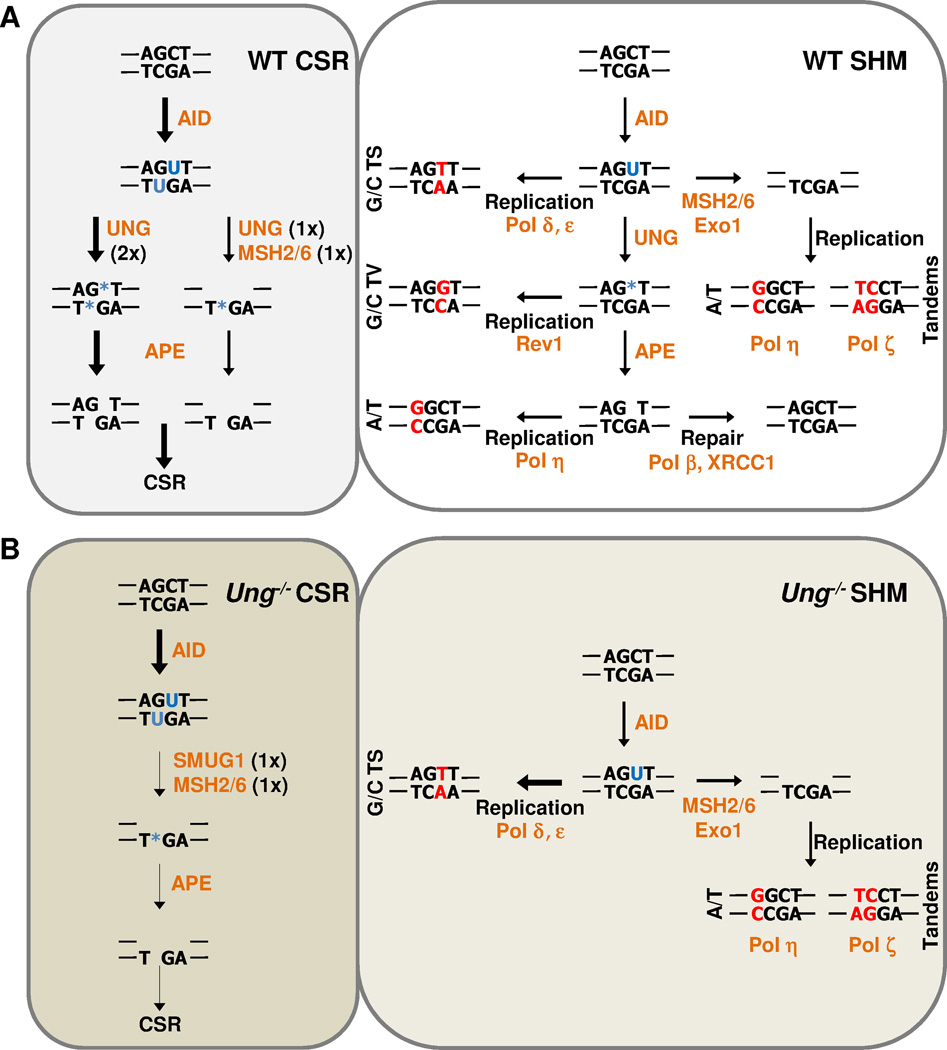
During the immune response, B cells undergo a programed mutagenic cascade to promote increased affinity and expanded antibody function. The two processes, somatic hypermutation (SHM) and class switch recombination (CSR), are initiated by the protein activation-induced deaminase (AID), which converts cytosine to uracil in the immunoglobulin loci. The presence of uracil in DNA promotes DNA mutagenesis though a subset of DNA repair proteins. Two distinct mechanisms have been proposed to control uracil processing. The first is through base removal by uracil DNA glycosylase (UNG), and the second is through detection by the mismatch repair (MMR) complex MSH2/6. In a study published in this issue of European Journal of Immunology, Dingler et al. [Eur. J. Immunol. 2014. 44: 1925-1935] examine uracil processing in B cells in the absence of UNG and SMUG1 glycosylases. Similar to UNG, SMUG1 is an uracil glycosylase which can remove the uracil base. While Smug1(-/-) mice show no clear deficiency in SHM or CSR, Ung(-/-) Smug1(-/-) mice display exacerbated phenotypes, suggesting a back-up role for SMUG1 in antibody diversity. This new information expands the model of uracil processing in B cells and raises several interesting questions about the dynamic relationship between base excision repair and MMR.
Keywords: Class switch recombination; DNA repair; SMUG1; Somatic hypermutation; UNG.
Published 2014. This article is a U.S. Government work and is in the public domain in the USA.
Conflict of interest statement
The authors declare no financial or commercial conflict of interest.
Figures
Comment on
-
Uracil excision by endogenous SMUG1 glycosylase promotes efficient Ig class switching and impacts on A:T substitutions during somatic mutation.Eur J Immunol. 2014 Jul;44(7):1925-35. doi: 10.1002/eji.201444482. Epub 2014 May 27. Eur J Immunol. 2014. PMID: 24771041 Free PMC article.
References
-
- Muramatsu M, Kinoshita K, Fagarasan S, Yamada S, Shinkai Y, Honjo T. Class switch recombination and hypermutation require activation-induced cytidine deaminase (AID), a potential RNA editing enzyme. Cell. 2000;102:553–563. - PubMed
-
- Revy P, Muto T, Levy Y, Geissmann F, Plebani A, Sanal O, Catalan N, et al. Activation-induced cytidine deaminase (AID) deficiency causes the autosomal recessive form of the Hyper-IgM syndrome (HIGM2) Cell. 2000;102:565–575. - PubMed
-
- Petersen-Mahrt SK, Harris RS, Neuberger MS. AID mutates E. coli suggesting a DNA deamination mechanism for antibody diversification. Nature. 2002;418:99–103. - PubMed
Publication types
MeSH terms
Substances
Grants and funding
LinkOut - more resources
Full Text Sources
Other Literature Sources
