Utility and safety of rituximab in pediatric autoimmune and inflammatory CNS disease
- PMID: 24920861
- PMCID: PMC4117174
- DOI: 10.1212/WNL.0000000000000570
Utility and safety of rituximab in pediatric autoimmune and inflammatory CNS disease
Abstract
Objective: To assess the utility and safety of rituximab in pediatric autoimmune and inflammatory disorders of the CNS.
Methods: Multicenter retrospective study.
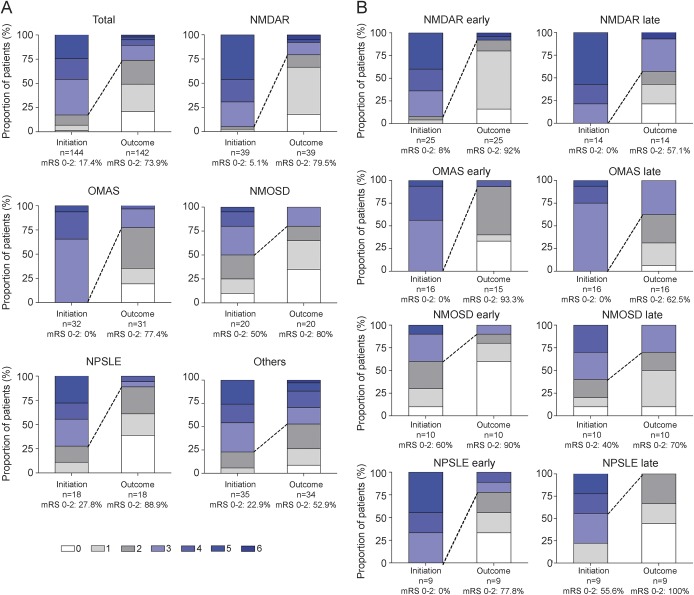
Results: A total of 144 children and adolescents (median age 8 years, range 0.7-17; 103 female) with NMDA receptor (NMDAR) encephalitis (n = 39), opsoclonus myoclonus ataxia syndrome (n = 32), neuromyelitis optica spectrum disorders (n = 20), neuropsychiatric systemic lupus erythematosus (n = 18), and other neuroinflammatory disorders (n = 35) were studied. Rituximab was given after a median duration of disease of 0.5 years (range 0.05-9.5 years). Infusion adverse events were recorded in 18/144 (12.5%), including grade 4 (anaphylaxis) in 3. Eleven patients (7.6%) had an infectious adverse event (AE), including 2 with grade 5 (death) and 2 with grade 4 (disabling) infectious AE (median follow-up of 1.65 years [range 0.1-8.5]). No patients developed progressive multifocal leukoencephalopathy. A definite, probable, or possible benefit was reported in 125 of 144 (87%) patients. A total of 17.4% of patients had a modified Rankin Scale (mRS) score of 0-2 at rituximab initiation, compared to 73.9% at outcome. The change in mRS 0-2 was greater in patients given rituximab early in their disease course compared to those treated later.
Conclusion: While limited by the retrospective nature of this analysis, our data support an off-label use of rituximab, although the significant risk of infectious complications suggests rituximab should be restricted to disorders with significant morbidity and mortality.
Classification of evidence: This study provides Class IV evidence that in pediatric autoimmune and inflammatory CNS disorders, rituximab improves neurologic outcomes with a 7.6% risk of adverse infections.
© 2014 American Academy of Neurology.
Figures
Comment in
-
B-cell depletion in children with neuroimmunologic conditions: the learning curve.Neurology. 2014 Jul 8;83(2):111-2. doi: 10.1212/WNL.0000000000000576. Epub 2014 Jun 11. Neurology. 2014. PMID: 24920852 No abstract available.
References
-
- Maloney DG, Grillo-Lopez AJ, White CA, et al. IDEC-C2B8 (Rituximab) anti-CD20 monoclonal antibody therapy in patients with relapsed low-grade non-Hodgkin's lymphoma. Blood 1997;90:2188–2195 - PubMed
-
- Cohen SB, Emery P, Greenwald MW, et al. Rituximab for rheumatoid arthritis refractory to anti-tumor necrosis factor therapy: results of a multicenter, randomized, double-blind, placebo-controlled, phase III trial evaluating primary efficacy and safety at twenty-four weeks. Arthritis Rheum 2006;54:2793–2806 - PubMed
-
- Hauser SL, Waubant E, Arnold DL, et al. B-cell depletion with rituximab in relapsing-remitting multiple sclerosis. N Engl J Med 2008;358:676–688 - PubMed
-
- Pranzatelli MR, Tate ED, Travelstead AL, et al. Rituximab (anti-CD20) adjunctive therapy for opsoclonus-myoclonus syndrome. J Pediatr Hematol Oncol 2006;28:585–593 - PubMed
Publication types
MeSH terms
Substances
Grants and funding
LinkOut - more resources
Full Text Sources
Other Literature Sources
Medical
Research Materials