


Sensory impairments in community health care: a descriptive study of hearing and vision among elderly Norwegians living at home
- PMID: 24920916
- PMCID: PMC4045259
- DOI: 10.2147/JMDH.S58461
Sensory impairments in community health care: a descriptive study of hearing and vision among elderly Norwegians living at home
Abstract
Background: Hearing and vision impairments increase with age and are common risk factors for functional decline reduced social participation and withdrawal.
Objective: Describe the hearing and vision of home care patients older than 80 years.
Methods: Ninety-three older adults (80+ years) receiving home care were screened for hearing and vision in their homes. Data were collected using a HEINE Mini 3000(®) Otoscope to examine the eardrum and presence of earwax, an Entomed SA201-IV portable pure-tone audiometer to measure the pure-tone average (PTAV), a logarithm of the minimum angle of resolution chart to measure visual acuity (VA), and the Combined Serious Sensory Impairment interview guide.
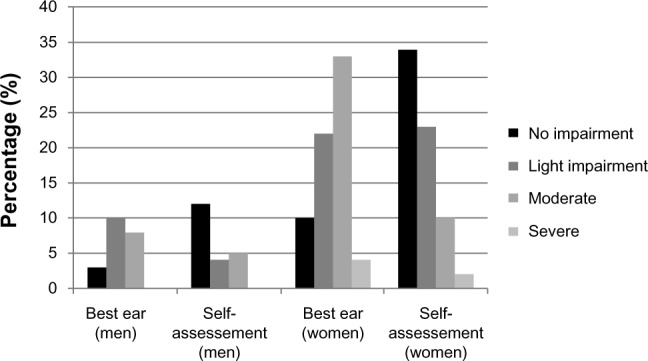
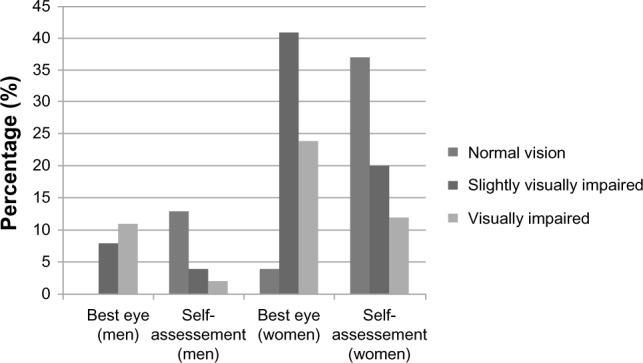
Results: Slight and moderate hearing impairments were found in 41% and 47% of the population, respectively (mean PTAV =40.4 dB for the better ear), and 40% and 56% had impaired and slightly impaired vision, respectively (mean VA =0.45 for the better eye). The participants' self-assessments of hearing and vision were only weakly correlated with PTAV and VA values. The visual function was significantly worse in men than in women (P=0.033). Difficulty in performing instrumental activities of daily living because of hearing and vision impairments was experienced by 17% of the participants, whereas 76% experienced no difficulties. When many people were present, 72% of the participants found it difficult to understand speech. Nearly 30% found it tiring to read, and 41% could not read very small print.
Conclusion: The patients' self-assessments of their hearing and vision did not correlate strongly with their VA and PTAV scores. Asking the elderly about their overall hearing and vision ability is not sufficient for detecting sensory impairment, and asking more specific questions about what they could not hear and see was not an adequate indicator of the patients' hearing and vision problems. To detect hearing and vision impairments among elderly home care patients, standardized measurements of their hearing and vision are necessary.
Keywords: dual sensory impairment; elderly; hearing; home care; vision.
Figures
References
-
- Lyng K, Svingen EM. Norsk Institutt for forskning om oppvekst, velferd og aldring (NOVA) Oslo: Norwegian; 2001. [Accessed: September 1, 2014]. Kartlegging av alvorlig, kombinert sansetap hos eldre [Screening of serious, combined impairment in elderly]. Nova Report 9 Evaluering av en sjekklistebasert screeningmetodikk. Available from: http://norlag.nova.no/asset/4363/1/4363_1.pdf.
-
- Wallhagen MI, Pettengill E. Hearing impairment: significant but underassessed in primary care settings. J Gerontol Nurs. 2008;34(2):36–42. - PubMed
-
- Houde SC, Huff MH. Age-related vision loss in older adults. A challenge for gerontological nurses. J Gerontol Nurs. 2003;29(4):25–33. - PubMed
-
- Burmedi D, Becker S, Heyl V, Wahl H, Himmelsbach I. Emotional and social consequences of age-related low vision. Vis Impair Res. 2002;4(1):47–71.
-
- Brody BL, Gamst AC, Williams RA, et al. Depression, visual acuity, comorbidity, and disability associated with age-related macular degeneration. Ophthalmology. 2001;108(10):1893–1900. - PubMed
LinkOut - more resources
Full Text Sources
Other Literature Sources
Miscellaneous
