


Prevalence and relationship between major depressive disorder and lung cancer: a cross-sectional study
- PMID: 24920922
- PMCID: PMC4043796
- DOI: 10.2147/OTT.S60000
Prevalence and relationship between major depressive disorder and lung cancer: a cross-sectional study
Abstract
Objective: The aims of this study were to estimate the prevalence and examine the factors associated with major depressive disorder (MDD) in lung cancer patients.
Materials and methods: This cross-sectional study was carried out in the oncology clinic of the University Hospital, Chiang Mai University, Thailand. Patients with all stages of lung cancer were included in this study. Demographic data of eligible patients were gathered. The Mini-International Neuropsychiatric Interview, Thai version 5.0.0 was used to identify MDD. The Thai version of the Personal Health Questionnaire Depression Scale was used to assess depression severity.
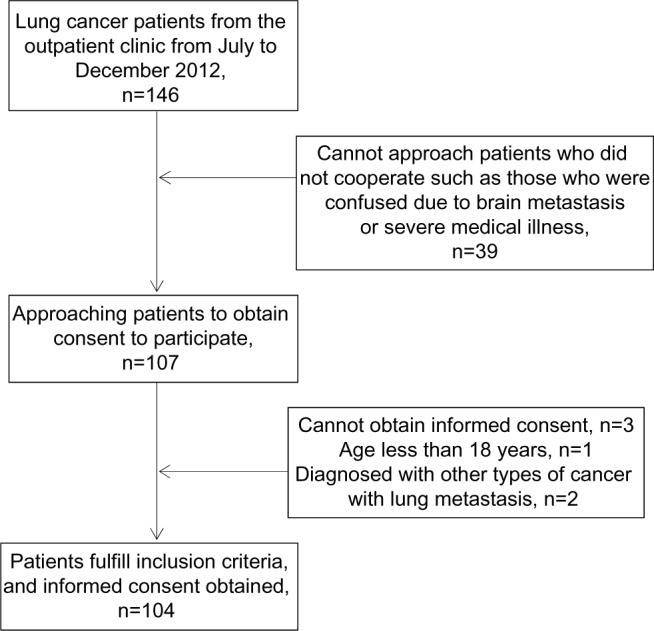
Results: A total of 146 lung cancer patients from the outpatient clinic from July to December 2012 were approached. The 104 patients were included and analyzed in this study. Based on the Mini-International Neuropsychiatric Interview, 14.4% of them were defined as having MDD. Multiple linear regression analysis revealed that Chalder Fatigue Scale, Functional Assessment of Cancer Therapy - Lung, and Pittsburgh Sleep Quality Index scores were significantly correlated with MDD in lung cancer patients.
Conclusion: The results suggest that MDD is more prevalent in lung cancer patients. In addition, fatigue, poor quality of life, and sleep disturbance may increase associated MDD. Because of the small sample size, further studies should be conducted to confirm these results.
Keywords: lung cancer; major depressive disorder; prevalence.
Figures
References
-
- Massie MJ. Prevalence of depression in patients with cancer. J Natl Cancer Inst Monogr. 2004;(32):57–71. - PubMed
-
- Hopwood P, Stephens RJ. Depression in patients with lung cancer: prevalence and risk factors derived from quality-of-life data. J Clin Oncol. 2000;18(4):893–903. - PubMed
-
- Shimizu K, Nakaya N, Saito-Nakaya K, et al. Clinical biopsychosocial risk factors for depression in lung cancer patients: a comprehensive analysis using data from the Lung Cancer Database Project. Ann Oncol. 2012;23(8):1973–1979. - PubMed
-
- Kittirattanapaiboon P, Khamwongpin M. The validity of the Mini International Neuropsychiatric Interview (MINI) – Thai version. J Ment Health Thailand. 2005;13(3):125–135.
LinkOut - more resources
Full Text Sources
Other Literature Sources
