


Satisfaction and health-related quality of life in women with heavy menstrual bleeding; results from a non-interventional trial of the levonorgestrel-releasing intrauterine system or conventional medical therapy
- PMID: 24920936
- PMCID: PMC4043813
- DOI: 10.2147/IJWH.S57470
Satisfaction and health-related quality of life in women with heavy menstrual bleeding; results from a non-interventional trial of the levonorgestrel-releasing intrauterine system or conventional medical therapy
Abstract
Purpose: To evaluate the patient satisfaction and health related quality of life (HRQoL) for levonorgestrel-releasing intrauterine system (LNG-IUS) versus conventional medical treatments ([CMTs] combined oral contraceptives, oral progestins, and antifibrinolytics, alone or in combination) in Asian women with heavy menstrual bleeding (HMB).
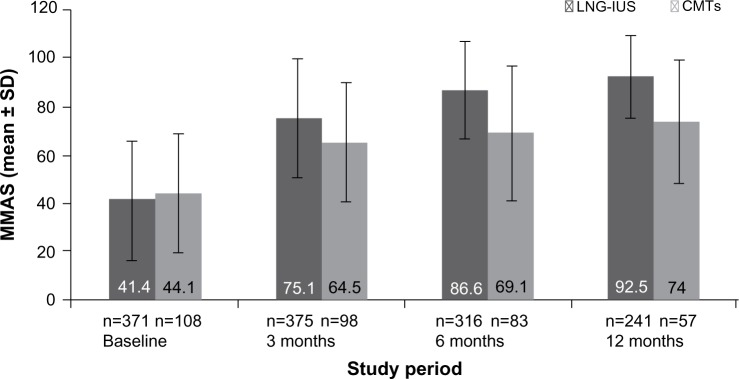
Patients and methods: A total of 647 patients diagnosed with HMB were recruited to this non-interventional study from the eight participating countries in Asia. Patient satisfaction was recorded at the last visit (at 12 months or premature discontinuation). At each visit (at 3, 6, and 12 months), patients completed the menorrhagia multi-attribute scale (MMAS) to assess HRQoL.
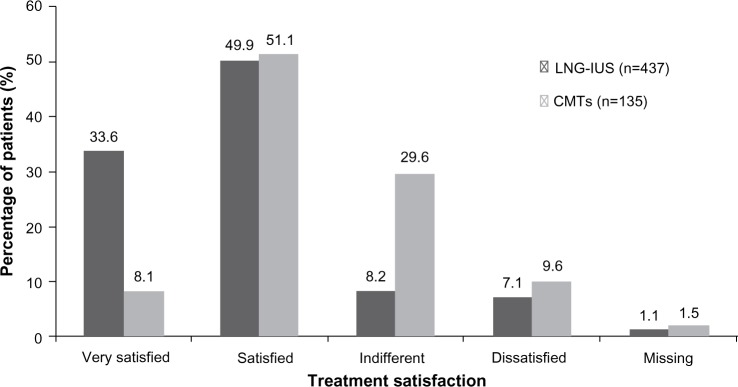
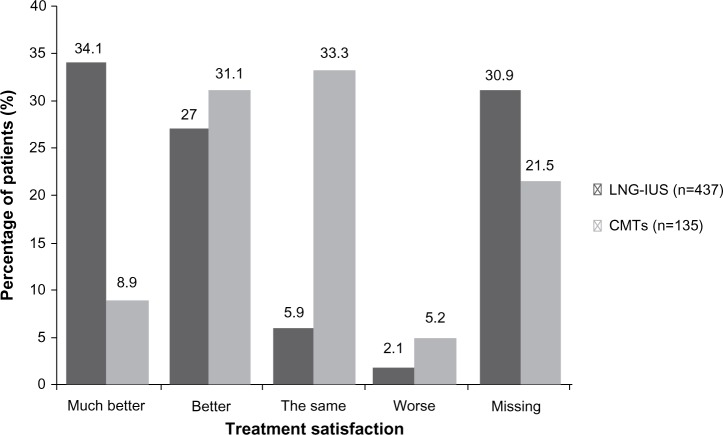
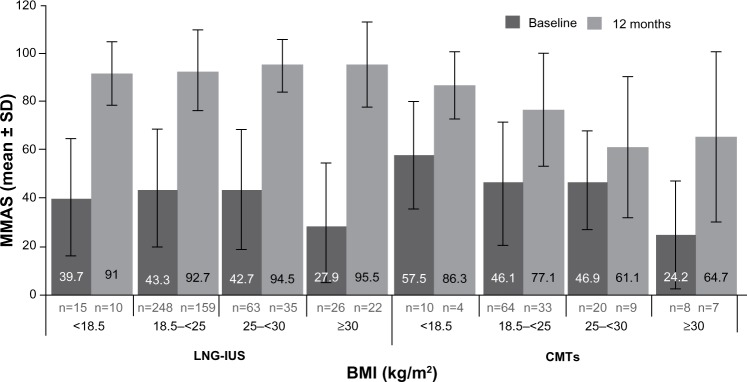
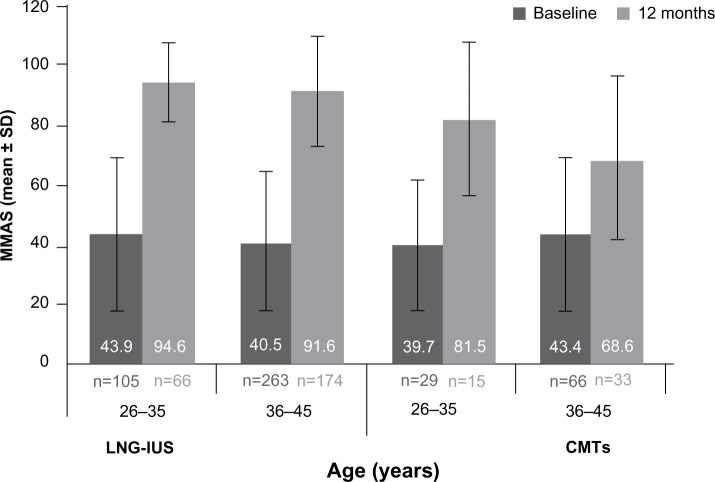
Results: A total of 83.5% of patients on the LNG-IUS were "very satisfied" or at least "satisfied" with the therapeutic effect of HMB treatment, compared with 59.2% of patients with CMTs (P<0.05). The mean (± standard deviation) MMAS score increased from 41.4±24.5 to 87.7±21.4 in the LNG-IUS arm, and from 44.1±24.9 to 73.1±25.3 in the CMTs arm. This increase was significantly higher in patients on the LNG-IUS, as compared with those on CMTs (P<0.05). The improvement in HRQoL in both treatment groups correlated with the body mass index of the patient, with larger improvement obtained in women with a higher body mass index.
Conclusion: The majority of women using the LNG-IUS or CMTs for HMB were satisfied with their treatment, and both treatment modalities were associated with significant improvements in HRQoL over time. The improvement was greater with the LNG-IUS, compared with CMTs.
Keywords: HRQoL; MMAS; dysfunctional uterine bleeding; menorrhagia; tranexamic acid.
Figures
References
-
- National Institute for Health and Clinical Excellence . Heavy Menstrual Bleeding NICE. Clinical Guideline 44. National Institute for Health and Clinical Excellence; 2007. [Accessed May 5, 2014]. Available from: http://www.nice.org.uk/nicemedia/pdf/CG44NICEGuideline.pdf.
-
- Roy SN, Bhattacharya S. Benefits and risks of pharmacological agents used for the treatment of menorrhagia. Drug Saf. 2004;27:75–90. - PubMed
-
- Wyatt KM, Dimmock PW, Walker TJ, O’Brien PM. Determination of total menstrual blood loss. Fertil Steril. 2001;76:125–131. - PubMed
-
- Shaaban MM, Zakherah MS, El-Nashar SA, Sayed GH. Levonorgestrel-releasing intrauterine system compared to low dose combined oral contraceptive pills for idiopathic menorrhagia: a randomized clinical trial. Contraception. 2011;83:48–54. - PubMed
-
- Jensen J, Mansour D, Lukkari-Lax E, Inki P, Burock K, Fraser IS. Bleeding patterns with the levonorgestrel-releasing intrauterine system when used for heavy menstrual bleeding in women without structural pelvic pathology: a pooled analysis of randomized controlled studies. Contraception. 2013;87:107–112. - PubMed
LinkOut - more resources
Full Text Sources
Other Literature Sources
