Explaining the host-finding behavior of blood-sucking insects: computerized simulation of the effects of habitat geometry on tsetse fly movement
- PMID: 24921243
- PMCID: PMC4055578
- DOI: 10.1371/journal.pntd.0002901
Explaining the host-finding behavior of blood-sucking insects: computerized simulation of the effects of habitat geometry on tsetse fly movement
Abstract
Background: Male and female tsetse flies feed exclusively on vertebrate blood. While doing so they can transmit the diseases of sleeping sickness in humans and nagana in domestic stock. Knowledge of the host-orientated behavior of tsetse is important in designing bait methods of sampling and controlling the flies, and in understanding the epidemiology of the diseases. For this we must explain several puzzling distinctions in the behavior of the different sexes and species of tsetse. For example, why is it that the species occupying savannahs, unlike those of riverine habitats, appear strongly responsive to odor, rely mainly on large hosts, are repelled by humans, and are often shy of alighting on baits?
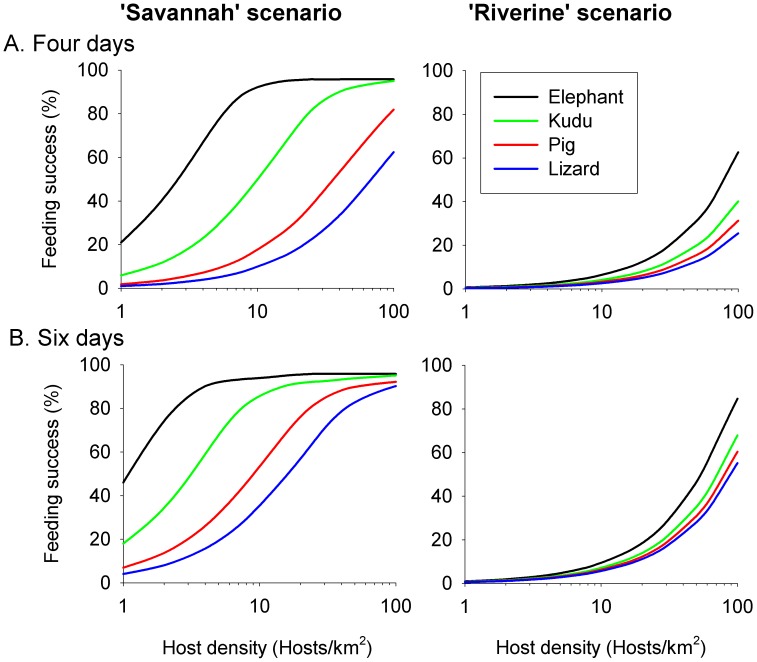
Methodology/principal findings: A deterministic model that simulated fly mobility and host-finding success suggested that the behavioral distinctions between riverine, savannah and forest tsetse are due largely to habitat size and shape, and the extent to which dense bushes limit occupiable space within the habitats. These factors seemed effective primarily because they affect the daily displacement of tsetse, reducing it by up to ∼70%. Sex differences in behavior are explicable by females being larger and more mobile than males.
Conclusion/significance: Habitat geometry and fly size provide a framework that can unify much of the behavior of all sexes and species of tsetse everywhere. The general expectation is that relatively immobile insects in restricted habitats tend to be less responsive to host odors and more catholic in their diet. This has profound implications for the optimization of bait technology for tsetse, mosquitoes, black flies and tabanids, and for the epidemiology of the diseases they transmit.
Conflict of interest statement
The authors have declared that no competing interests exist.
Figures
References
-
- Leak SG (1999) Tsetse biology and ecology; their role in the epidemiology and control of trypanosomiasis. OXON: CABI. 568 p.
-
- Vale GA (1974) The response of tsetse flies (Diptera, Glossinidae) to mobile and stationary baits. Bulletin of Entomological Research 64: 545–588.
-
- Shaw APM, Torr SJ, Waiswa C, Cecchi G, Wint GRW, et al. (2013) Estimating the costs of tsetse control options: An example for Uganda. Preventive Veterinary Medicine 110: 290–303. - PubMed
-
- Dransfield RD, Brightwell R, Kyorku C, Williams B (1990) Control of tsetse fly (Diptera: Glossinidae) populations using traps at Nguruman, south-west Kenya. Bulletin of Entomological Research 80: 265–276.
Publication types
MeSH terms
LinkOut - more resources
Full Text Sources
Other Literature Sources