


A chronic kidney disease risk score to determine tenofovir safety in a prospective cohort of HIV-positive male veterans
- PMID: 24922479
- PMCID: PMC4188545
- DOI: 10.1097/QAD.0000000000000258
A chronic kidney disease risk score to determine tenofovir safety in a prospective cohort of HIV-positive male veterans
Abstract
Objective: Tenofovir disoproxil fumarate is a widely used antiretroviral for HIV infection that has been associated with an increased risk of chronic kidney disease (CKD). Our objective was to derive a scoring system to predict 5-year risk of developing CKD in HIV-infected individuals and to estimate difference in risk associated with tenofovir use.
Design: We evaluated time to first occurrence of CKD (estimated glomerular filtration rate <60 ml/min per 1.73 m(2)) in 21 590 HIV-infected men from the Veterans Health Administration initiating antiretroviral therapy from 1997 to 2010.
Methods: We developed a point-based score using multivariable Cox regression models. Median follow-up was 6.3 years, during which 2059 CKD events occurred.
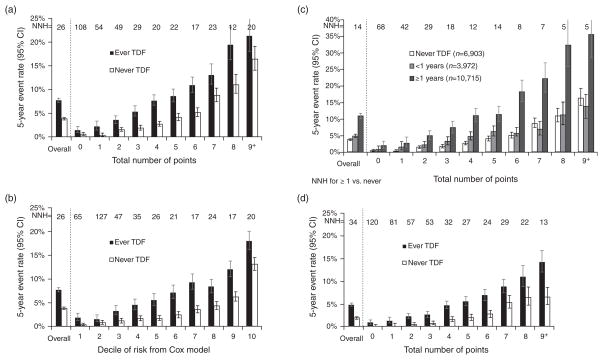
Results: Dominant contributors to the CKD risk score were traditional kidney risk factors (age, glucose, SBP, hypertension, triglycerides, proteinuria); CD4(+) cell count was also a component, but not HIV RNA. The overall 5-year event rate was 7.7% in tenofovir users and 3.8% in nonusers [overall adjusted hazard ratio 2.0, 95% confidence interval (CI) 1.8-2.2]. There was a progressive increase in 5-year CKD risk, ranging from less than 1% (zero points) to 16% (≥9 points) in nonusers of tenofovir, and from 1.4 to 21.4% among tenofovir users. The estimated number-needed-to-harm (NNH) for tenofovir use ranged from 108 for those with zero points to 20 for persons with at least nine points. Among tenofovir users with at least 1 year exposure, NNH ranged from 68 (zero points) to five (≥9 points).
Conclusion: The CKD risk score can be used to predict an HIV-infected individual's absolute risk of developing CKD over 5 years and may facilitate clinical decision-making around tenofovir use.
Conflict of interest statement
There are no conflicts of interest.
Figures
References
-
- Panel on Antiretroviral Guidelines for Adults and Adolescents. [Accessed 24 February 2014];Guidelines for the use of antiretroviral agents in HIV-1-infected adults and adolescents. http://aidsinfo.nih.gov/contentfiles/lvguidelines/adultandadolescentgl.pdf. [Updated 12 February 2013]
-
- World Health Organization. Antiretroviral therapy for HIV infection in adults and adolescents: recommendations for a public health approach [Revised] Geneva: WHO; 2010. [Accessed 24 February 2014]. http://www.who.int/hiv/pub/arv/adult2010/en/index.html. - PubMed
-
- McAlister FA, Ezekowitz J, Tonelli M, Armstrong PW. Renal insufficiency and heart failure: prognostic and therapeutic implications from a prospective cohort study. Circulation. 2004;109:1004–1009. - PubMed
Publication types
MeSH terms
Substances
Grants and funding
- KL2 TR000143/TR/NCATS NIH HHS/United States
- K24AI069994/AI/NIAID NIH HHS/United States
- KL2 RR024130/RR/NCRR NIH HHS/United States
- K24 AI069994/AI/NIAID NIH HHS/United States
- R03 AG034871/AG/NIA NIH HHS/United States
- R01 DK066488/DK/NIDDK NIH HHS/United States
- R37 AI098472/AI/NIAID NIH HHS/United States
- R01 DK066488-01/DK/NIDDK NIH HHS/United States
- R01 AI098472/AI/NIAID NIH HHS/United States
- K23 DK080645/DK/NIDDK NIH HHS/United States
- P30 MH062246/MH/NIMH NIH HHS/United States
- 1R03AG034871-01/AG/NIA NIH HHS/United States
- K23DK080645-01A1/DK/NIDDK NIH HHS/United States
LinkOut - more resources
Full Text Sources
Other Literature Sources
Medical
Research Materials
