


Abdominal obesity is associated with heart disease in dogs
- PMID: 24923277
- PMCID: PMC4066699
- DOI: 10.1186/1746-6148-10-131
Abdominal obesity is associated with heart disease in dogs
Abstract
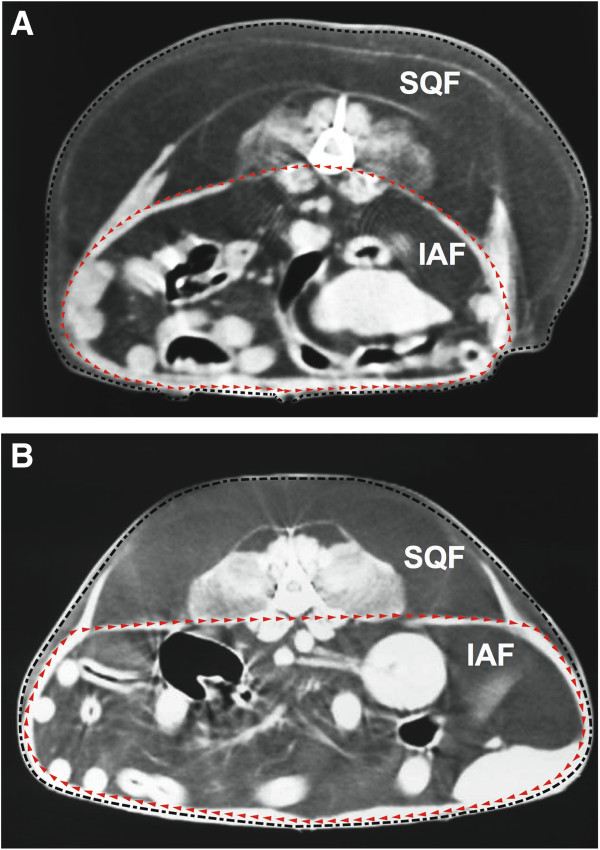
Background: The relationship between overall obesity and fat distribution in dogs and the development of heart disease is unclear. In the present study we evaluated the association between overall obesity and fat distribution and clinical heart disease by morphometric and computed tomography (CT)-based measurements. Body condition score (BCS), modified body mass index (MBMI, kg/m2), waist-to-hock-to-stifle distance ratio (WHSDR), waist-to-ilium wing distance ratio (WIWDR), and waist-to-truncal length ratio (WTLR) were compared between dogs with (n = 44) and without (n = 43) heart disease using receiver operating characteristic (ROC) analysis. Intra-abdominal fat (IAF) and subcutaneous fat (SQF) were measured in dogs with (n = 8) and without (n = 9) heart disease at the center of the fourth and fifth lumbar vertebrae by CT.
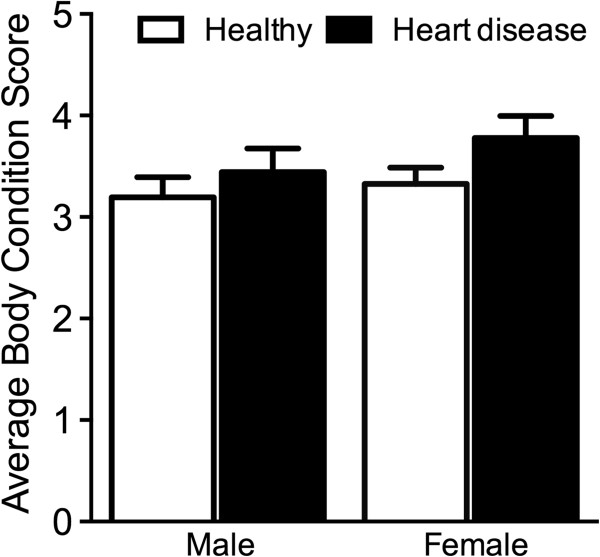
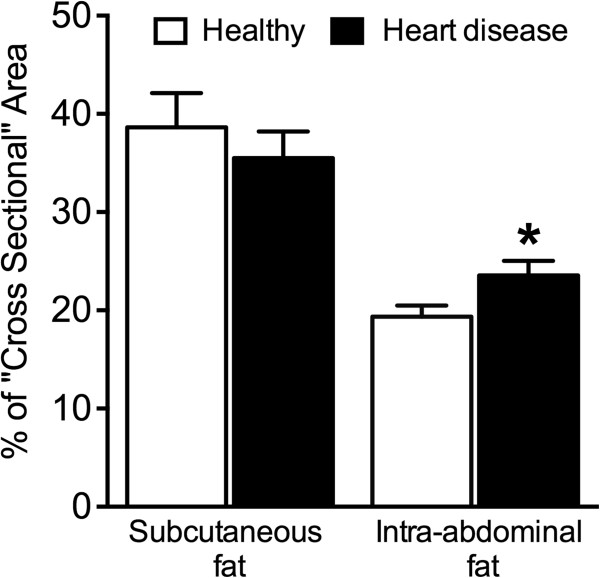
Results: BCS was similar between heart disease and healthy groups (3.6 ± 0.2 vs. 3.3 ± 0.1, P = 0.126). The following morphometric measurements were greater in the heart disease group compared with healthy canines: MBMI (65.0 ± 4.5 vs. 52.5 ± 3.7 kg/m2, respectively, P = 0.035); WIWDR (4.1 ± 0.1 vs. 3.1 ± 0.1, P < 0.01); and WTLR (1.25 ± 0.04 vs. 1.05 ± 0.04, P < 0.01). However, there was no significant difference in WHSDR (3.6 ± 0.1 vs. 3.7 ± 0.2, P = 0.875). Interestingly, IAF was significantly increased in dogs with heart disease compared with healthy dogs (23.5 ± 1.5% vs. 19.4 ± 1.2%, P = 0.039) whereas SQF was similar between two groups (35.5 ± 2.7% vs. 38.6 ± 3.5%, P = 0.496). Of the five morphometric indices studied, WIWDR and WTLR provided acceptable discrimination for diagnosing heart disease in dogs, with areas under the ROC curve of 0.778 (95% confidence interval [CI]:0.683-0.874) and 0.727 (95% CI:0.619-0.835), respectively.
Conclusions: Our data indicate that abdominal obesity, rather than overall obesity, is associated with heart disease in dogs. Measurements of both WIWDR and WTLR are particular useful for detection of an abdominal obesity in dogs.
Figures
References
-
- Snell-Bergeon JK, Hokanson JE, Kinney GL, Dabelea D, Ehrlich J, Eckel RH, Ogden L, Rewers M. Measurement of abdominal fat by CT compared to waist circumference and BMI in explaining the presence of coronary calcium. Int J Obes Relat Metab Disord. 2004;28(12):1594–1599. doi: 10.1038/sj.ijo.0802796. - DOI - PubMed
-
- Nasir K, Campbell CY, Santos RD, Roguin A, Braunstein JB, Carvalho JA, Blumenthal RS. The association of subclinical coronary atherosclerosis with abdominal and total obesity in asymptomatic men. Prev Cardiol. 2005;8(3):143–148. - PubMed
Publication types
MeSH terms
LinkOut - more resources
Full Text Sources
Other Literature Sources
Medical
