


A nationwide study of serous "borderline" ovarian tumors in Denmark 1978-2002: centralized pathology review and overall survival compared with the general population
- PMID: 24924123
- PMCID: PMC4370179
- DOI: 10.1016/j.ygyno.2014.06.002
A nationwide study of serous "borderline" ovarian tumors in Denmark 1978-2002: centralized pathology review and overall survival compared with the general population
Abstract
Objective: To describe the study population and estimate overall survival of women with a serous "borderline" ovarian tumor (SBT) in Denmark over 25 years relative to the general population.
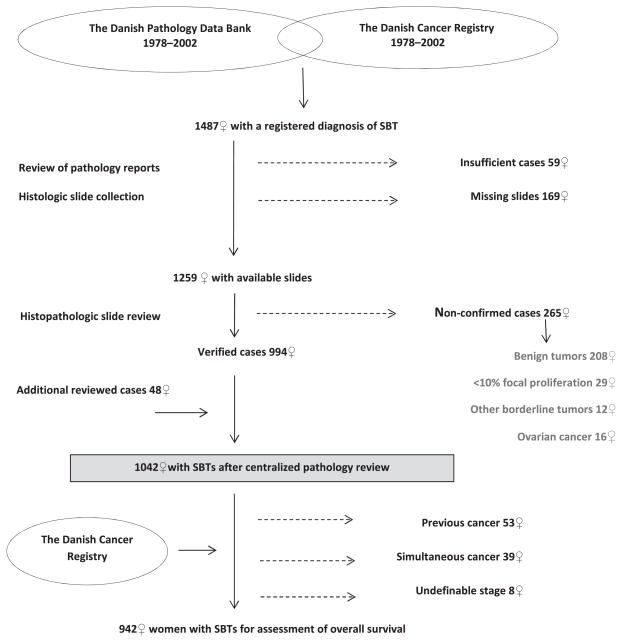
Methods: The Danish Pathology Data Bank and the Danish Cancer Registry were used to identify 1487 women diagnosed with SBTs from 1978 to 2002. The histologic slides were collected from Danish pathology departments and reviewed by expert pathologists and classified as SBT/atypical proliferative serous tumor (APST) or noninvasive low-grade serous carcinoma (LGSC). Associated implants were classified as noninvasive or invasive. Medical records were collected from hospital departments and reviewed. Data were analyzed using Kaplan-Meier and relative survival was estimated with follow-up through September 2, 2013.
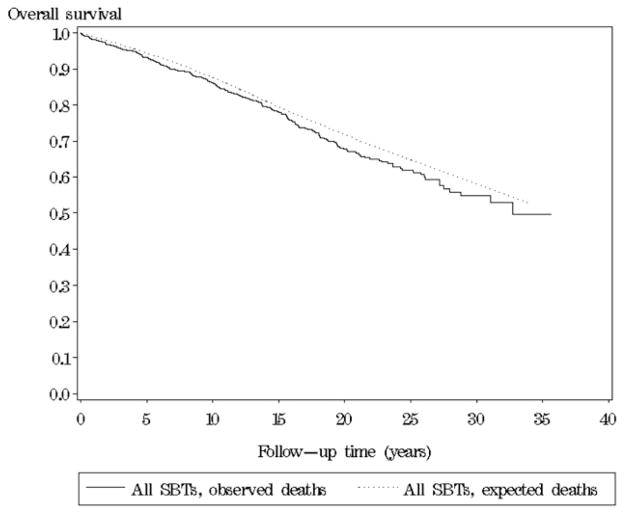
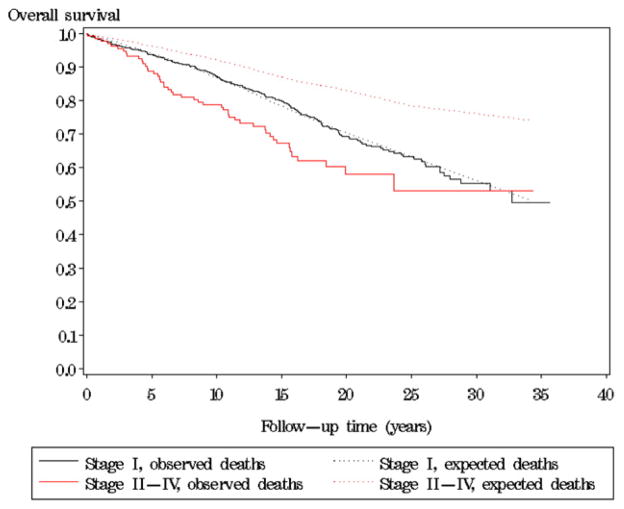
Results: A cohort of 1042 women with a confirmed SBT diagnosis was identified. Women with stage I had an overall survival similar to the overall survival expected from the general population (p=0.3), whereas women with advanced stage disease had a poorer one (p<0.0001). This was evident both in women with noninvasive (p<0.0001) and invasive implants (p<0.0001). Only among women with advanced stage, overall survival of women with SBT/APST (p<0.0001) and noninvasive LGSC (p<0.0001) was poorer than expected from the general population.
Conclusions: To date this is the largest nationwide cohort of SBTs where all tumors have been verified by expert pathologists. Only in women with advanced stage SBT, overall survival is poorer than in the general population which applies both to women with noninvasive and invasive implants as well as to women with SBT/APST and noninvasive LGSC.
Keywords: Centralized pathology review; Long-term follow-up; Population-based; Relative survival; Serous “borderline” ovarian tumors.
Copyright © 2014. Published by Elsevier Inc.
Conflict of interest statement
The authors declare no conflicts of interest.
Figures
References
-
- Jemal A, Bray F, Center MM, Ferlay J, Ward E, Forman D. Global cancer statistics. CA Cancer J Clin. 2011;61(2):69–90. - PubMed
-
- Seidman JD, Cho KR, Ronnett BM, Kurman RJ. Surface Epithelial Tumors of the Ovary. In: Kurman RJ, Ellenson LH, Ronnett BM, editors. Blaustein’s Pathology of the Female Genital Tract. 6. New York: Springer; 2011. pp. 679–784.
-
- Serov SF, Scully RE, Sobin LH. International histological classification and staging of tumors, histologic typing of ovarian tumors. Geneva: World Health Organization; 1973.
-
- Seidman JD, Kurman RJ. Ovarian serous borderline tumors: a critical review of the literature with emphasis on prognostic indicators. Hum Pathol. 2000;31(5):539–57. - PubMed
-
- Seidman JD, Kurman RJ. Subclassification of serous borderline tumors of the ovary into benign and malignant types. A clinicopathologic study of 65 advanced stage cases. Am J Surg Pathol. 1996;20(11):1331–45. - PubMed
Publication types
MeSH terms
Grants and funding
LinkOut - more resources
Full Text Sources
Other Literature Sources
Medical
