. 2014 Jun 12:7:268.
doi: 10.1186/1756-3305-7-268.

Field evaluation of four widely used mosquito traps in Central Europe

Affiliations

Field evaluation of four widely used mosquito traps in Central Europe

Renke Lühken et al. Parasit Vectors. .

Abstract

Background: To monitor adult mosquitoes several trapping devices are available. These are differently constructed and use various mechanisms for mosquito attraction, thus resulting in different trapping sensitivities and efficacies for the various species. Mosquito monitoring and surveillance programs in Europe use various types of mosquito traps, but only a few comparisons have been conducted so far. This study compared the performance of four commercial trapping devices, which are commonly used in Europe.

Methods: Four different traps, Biogents Sentinel trap (BG trap), Heavy Duty Encephalitis Vector Survey trap (EVS trap), Centres for Disease Control miniature light trap (CDC trap) and Mosquito Magnet Patriot Mosquito trap (MM trap) were compared in a 4 × 4 latin square study. In the years 2012 and 2013, more than seventy 24-hour trap comparisons were conducted at ten different locations in northern and southern Germany, representing urban, forest and floodplain biotopes.

Results: Per 24-hour trapping period, the BG trap caught the widest range of mosquito species, the highest number of individuals of the genus Culex as well as the highest number of individuals of the species Ochlerotatus cantans, Aedes cinereus/geminus, Oc. communis and Culex pipiens/torrentium. The CDC trap revealed best performance for Aedes vexans, whereas the MM trap was most efficient for mosquitoes of the genus Anopheles and the species Oc. geniculatus. The EVS trap did not catch more individuals of any genus or species compared to the other three trapping devices. The BG trap caught the highest number of individuals per trapping period in urban environments as well as in wet forest, while the CDC trap caught the highest number of individuals in the floodplain biotopes. Additionally, the BG trap was most efficient for the number of mosquito species in urban locations.

Conclusion: The BG trap showed a significantly better or similar performance compared to the CDC, EVS or MM trap with regard to trapping efficacy for most common mosquito species in Germany, including diversity of mosquito species and number of mosquitoes per trapping period. Thus, the BG trap is probably the best solution for general monitoring or surveillance programs of adult mosquitoes in Central Europe.


Figures
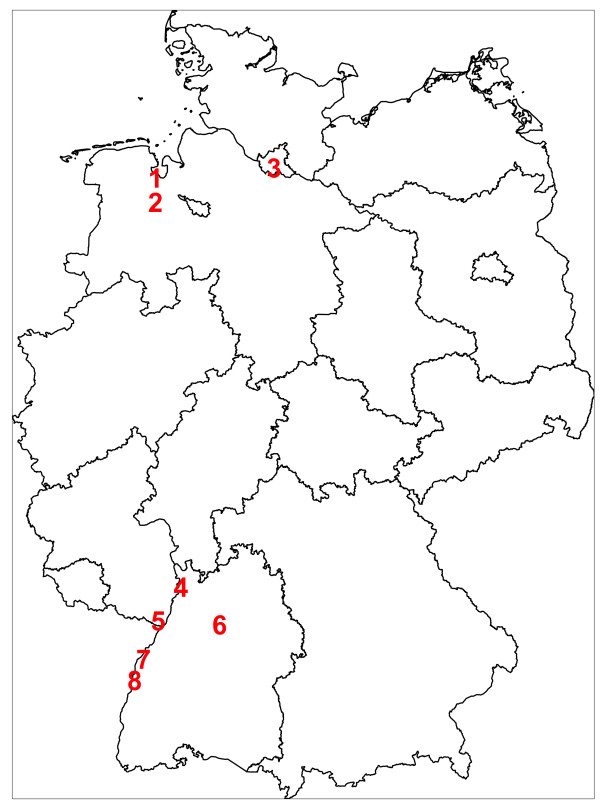
Figure 1
Figure 1
Sampling locations. Sampling locations of the trap comparisons in Germany. Numbers correspond to the IDs in Table 1.
Figure 2
Figure 2
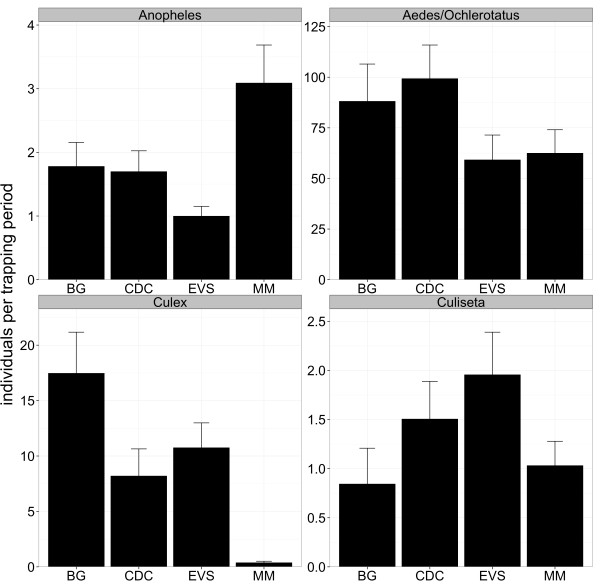
Number of trapped individuals per genera among the four trapping devices. Mean +/-SE number of trapped individuals per trapping period among the four trapping devices. Only mosquito genera caught with more than 100 individuals are shown and trapping periods were only included if the genus was detected with at least one individual in the corresponding trapping period at the sampling location.
Figure 3
Figure 3
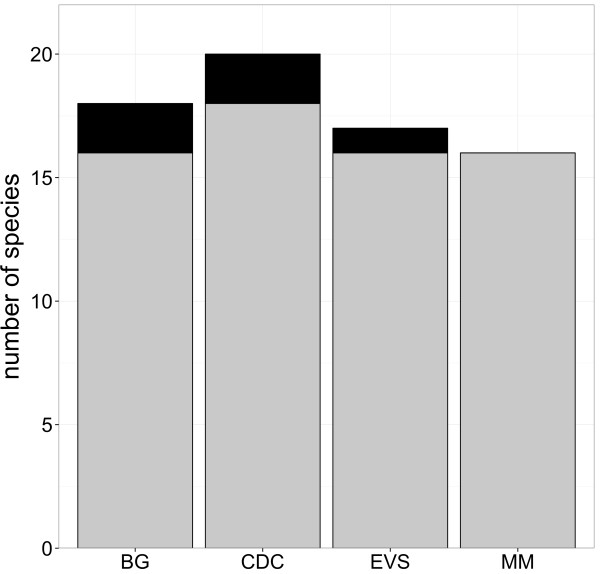
Number of species among the four trapping devices. Total number of species caught among the four trapping devices (grey = number of species without singletons, black = singletons).
Figure 4
Figure 4
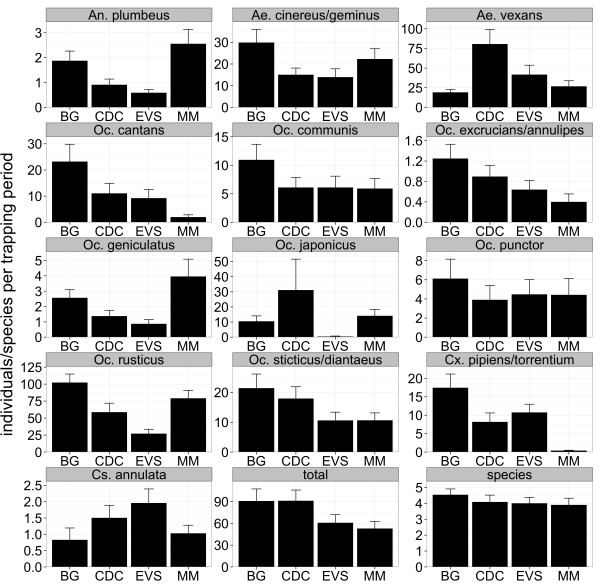
Number of trapped individuals per species and the total number of individuals among the four trapping devices. Mean +/-SE number of trapped individuals per trapping period for each species and the total number of individuals and the mean +/-SE number of species among the four trapping devices. Only mosquito species caught with more than 100 individuals are shown and trapping periods were only included if the species was detected with at least one individual in the corresponding trapping period at the sampling location.
Figure 5
Figure 5
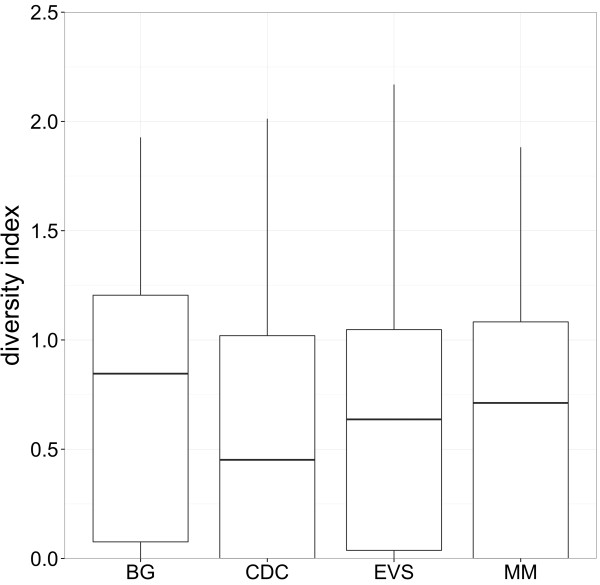
Simpson’s diversity index among the four trapping devices. Boxplots of Simpson’s diversity indices per trapping period among the four trapping devices.
Figure 6
Figure 6
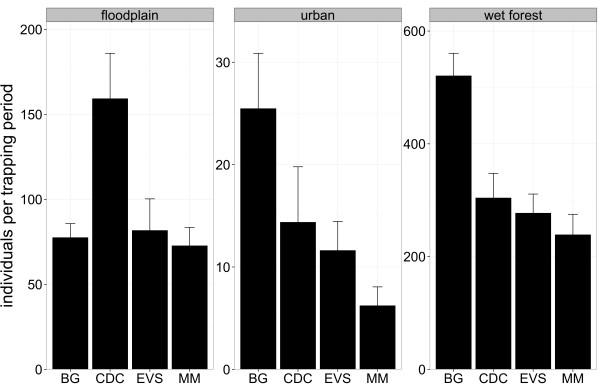
Number of individuals per aggregated biotope among the four trapping devices. Mean +/-SE number of trapped individuals per trapping period among the four trapping devices and the three aggregated biotopes.
Figure 7
Figure 7
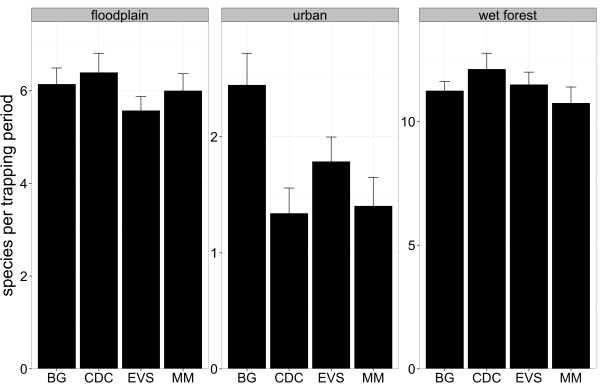
Number of species among the four trapping devices and aggregated biotopes. Mean +/-SE number of trapped species per trapping period among the four trapping devices and the three aggregated biotopes.

References

    1. Versteirt V, Boyer S, Damiens D, De Clercq EM, Dekoninck W, Ducheyne E, Grootaert P, Garros C, Hance T, Hendrickx G, Coosemans M, Van Bortel W. Nationwide inventory of mosquito biodiversity (Diptera: Culicidae) in Belgium, Europe. Bull Entomol Res. 2012;103:193–203. - PMC - PubMed
    1. Becker N, Geier M, Balczun C, Bradersen U, Huber K, Kiel E, Krüger A, Lühken R, Orendt C, Plenge-Bönig A, Rose A, Schaub GA, Tannich E. Repeated introduction of Aedes albopictus into Germany, July to October 2012. Parasitol Res. 2013;112:1787–1790. doi: 10.1007/s00436-012-3230-1. - DOI - PubMed
    1. Jöst H, Bialonski A, Maus D, Sambri V, Eiden M, Groschup MH, Gunther S, Becker N, Schmidt-Chanasit J. Isolation of Usutu virus in Germany. Am J Trop Med Hyg. 2011;85:551–553. doi: 10.4269/ajtmh.2011.11-0248. - DOI - PMC - PubMed
    1. Jackson MJ, Gow JL, Evelyn MJ, McMahon TJS, Howay TJ, Campbell H, Blancard J, Thielman A. An evaluation of the effectiveness of a commercial mechanical trap to reduce abundance of adult nuisance mosquito populations. J Am Mosq Control Assoc. 2012;28:292–300. doi: 10.2987/12-6241R.1. - DOI - PubMed
    1. Kaufman MG, Fonseca DM. Invasion biology of Aedes japonicus japonicus (Diptera: Culicidae) Annu Rev Entomol. 2014;59:31–49. doi: 10.1146/annurev-ento-011613-162012. - DOI - PMC - PubMed

Publication types