


Improvements in gait characteristics after intensive resistance and functional training in people with dementia: a randomised controlled trial
- PMID: 24924703
- PMCID: PMC4062767
- DOI: 10.1186/1471-2318-14-73
Improvements in gait characteristics after intensive resistance and functional training in people with dementia: a randomised controlled trial
Abstract
Background: Preventing and rehabilitating gait disorders in people with dementia during early disease stage is of high importance for staying independent and ambulating safely. However, the evidence gathered in randomized controlled trials (RCTs) on the effectiveness of exercise training for improving spatio-temporal gait parameters in people with dementia is scarce. The aim of the present study was to determine whether a specific, standardized training regimen can improve gait characteristics in people with dementia.
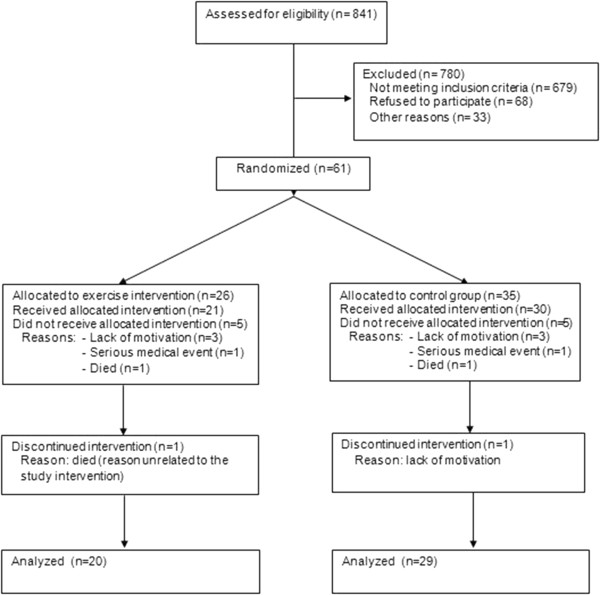
Methods: Sixty-one individuals (mean age: 81.9 years) with confirmed mild to moderate stage dementia took part in a 3-month double-blinded outpatient RCT. Subjects in the intervention group (IG) received supervised, progressive resistance and functional group training for 3 months (2 times per week for two hours) specifically developed for people with dementia. Subjects in the control group (CG) conducted a low-intensity motor placebo activity program. Gait characteristics were measured before and after the intervention period using a computerized gait analysis system (GAITRite®).
Results: Adherence to the intervention was excellent, averaging 91.9% in the IG and 94.4% in the CG. The exercise training significantly improved gait speed (P < 0.001), cadence (P = 0.002), stride length (P = 0.008), stride time (P = 0.001), and double support (P = 0.001) in the IG compared to the CG. Effect sizes were large for all gait parameters that improved significantly (Cohen's d: 0.80-1.27). No improvements were found for step width (P = 0.999), step time variability (P = 0.425) and Walk-Ratio (P = 0.554). Interestingly, low baseline motor status, but not cognitive status, predicted positive training response (relative change in gait speed from baseline).
Conclusion: The intensive, dementia-adjusted training was feasible and improved clinically meaningful gait variables in people with dementia. The exercise program may represent a model for preventing and rehabilitating gait deficits in the target group. Further research is required for improving specific gait characteristics such as gait variability in people with dementia.
Trial registration: ISRCTN49243245.
Figures
Comment in
-
Gait improves after 12 weeks of intensive resistance and functional training in people with mild to moderate dementia.J Physiother. 2015 Apr;61(2):97. doi: 10.1016/j.jphys.2015.02.009. Epub 2015 Mar 20. J Physiother. 2015. PMID: 25801928 No abstract available.
References
-
- Rapp K, Becker C, Cameron ID, Konig HH, Buchele G. Epidemiology of falls in residential aged care: analysis of more than 70,000 falls from residents of bavarian nursing homes. J Am Med Dir Assoc. 2012;14(2):187. e181-186. - PubMed
Publication types
MeSH terms
Associated data
LinkOut - more resources
Full Text Sources
Other Literature Sources
Medical
