


Cystatin C, a novel indicator of renal function, reflects severity of cerebral microbleeds
- PMID: 24925313
- PMCID: PMC4077563
- DOI: 10.1186/1471-2377-14-127
Cystatin C, a novel indicator of renal function, reflects severity of cerebral microbleeds
Abstract
Background: Chronic renal insufficiency, diagnosed using creatinine based estimated glomerular filtration rate (GFR) or microalbumiuria, has been associated with the presence of cerebral microbleeds (CMBs). Cystatin C has been shown to be a more sensitive renal indicator than conventional renal markers. Under the assumption that similar pathologic mechanisms of the small vessel exist in the brain and kidney, we hypothesized that the levels of cystatin C may delineate the relationship between CMBs and renal insufficiency by detecting subclinical kidney dysfunction, which may be underestimated by other indicators, and thus reflect the severity of CMBs more accurately.
Methods: Data was prospectively collected for 683 patients with ischemic stroke. The severity of CMBs was categorized by the number of lesions. Patients were divided into quartiles of cystatin C, estimated GFR and microalbumin/creatinine ratios. Ordinal logistic regression analysis was used to examine the association of each renal indicator with CMBs.
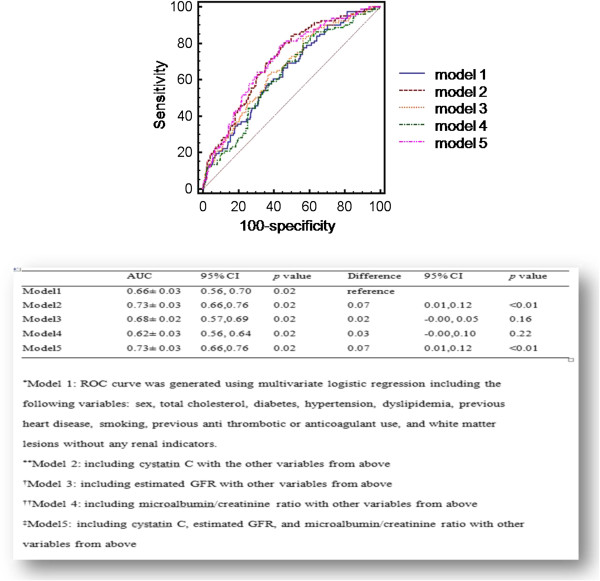
Results: In models including both quartiles of cystatin C and estimated GFR, only cystatin C quartiles were significant (the highest vs. the lowest, adjusted OR, 1.88; 95% CI 1.05-3.38; p = 0.03) in contrast to estimated GFR (the highest vs. the lowest, adjusted OR, 1.28; 95% CI 0.38-4.36; p = 0.70). A model including both quartiles of cystatin C and microalbumin/creatinine ratio also showed that only cystatin C quartiles was associated with CMBs (the highest vs. the lowest, adjusted OR, 2.06; 95% CI 1.07-3.94; p = 0.03). These associations were also observed in the logistic models using log transformed-cystatin C, albumin/creatinine ratio and estimated GFR as continuous variables. Cystatin C was a significant indicator of deep or infratenorial CMBs, but not strictly lobar CMBs. In addition, cystatin C showed the greatest significance in c-statistics for the presence of CMBs (AUC = 0.73 ± 0.03; 95% CI 0.66-0.76; p = 0.02).
Conclusion: Cystatin C may be the most sensitive indicator of CMB severity among the renal disease markers.
Figures
References
-
- Cordonnier C, Al-Shahi Salman R, Wardlaw J. Spontaneous brain microbleeds: systematic review, subgroup analyses and standards for study design and reporting. Brain. 2007;130(Pt 8):1988–2003. - PubMed
-
- Vernooij MW, Ikram MA, Wielopolski PA, Krestin GP, Breteler MM, van der Lugt A. Cerebral microbleeds: accelerated 3D T2*-weighted GRE MR imaging versus conventional 2D T2*-weighted GRE MR imaging for detection. Radiology. 2008;248(1):272–277. - PubMed
-
- Lovelock CE, Cordonnier C, Naka H, Al-Shahi Salman R, Sudlow CL, Sorimachi T, Werring DJ, Gregoire SM, Imaizumi T, Lee SH, Briley D, Rothwell PM. Antithrombotic drug use, cerebral microbleeds, and intracerebral hemorrhage: a systematic review of published and unpublished studies. Stroke. 2010;41(6):1222–1228. - PubMed
-
- Lee SH, Kim BJ, Roh JK. Silent microbleeds are associated with volume of primary intracerebral hemorrhage. Neurology. 2006;66(3):430–432. - PubMed
-
- Koennecke HC. Cerebral microbleeds on MRI: prevalence, associations, and potential clinical implications. Neurology. 2006;66(2):165–171. - PubMed
MeSH terms
Substances
LinkOut - more resources
Full Text Sources
Other Literature Sources
Medical
