. 2014 Jun 13;344(6189):1285-9.
doi: 10.1126/science.1253458.

Interactions between RNA polymerase and the "core recognition element" counteract pausing

Affiliations

Interactions between RNA polymerase and the "core recognition element" counteract pausing

Irina O Vvedenskaya et al. Science. .

Abstract

Transcription elongation is interrupted by sequences that inhibit nucleotide addition and cause RNA polymerase (RNAP) to pause. Here, by use of native elongating transcript sequencing (NET-seq) and a variant of NET-seq that enables analysis of mutant RNAP derivatives in merodiploid cells (mNET-seq), we analyze transcriptional pausing genome-wide in vivo in Escherichia coli. We identify a consensus pause-inducing sequence element, G₋₁₀Y₋₁G(+1) (where -1 corresponds to the position of the RNA 3' end). We demonstrate that sequence-specific interactions between RNAP core enzyme and a core recognition element (CRE) that stabilize transcription initiation complexes also occur in transcription elongation complexes and facilitate pause read-through by stabilizing RNAP in a posttranslocated register. Our findings identify key sequence determinants of transcriptional pausing and establish that RNAP-CRE interactions modulate pausing.


Figures

Fig. 1
Fig. 1. Identification of consensus PE
A. Sequence logo for consensus PE from NET-seq. Red, bases with ≥0.2 bit sequence-information content. B. In vitro transcription assays with consensus PEs and mutant PEs. Top, templates. Bottom, results. +29, RNA before addition of UTP; +46, RNA in TEC at PE; RT, read-through RNA; red, consensus PE bases.
Fig. 2
Fig. 2. Contributions of individual base pairs of consensus PE
A. In vitro transcription assays with yrbL PE derivatives. Red, consensus PE bases. B. Schematic representation of TEC in pre-translocated state at consensus PE (top) and TEC in post-translocated state at consensus PE (bottom). White boxes, DNA; gray boxes, RNA; gray shading, RNAP; red, consensus PE bases; i and i+1, RNAP active-center i and i+1 sites.
Fig. 3
Fig. 3. Sequence-specific RNAP-GCRE interactions modulate pausing
A. Structural organization of TEC in post-translocated state at consensus PE (left) and RPo in transcription initiation at promoter containing consensus CRE (right; 21). The presence in each case of an unpaired G at downstream end of nontemplate strand of transcription bubble suggests the possibility of equivalent sequence-specific interactions between RNAP core and the G. Red at left, bases of the consensus PE; red at right, GCRE. B. Results of fluorescence-detected equilibrium assays (top) and kinetic (bottom) assays of interactions of RNAP derivatives with nucleic-acid scaffolds containing G, A, T, or an abasic site (X) at position corresponding to GCRE. ntDNA, nontemplate-strand DNA; tDNA template-strand DNA. C. Sequence logos for consensus PE with RNAP-βWT (top; 0.4 bit sequence-information content at GCRE) and RNAP-βD446A (bottom; 1 bit of sequence-information content at GCRE), as defined by mNET-seq. Red, bases with ≥0.2 bit sequence information content. D. Pause-capture efficiencies of RNAP βWT (left panels) and RNAP βD446A (right panels) at yrbL PE and gltP PE in vitro. +29, RNA before addition of UTP; +46, RNA in TEC at PE; asterisks, RNA in TECs at additional sites where RNAP βD446A exhibits higher pause-capture efficiency than RNAP βWT; RT, read-through RNA; red, consensus PE bases.
Fig. 4
Fig. 4. Sequence-specific RNAP-GCRE interactions modulate translocation bias
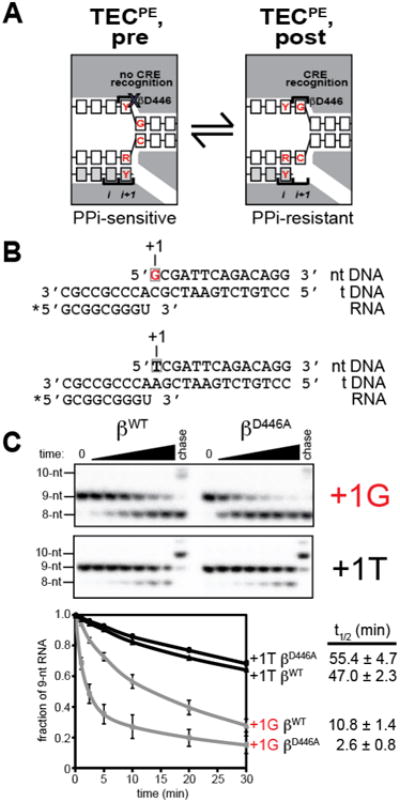
A. Structural organization of TEC in pre-translocated state at consensus PE (left; unfavorable RNAP-CRE interaction) and TEC in post-translocated state at consensus PE (right; favorable RNAP-CRE interaction). PPi, pyrophosphate. B. Nucleic-acid scaffolds used for translocation-bias assays. Asterisk, radiolabel on RNA 5′ end; box, position corresponding to GCRE; red, consensus PE base. C. Translocational bias for RNAP βWT and RNAP βD446A on nucleic-acid scaffolds containing G or T at position corresponding to GCRE. Gel images show pyrophosphorolysis reaction progress from 0-30 min. 9-nt, scaffold; 8-nt, product of pyrophosphorolysis; 10-nt, product of “chase” reaction with GTP (+1G template) or UTP (+1T template). Graph shows fraction of unaltered scaffold (mean±SEM; 3 measurements) as function of time.

Comment in

References

    1. Larson M, Landick R, Block S. Single-molecule studies of RNA polymerase. Mol Cell. 2011;41:249–262. - PMC - PubMed
    1. Dangkulwanich M, Ishibashi T, Bintu L, Bustamante C. Molecular mechanisms of transcription through single-molecule experiments. Chem Rev. 2014;114:3203–3223. - PMC - PubMed
    1. Hein P, Palangat M, Landick R. RNA transcript 3′-proximal sequence affects translocation bias of RNA polymerase. Biochem. 2011;50:7002–7014. - PMC - PubMed
    1. Kyzer S, Ha K, Landick R, Palangat M. Direct versus limited-step reconstitution reveals key features of an RNA hairpin-stabilized paused transcription complex. J Biol Chem. 2007;282:19020–19028. - PubMed
    1. Chan C, Landick R. Dissection of the his leader pause site by base substitution reveals a multipartite signal that includes a pause RNA hairpin. J Mol Biol. 1993;233:25–42. - PubMed

Publication types

MeSH terms

Substances

Associated data

LinkOut - more resources