Aortic arch atherosclerosis in ischaemic stroke of unknown origin affects prognosis
- PMID: 24926306
- PMCID: PMC4035681
- DOI: 10.1159/000362434
Aortic arch atherosclerosis in ischaemic stroke of unknown origin affects prognosis
Abstract
Background: Cerebral infarction of unknown origin at admission accounts for half of all cerebral infarction cases in some institutions. However, the factors associated with cerebral infarction prognosis have not been sufficiently examined. Here, we investigated whether aortic arch plaques (AAPs) on transoesophageal echocardiography (TOE) were associated with the prognosis of cerebral infarction of unknown origin at admission.
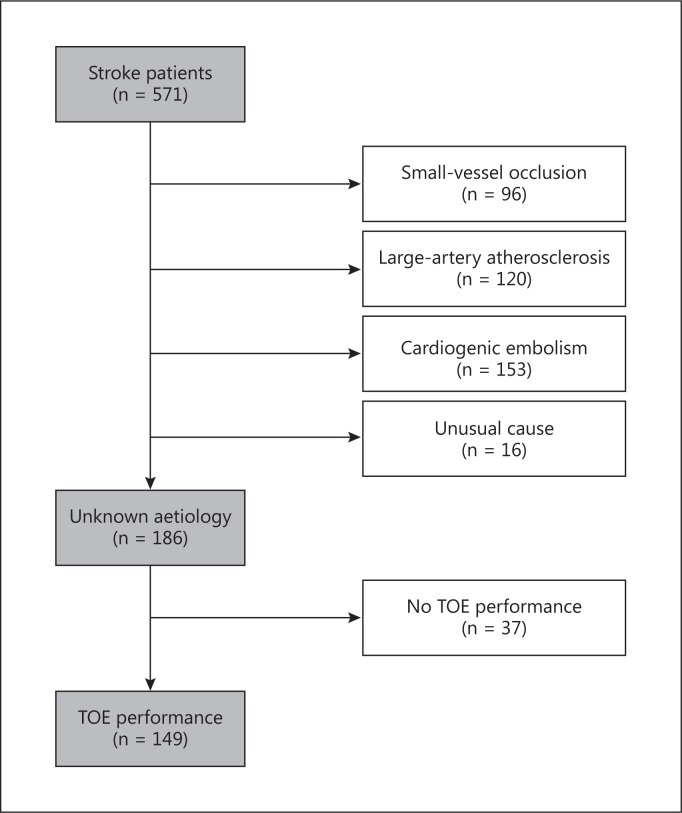
Methods: Of 571 patients who were hospitalised between June 2009 and September 2011, 149 (age: 67 ± 14 years; 95 men) with cerebral infarctions of unknown origin at admission underwent TOE and were enrolled in this study. We examined their clinical characteristics, the incidence of intermittent atrial fibrillation detected on 24-hour electrocardiography, and the echographic findings of the carotid artery in the hospital. A poor prognostic outcome was defined as a modified Rankin Scale score of ≥3 after 90 days.
Results: In all, 110 patients (74%) showed good prognoses and 39 patients (26%) showed poor outcomes. A National Institutes of Health Stroke Scale score of >6 on admission [odds ratio (OR) = 6.77; 95% confidence interval (CI): 2.59-18.8; p < 0.001] and AAPs of ≥4 mm (OR = 2.75; 95% CI: 1.19-6.91; p = 0.024) showed significant associations with a poor prognosis of cerebral infarction of unknown origin at admission.
Conclusions: Thick AAPs could be a factor in the prediction of a poor prognosis of cerebral infarction of unknown origin at admission. The establishment of international standards for aortogenic brain embolisms is required. Future prospective studies should examine cerebral infarctions of unknown origin.
Keywords: Aortic arch atherosclerosis; Prognosis; Stroke of unknown origin.
Figures
References
-
- Miller EL, Murray L, Richards L, Zorowitz RD, Bakas T, Clark P, Billinger SA. Comprehensive overview of nursing and interdisciplinary rehabilitation care of the stroke patient: a scientific statement from the American Heart Association. Stroke. 2010;41:2402–2448. - PubMed
-
- Thrift AG, Dewey HM, Macdonell RA, McNeil JJ, Donnan GA. Incidence of the major stroke subtypes: initial findings from the North East Melbourne Stroke Incidence Study (NEMESIS) Stroke. 2001;32:1732–1738. - PubMed
-
- Feigin VL, Lawes CM, Bennett DA, Anderson CS. Stroke epidemiology: a review of population-based studies of incidence, prevalence, and case-fatality in the late 20th century. Lancet Neurol. 2003;2:43–53. - PubMed
-
- Reid JM, Gubitz GJ, Dai D, Kydd D, Eskes G, Reidy Y, Christian C, Counsell CE, Dennis M, Phillips SJ. Predicting functional outcome after stroke by modelling baseline clinical and CT variables. Age Ageing. 2010;39:360–366. - PubMed
-
- Fiorelli M, Alperovitch A, Argentino C, Sacchetti ML, Toni D, Sette G, Cavalletti C, Gori MC, Fieschi C. Prediction of long-term outcome in the early hours following acute ischemic stroke. Italian Acute Stroke Study Group. Arch Neurol. 1995;52:250–255. - PubMed
LinkOut - more resources
Full Text Sources
Other Literature Sources