


Trends in family ratings of experience with care and racial disparities among Maryland nursing homes
- PMID: 24926712
- PMCID: PMC4058647
- DOI: 10.1097/MLR.0000000000000152
Trends in family ratings of experience with care and racial disparities among Maryland nursing homes
Abstract
Background: Providing equitable and patient-centered care is critical to ensuring high quality of care. Although racial/ethnic disparities in quality are widely reported for nursing facilities, it is unknown whether disparities exist in consumer experiences with care and how public reporting of consumer experiences affects facility performance and potential racial disparities.
Methods: We analyzed trends of consumer ratings publicly reported for Maryland nursing homes during 2007-2010, and determined whether racial/ethnic disparities in experiences with care changed during this period. Multivariate longitudinal regression models controlled for important facility and county characteristics and tested changes overall and by facility groups (defined based on concentrations of black residents). Consumer ratings were reported for: overall care; recommendation of the facility; staff performance; care provided; food and meals; physical environment; and autonomy and personal rights.
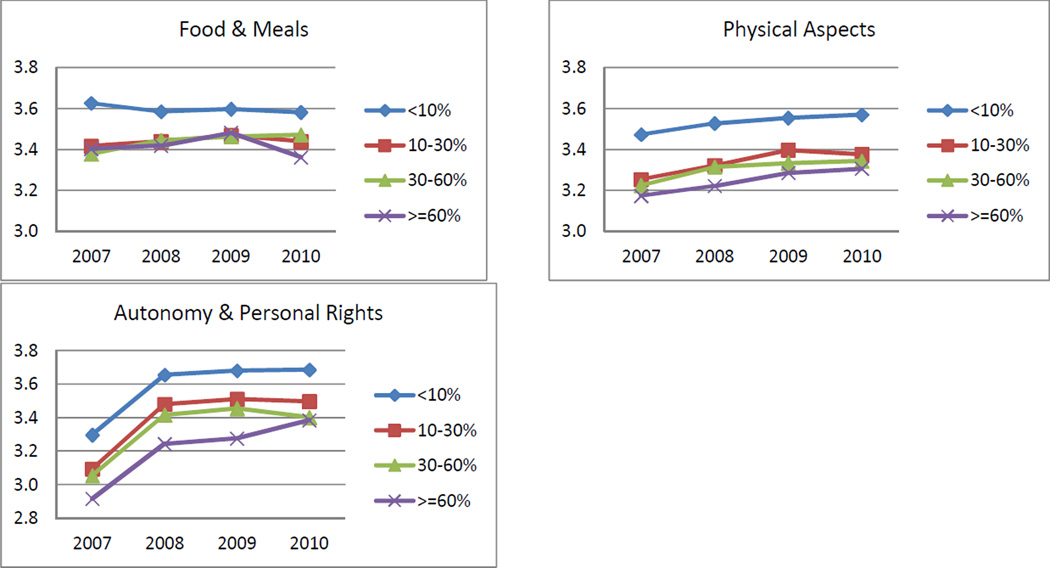
Results: Overall ratings on care experience remained relatively high (mean=8.3 on a 1-10 scale) during 2007-2010. Ninety percent of survey respondents each year would recommend the facility to someone who needs nursing home care. Ratings on individual domains of care improved among all nursing homes in Maryland (P<0.01), except for food and meals (P=0.827 for trend). However, site-of-care disparities existed in each year for overall ratings, recommendation rate, and ratings on all domains of care (P<0.01 in all cases), with facilities more predominated by black residents having lower scores; such disparities persisted over time (P>0.2 for trends in disparities).
Conclusions: Although Maryland nursing homes showed maintained or improved consumer ratings during the first 4 years of public reporting, gaps persisted between facilities with high versus low concentrations of minority residents.
Conflict of interest statement
Conflicts of Interests: no conflict of interest for any author.
Figures

References
-
- Martin AB, Lassman D, Washington B, Catlin A. Growth in US health spending remained slow in 2010; health share of gross domestic product was unchanged from 2009. Health Aff (Millwood) 2012 Jan;31(1):208–219. - PubMed
-
- Harrington CCH, Dowdell M, Tang PP, Blank BW. Nursing Facilities, Staffing, Residents and Facility Deficiencies, 2005 Through 2010. San Francisco, CA: Department of Social and Behavioral Sciences, University of California, San Francisco; 2011.
-
- Bernabei R, Gambassi G, Lapane K, et al. Management of pain in elderly patients with cancer. SAGE Study Group. Systematic Assessment of Geriatric Drug Use via Epidemiology. Jama. 1998 Jun 17;279(23):1877–1882. - PubMed
Publication types
MeSH terms
Grants and funding
LinkOut - more resources
Full Text Sources
Other Literature Sources
Medical
