. 2014 Jun 24;111(25):9313-8.
doi: 10.1073/pnas.1317363111. Epub 2014 Jun 9.

An alcohol-sensing site in the calcium- and voltage-gated, large conductance potassium (BK) channel

Affiliations

An alcohol-sensing site in the calcium- and voltage-gated, large conductance potassium (BK) channel

Anna N Bukiya et al. Proc Natl Acad Sci U S A. .

Abstract

Ethanol alters BK (slo1) channel function leading to perturbation of physiology and behavior. Site(s) and mechanism(s) of ethanol-BK channel interaction are unknown. We demonstrate that ethanol docks onto a water-accessible site that is strategically positioned between the slo1 calcium-sensors and gate. Ethanol only accesses this site in presence of calcium, the BK channel's physiological agonist. Within the site, ethanol hydrogen-bonds with K361. Moreover, substitutions that hamper hydrogen bond formation or prevent ethanol from accessing K361 abolish alcohol action without altering basal channel function. Alcohol interacting site dimensions are approximately 10.7 × 8.6 × 7.1 Å, accommodating effective (ethanol-heptanol) but not ineffective (octanol, nonanol) channel activators. This study presents: (i) to our knowledge, the first identification and characterization of an n-alkanol recognition site in a member of the voltage-gated TM6 channel superfamily; (ii) structural insights on ethanol allosteric interactions with ligand-gated ion channels; and (iii) a first step for designing agents that antagonize BK channel-mediated alcohol actions without perturbing basal channel function.

Keywords: MaxiK channel; calcium sensitivity; ethanol site; patch-clamp electrophysiology; potassium channel.


Conflict of interest statement

The authors declare no conflict of interest.

Figures
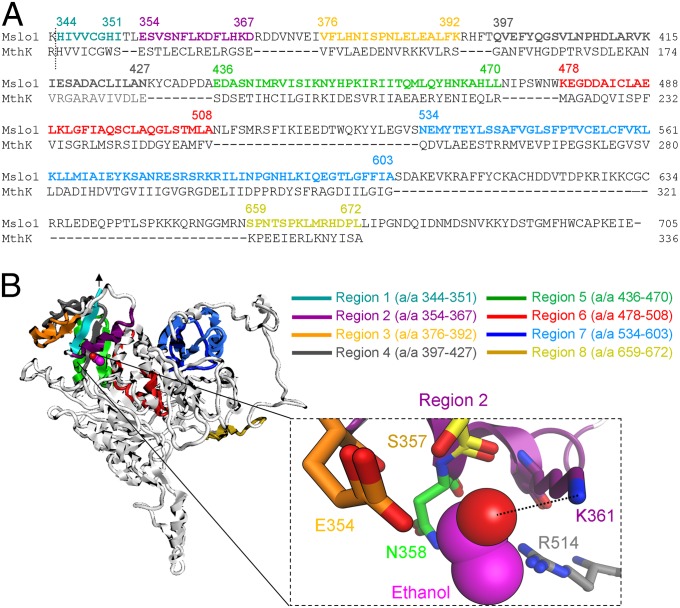
Fig. 1.
Fig. 1.
Ethanol-sensing site in mslo1 CTD. (A) Sequence alignment of ethanol-sensitive mslo1 and MthK proteins reveals eight common regions that may provide ethanol-sensitivity. A dotted line indicates the N-end of the slo1 CTD based on crystallography (33). Amino acid numbering follows the numbering of corresponding hslo1 residues (33). (B) Putative ethanol-sensing regions mapped on the mslo1 CTD homology model (side view). The ethanol C chain is shown in pink; oxygen is in red. An arrow points at the N-end of the CTD in contact with the membrane. (Inset) The ethanol-sensing region 2 (a/a 354–367) where K361 hydrogen bonds (dotted line) with ethanol. Nitrogen is blue; hydrogen is hidden to improve display.
Fig. 2.
Fig. 2.
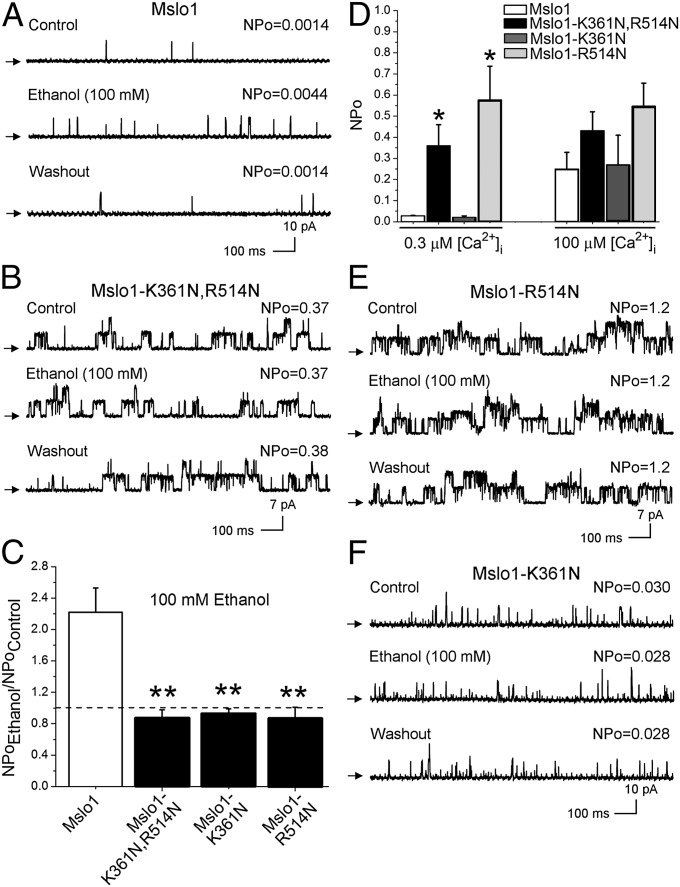
Substitutions at K361 and R514 abolish ethanol action. (A) Reversible increase in WT mslo1 NPo with 100 mM ethanol. Cai2+= 0.3 mM; unless stated otherwise, Vm = 60 mV. Arrows show the baseline (channels closed). (B) Lack of ethanol effect on mslo1-K361N,R514N; Vm = 30 mV. (C) Ethanol responses of mslo1 (n = 10) vs. mslo1-K361N,R514N (n = 10), mslo1-K361N (n = 15), and mslo1-R514N (n = 7). In all bar graphs, a dashed line indicates the point at which NPo is unchanged by ethanol; **P < 0.01 vs. WT mslo1. (D) Cai2+ responses from mslo1-K361N,R514N, mslo1-R514N NPo vs. WT mslo1 (*P < 0.05). Records from mslo1-R514N (E) and mslo1-K361N (F) show lack of ethanol effect; Vm = 30 mV and 60 mV, respectively.
Fig. 3.
Fig. 3.
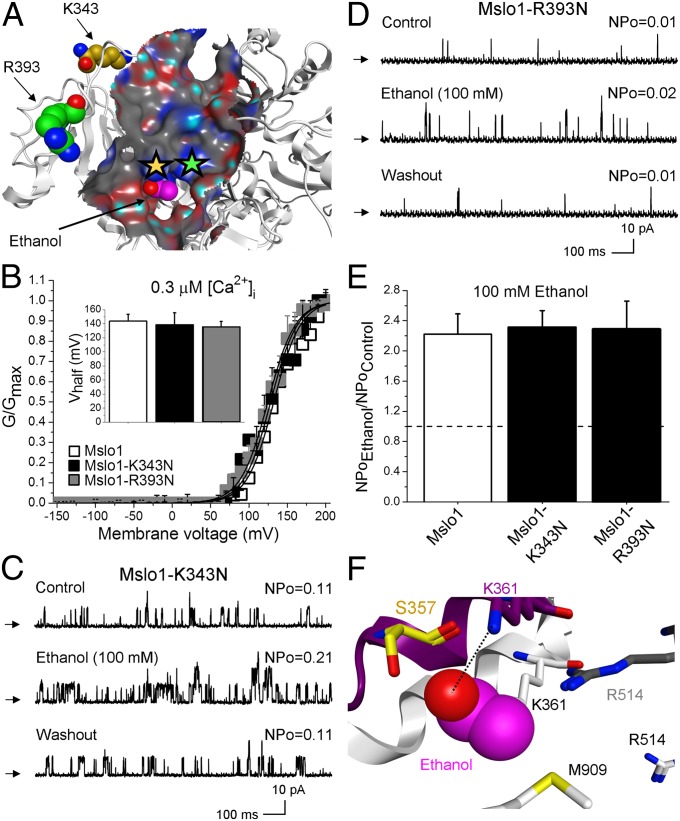
K343 and R393 substitutions outside the alcohol-sensing site do not affect ethanol-induced mslo1 activation or the Cai2+ sensitivity of the channel. (A) Molecular surface map and location of K343 and R393. (B) G/GmaxV plots from mslo1 (n = 8), mslo1-K343N (n = 3), and mslo1-R393N (n = 3) are undistinguishable. (Inset) Vhalf for the three constructs. Records from mslo1-K343N (C) and mslo1-R393N (D) show reversible increases in NPo by 100 mM ethanol. (E) WT mslo1 (n = 10), mslo1-K343N (n = 8), and mslo1-R393N (n = 3) NPo are increased by ethanol. (F) Superposition of the ethanol site in the “Ca2+-bound” channel open state (color-coded as in Fig. 1B, Inset) with the “Ca2+-free” channel closed state (black and white) of slo1.
Fig. 4.
Fig. 4.
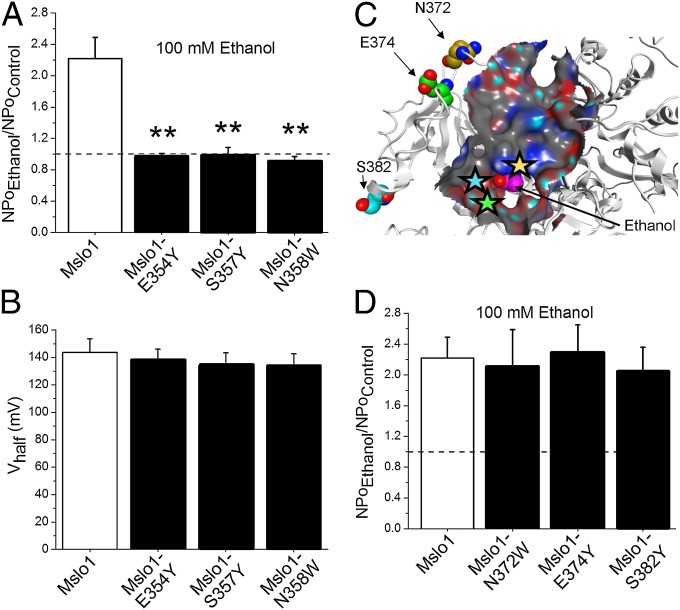
Mutations that prevent ethanol from accessing K361 abolish ethanol-induced increase in mslo1 channel activity. (A) Ethanol responses of mslo1-E354Y (n = 5), mslo1-S357Y (n = 3), and mslo1-N358W NPo (n = 4) vs. WT mslo1; **P < 0.01. (B) At Cai2+= 0.3 mM, WT mslo1, mslo1-E354Y, mslo1-S357Y, and mslo1-N358W have similar Vhalf. (C) Molecular surface map highlights the location of N372, E374 and S382 outside the ethanol site. (D) Ethanol-induced increases in NPo are similar in mslo1 (n = 10), mslo1-N372W (n = 5), mslo1-E374Y (n = 5), and mslo1-S382Y (n = 4).
Fig. 5.
Fig. 5.
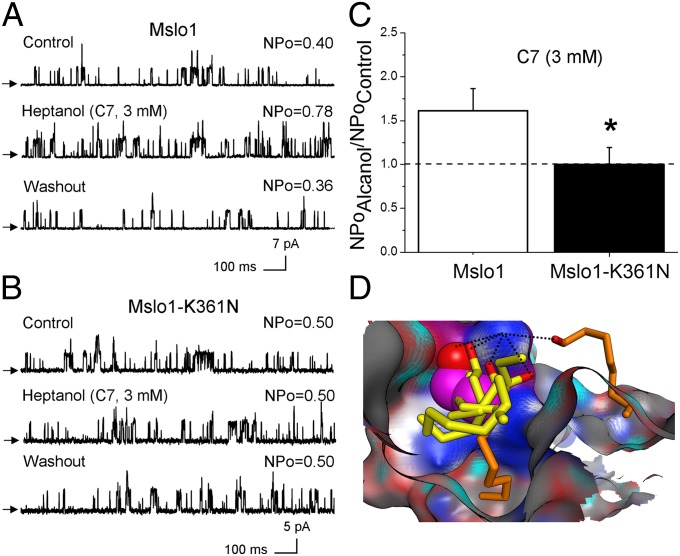
Role of the ethanol site in long-chain alkanol effects on mslo1. Heptanol increases WT mslo1 (A) but not mslo1-K361N NPo (B). (C) Averaged responses to heptanol from mslo1 (n = 4) vs. mslo1-K361N NPo (n = 3). (D) Poses of n-alkanols on the ethanol site surface map. Ethanol C backbone is in pink; other activatory n-alkanols are shown in yellow, whereas ineffective n-alkanols are in orange. In all cases, oxygen is in red. Hydrogen bond is a dotted line.

References

    1. Fleming M, Mihic SJ, Harris RA (2001) Ethanol, eds Hardman JG, Limbird LE (McGraw-Hill, New York), pp 429–445. National Institute on Alcohol Abuse and Alcoholism ( www.niaaa.nih.gov)
    1. Dildy-Mayfield JE, Mihic SJ, Liu Y, Deitrich RA, Harris RA. Actions of long chain alcohols on GABAA and glutamate receptors: Relation to in vivo effects. Br J Pharmacol. 1996;118(2):378–384. - PMC - PubMed
    1. Mihic SJ, et al. Sites of alcohol and volatile anaesthetic action on GABA(A) and glycine receptors. Nature. 1997;389(6649):385–389. - PubMed
    1. Mascia MP, Trudell JR, Harris RA. Specific binding sites for alcohols and anesthetics on ligand-gated ion channels. Proc Natl Acad Sci USA. 2000;97(16):9305–9310. - PMC - PubMed
    1. Harris RA, Trudell JR, Mihic SJ. Ethanol’s molecular targets. Sci Signal. 2008;1(28):re7. - PMC - PubMed

Publication types

MeSH terms

Substances

LinkOut - more resources