


Social identification moderates the effect of crowd density on safety at the Hajj
- PMID: 24927593
- PMCID: PMC4078860
- DOI: 10.1073/pnas.1404953111
Social identification moderates the effect of crowd density on safety at the Hajj
Abstract
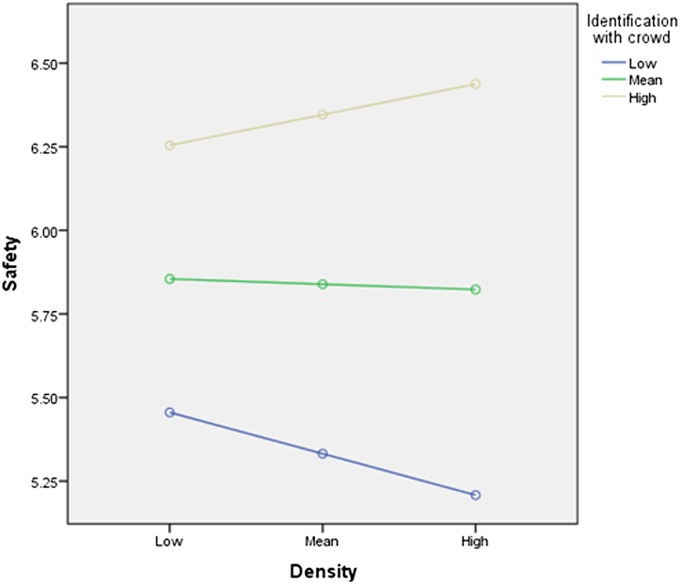
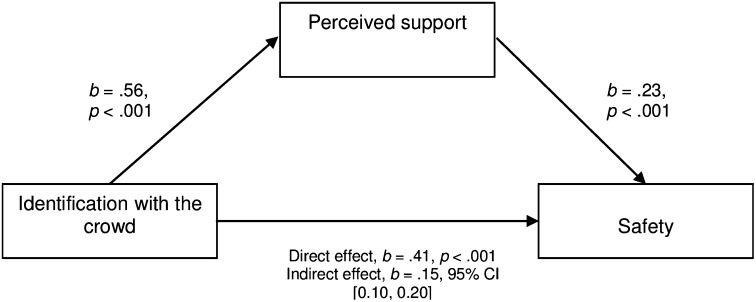
Crowd safety is a major concern for those attending and managing mass gatherings, such as the annual Hajj or pilgrimage to Mecca (also called Makkah). One threat to crowd safety at such events is crowd density. However, recent research also suggests that psychological membership of crowds can have positive benefits. We tested the hypothesis that the effect of density on safety might vary depending on whether there is shared social identification in the crowd. We surveyed 1,194 pilgrims at the Holy Mosque, Mecca, during the 2012 Hajj. Analysis of the data showed that the negative effect of crowd density on reported safety was moderated by social identification with the crowd. Whereas low identifiers reported reduced safety with greater crowd density, high identifiers reported increased safety with greater crowd density. Mediation analysis suggested that a reason for these moderation effects was the perception that other crowd members were supportive. Differences in reported safety across national groups (Arab countries and Iran compared with the rest) were also explicable in terms of crowd identification and perceived support. These findings support a social identity account of crowd behavior and offer a novel perspective on crowd safety management.
Keywords: social cure; social groups; social support.
Figures
References
-
- Fruin JJ. 2002. The causes and prevention of crowd disasters. Originally presented at the First International Conference on Engineering for Crowd Safety, London, England, March 1993 (Revised exclusively for crowdsafe.com, January 2002.) Available at www.crowdsafe.com/FruinCauses.pdf. Accessed May 25, 2014.
-
- Algadhi SAH, Mahmassani HS. Modelling crowd behavior and movement: Application to Makkah pilgrimage. In: Koshi M, editor. Transportation and Traffic Theory. Oxford: Elsevier; 1990. pp. 59–78.
-
- Helbing D, Johansson A, Al-Abideen HZ. Dynamics of crowd disasters: An empirical study. Phys Rev E Stat Nonlin Soft Matter Phys. 2007;75(4 Pt 2):046109. - PubMed
-
- Still GK. Introduction to Crowd Science. Boca Raton, FL: CRC Press; 2014.
Publication types
MeSH terms
LinkOut - more resources
Full Text Sources
Other Literature Sources
Molecular Biology Databases
