


Mechanisms of acquired resistance to androgen receptor targeting drugs in castration-resistant prostate cancer
- PMID: 24927631
- PMCID: PMC4221359
- DOI: 10.1586/14737140.2014.928594
Mechanisms of acquired resistance to androgen receptor targeting drugs in castration-resistant prostate cancer
Abstract
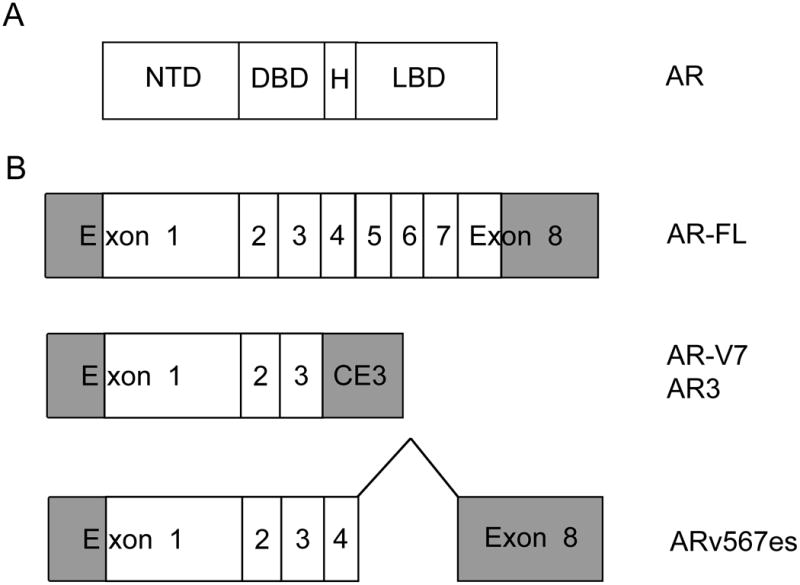
After initial response to androgen receptor (AR) targeting drugs abiraterone or enzalutamide, most patients develop progressive disease and therefore, castration resistant prostate cancer remains a terminal disease. Multiple mechanisms underlying acquired resistance have been postulated. Intratumoral androgen synthesis may resume after abiraterone treatment. A point mutation in the ligand-binding domain of AR may confer resistance to enzalutamide. Emergence of AR splice variants lacking the ligand-binding domain may mediate resistance to abiraterone and enzalutamide. Steroid receptors such as glucocorticoid receptor may substitute for AR. Drugs with novel mechanisms of action or combination therapy, along with biomarkers for patient selection, may be needed to improve the therapy of castration resistant prostate cancer.
Keywords: abiraterone; acquired drug resistance; androgen receptor; androgen receptor splice variants; enzalutamide; glucocorticoid receptor; intratumoral androgen synthesis; prostate cancer.
Figures
References
-
- Ferlay J, Steliarova-Foucher E, Lortet-Tieulent J, et al. Cancer incidence and mortality patterns in Europe: estimates for 40 countries in 2012. Eur J Cancer. 2013;49(6):1374–1403. - PubMed
-
- Siegel R, Naishadham D, Jemal A. Cancer statistics, 2013. CA Cancer J Clin. 2013;63(1):11–30. - PubMed
-
- Huggins C, Hodges CV. Studies on prostatic cancer: I. The effect of castration, of estrogen and of androgen injection on serum phosphatases in metastatic carcinoma of the prostate. 1941. J Urol. 2002;168(1):9–12. - PubMed
-
- Schally AV, Arimura A, Kastin AJ, et al. Gonadotropin-releasing hormone: one polypeptide regulates secretion of luteinizing and follicle-stimulating hormones. Science. 1971;173(4001):1036–1038. - PubMed
-
- Berthold DR, Pond GR, Soban F, de Wit R, Eisenberger M, Tannock IF. Docetaxel plus prednisone or mitoxantrone plus prednisone for advanced prostate cancer: updated survival in the TAX 327 study. J Clin Oncol. 2008;26(2):242–245. - PubMed
Publication types
MeSH terms
Substances
Grants and funding
LinkOut - more resources
Full Text Sources
Other Literature Sources
Research Materials
