


A new mutation of the PCNT gene in a Colombian patient with microcephalic osteodysplastic primordial dwarfism type II: a case report
- PMID: 24928221
- PMCID: PMC4086705
- DOI: 10.1186/1752-1947-8-191
A new mutation of the PCNT gene in a Colombian patient with microcephalic osteodysplastic primordial dwarfism type II: a case report
Abstract
Introduction: Microcephalic osteodysplastic primordial dwarfism is a syndrome characterized by the presence of intrauterine growth restriction, post-natal growth deficiency and microcephaly. Microcephalic osteodysplastic primordial dwarfism type II is the most distinctive syndrome in this group of entities. Individuals affected by this disease present at an adult height of less than 100 cm, a post-pubertal head circumference of 40 cm or less, mild mental retardation, an outgoing personality and bone dysplasia.
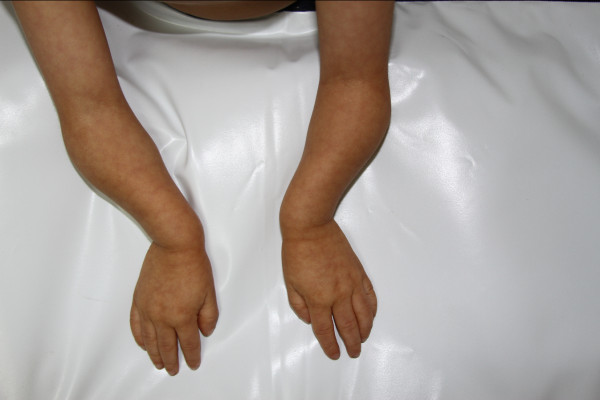
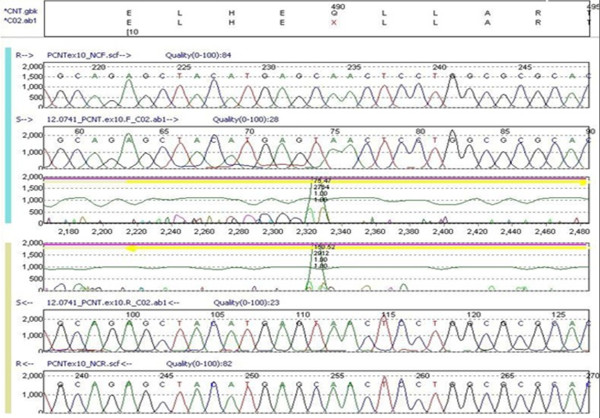
Case presentation: We report the first case of a five-year-old Colombian boy of mixed race ancestry (mestizo), with clinical features of microcephaly, prominent and narrow nose, arched palate, amelogenesis imperfecta, short stature, tall and narrow pelvis, disproportionate shortening of fore-arms and legs, and mild coxa vara. Analysis of the PCNT gene by sequencing showed the presence of a nucleotide change in exon 10, c. 1468C>T, evidencing a new mutation not reported in the literature for microcephalic osteodysplastic primordial dwarfism.
Conclusion: The new mutation identified in this case could be associated with the severity of the phenotypic expression of the disease, resulting in the extreme short stature of the patient. Further studies are required to reach an explanation that can justify such findings, and it is vital to emphasize the importance of detection and follow-up by the epidemiological surveillance groups in birth defects and rare diseases.
Figures
References
-
- Bober MB, Niiler T, Duker AL, Murray JE, Ketterer T, Harley ME, Alvi S, Flora C, Rustad C, Bongers EM, Bicknell LS, Wise C, Jackson AP. Growth in individuals with Majewski osteodysplastic primordial dwarfism type II caused by Pericentrin mutations. Am J Med Genet Part A. 2012;158A:2719–2725. doi: 10.1002/ajmg.a.35447. - DOI - PubMed
-
- Sigaudy S, Toutain A, Moncla A, Fredouille C, Bourlière B, Ayme S, Philip N. Microcephalic osteodysplastic primordial dwarfism Taybi-Linder type: report of four cases and review of the literature. Am J Med Genet. 1998;80:16–24. doi: 10.1002/(SICI)1096-8628(19981102)80:1<16::AID-AJMG4>3.0.CO;2-5. - DOI - PubMed
-
- Willems M, Geneviève D, Borck G, Baumann C, Baujat G, Bieth E, Edery P, Farra C, Gerard M, Héron D, Leheup B, Le Merrer M, Lyonnet S, Martin-Coignard D, Mathieu M, Thauvin-Robinet C, Verloes A, Colleaux L, Munnich A, Cormier-Daire V. Molecular analysis of Pericentrin gene (PCNT) in a series of 24 Seckel/microcephalic osteodysplastic primordial dwarfism type II (MOPD II) families. J Med Genet. 2010;47:797–802. doi: 10.1136/jmg.2009.067298. - DOI - PubMed
Publication types
MeSH terms
Substances
Supplementary concepts
LinkOut - more resources
Full Text Sources
Other Literature Sources
Medical
