. 2014 Aug;80(16):5053-67.
doi: 10.1128/AEM.00820-14. Epub 2014 Jun 13.

Uptake and metabolism of N-acetylglucosamine and glucosamine by Streptococcus mutans

Affiliations

Uptake and metabolism of N-acetylglucosamine and glucosamine by Streptococcus mutans

Zachary D Moye et al. Appl Environ Microbiol. 2014 Aug.

Abstract

Glucosamine and N-acetylglucosamine are among the most abundant sugars on the planet, and their introduction into the oral cavity via the diet and host secretions, and through bacterial biosynthesis, provides oral biofilm bacteria with a source of carbon, nitrogen, and energy. In this study, we demonstrated that the dental caries pathogen Streptococcus mutans possesses an inducible system for the metabolism of N-acetylglucosamine and glucosamine. These amino sugars are transported by the phosphoenolpyruvate:sugar phosphotransferase system (PTS), with the glucose/mannose enzyme II permease encoded by manLMN playing a dominant role. Additionally, a previously uncharacterized gene product encoded downstream of the manLMN operon, ManO, was shown to influence the efficiency of uptake and growth on N-acetylglucosamine and, to a lesser extent, glucosamine. A transcriptional regulator, designated NagR, was able to bind the promoter regions in vitro, and repress the expression in vivo, of the nagA and nagB genes, encoding N-acetylglucosamine-6-phosphate deacetylase and glucosamine-6-phosphate deaminase, respectively. The binding activity of NagR could be inhibited by glucosamine-6-phosphate in vitro. Importantly, in contrast to the case with certain other Firmicutes, the gene for de novo synthesis of glucosamine-6-phosphate in S. mutans, glmS, was also shown to be regulated by NagR, and NagR could bind the glmS promoter region in vitro. Finally, metabolism of these amino sugars by S. mutans resulted in the production of significant quantities of ammonia, which can neutralize cytoplasmic pH and increase acid tolerance, thus contributing to enhanced persistence and pathogenic potential.


Figures

FIG 1
FIG 1
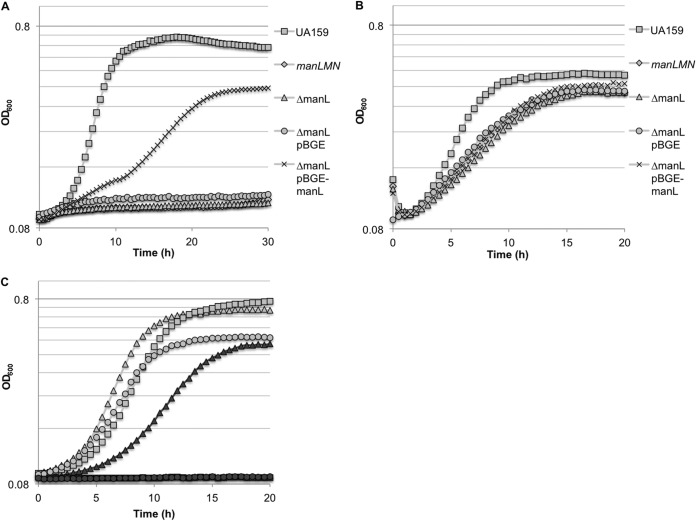
Growth curves of S. mutans UA159 and derivatives on TV media supplemented with various carbohydrates. (A and B) UA159, a manLMN deletion mutant, a manL deletion mutant (ΔmanL), a manL deletion mutant containing the empty pBGE vector (ΔmanL pBGE), and a manL deletion mutant complemented with pBGE-manL (ΔmanL pBGE-manL) were grown in TV medium supplemented with 20 mM GlcNAc (A) or 20 mM GlcN (B); (C) UA159 (light shapes) and a PTS enzyme I deletion mutant (dark shapes) were grown in TV medium supplemented with 20 mM glucose (triangles), 20 mM GlcNAc (squares), or 20 mM GlcN (circles).
FIG 2
FIG 2
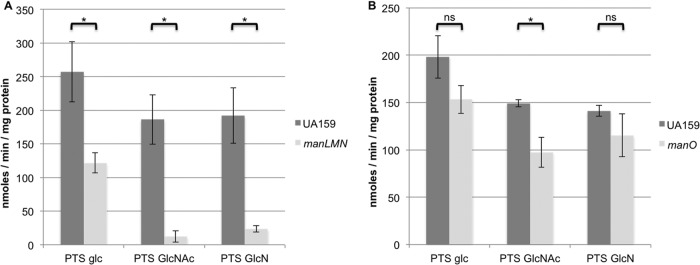
PTS-dependent sugar:phosphotransferase activity. S. mutans UA159 and a manLMN deletion mutant (A) or a manO deletion mutant (B) were grown in TV base medium supplemented with glucose. PTS-dependent transport of glucose (glc), GlcNAc, or GlcN was determined using permeabilized cells as described in Materials and Methods. Each bar represents the average of results of three independent experiments, with error bars indicating the standard deviation. *, P < 0.05 (by the Student t test). ns, not significant.
FIG 3
FIG 3
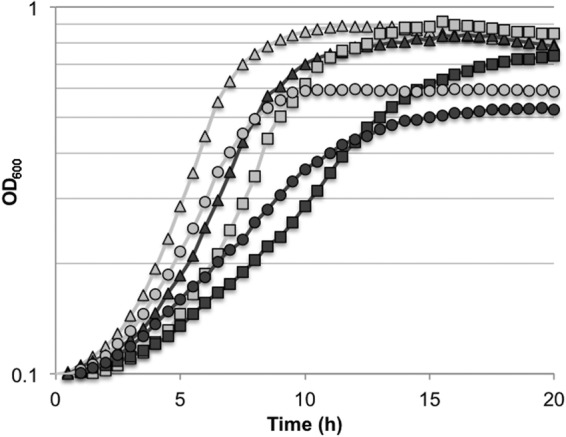
Growth curves of S. mutans UA159 (light shapes) and a manO deletion mutant (dark shapes) grown in TV base medium supplemented with 20 mM glucose (triangles), 20 mM GlcNAc (squares), or 20 mM GlcN (circles).
FIG 4
FIG 4
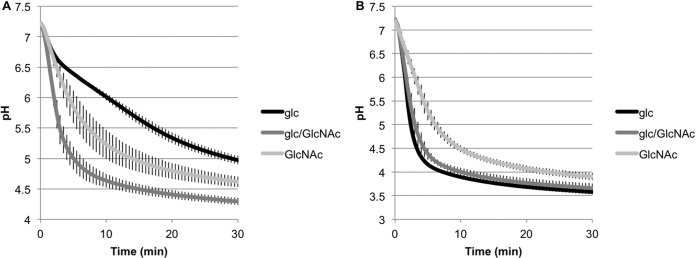
pH drop assays. Cells of S. mutans UA159 were grown to mid-exponential phase in TV base medium supplemented with 20 mM glucose (glc), 20 mM glc and 20 mM GlcNAc (glc/GlcNAc), or 20 mM GlcNAc (GlcNAc) before being subjected to pH drop assays as described in Materials and Methods. The assay was initiated by the addition of 50 mM (final concentration) of either GlcNAc (A) or glucose (B), and the change in the pH was monitored at 30-s intervals for 30 min. The data represent the averages of results of three independent experiments, with error bars indicating the standard deviation.
FIG 5
FIG 5
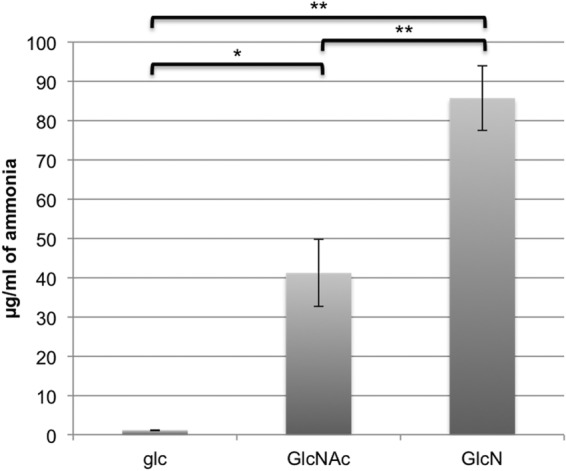
Measurements of ammonia in supernatant fluids of UA159 incubated with 50 mM glucose (glc), 50 mM GlcNAc, or 50 mM GlcN. The data are averages of results of three independent experiments, with error bars indicating the standard deviation. *, P < 0.05; **, P < 0.005 (by the Student t test).
FIG 6
FIG 6
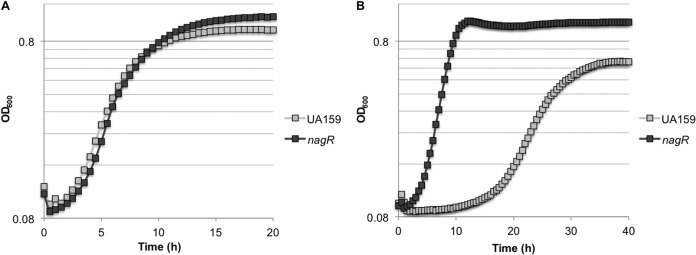
Growth curves of S. mutans UA159 and a nagR mutant grown in FMC medium formulated with 20 mM GlcN (A) or 20 mM GlcNAc (B) as the sole carbohydrate source.
FIG 7
FIG 7
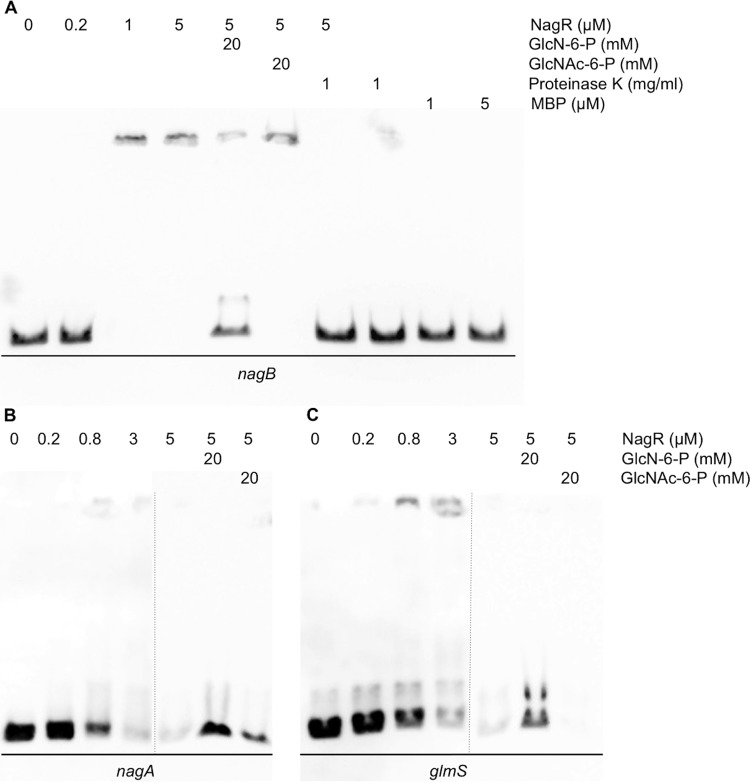
EMSAs performed using the NagR protein and biotinylated DNA fragments containing regions upstream of the nagB (A), nagA (B), or glmS (C) coding sequences. DNA probes and purified protein were generated as described in Materials and Methods. All EMSAs are representative examples of at least three independent experiments showing similar results.

References

    1. Loesche WJ. 1986. Role of Streptococcus mutans in human dental decay. Microbiol. Rev. 50:353–380 - PMC - PubMed
    1. Hamada S, Slade HD. 1980. Biology, immunology, and cariogenicity of Streptococcus mutans. Microbiol. Rev. 44:331–384 - PMC - PubMed
    1. Lemos JA, Burne RA. 2008. A model of efficiency: stress tolerance by Streptococcus mutans. Microbiology 154:3247–3255. 10.1099/mic.0.2008/023770-0 - DOI - PMC - PubMed
    1. Burne RA. 1998. Oral streptococci. Products of their environment. J. Dent. Res. 77:445–452. 10.1177/00220345980770030301 - DOI - PubMed
    1. Banas JA. 2004. Virulence properties of Streptococcus mutans. Front. Biosci. 9:1267–1277. 10.2741/1305 - DOI - PubMed

Publication types

MeSH terms

Substances

LinkOut - more resources