


Recent advances using zebrafish animal models for muscle disease drug discovery
- PMID: 24931439
- PMCID: PMC4697731
- DOI: 10.1517/17460441.2014.927435
Recent advances using zebrafish animal models for muscle disease drug discovery
Abstract
Introduction: Animal models have enabled great progress in the discovery and understanding of pharmacological approaches for treating muscle diseases like Duchenne muscular dystrophy.
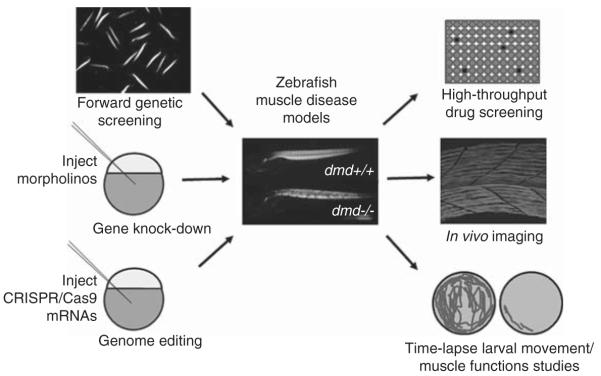
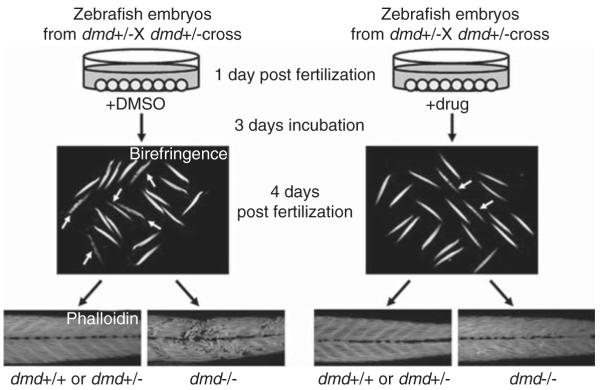
Areas covered: With this article, the author provides the reader with a description of the zebrafish animal model, which has been employed to identify and study pharmacological approaches to muscle disease. In particular, the author focuses on how both large-scale chemical screens and targeted drug treatment studies have established zebrafish as an important model for muscle disease drug discovery.
Expert opinion: There are a number of opportunities arising for the use of zebrafish models for further developing pharmacological approaches to muscle diseases, including studying drug combination therapies and utilizing genome editing to engineer zebrafish muscle disease models. It is the author's particular belief that the availability of a wide range of zebrafish transgenic strains for labeling immune cell types, combined with live imaging and drug treatment of muscle disease models, should allow for new elegant studies demonstrating how pharmacological approaches might influence inflammation and the immune response in muscle disease.
Keywords: Duchenne muscular dystrophy; birefringence; drug screen; muscle function; muscle structure; myopathy; zebrafish.
Figures
References
-
- Kaplan JC, Hamroun D. The 2014 version of the gene table of monogenic neuromuscular disorders (nuclear genome) Neuromuscul Disord. 2013;23:1081–111. - PubMed
-
-
Rahimov F, Kunkel LM. The cell biology of disease: cellular and molecular mechanisms underlying muscular dystrophy. J Cell Biol. 2013;201:499–510. This work provides an excellent recent review of the molecular and cellular mechanisms of muscle disease based on combined insights from animal model and human genetics studies.
-
-
-
Manring H, Abreu E, Brotto L, et al. Novel excitation-contraction coupling related genes reveal aspects of muscle weakness beyond atrophy-new hopes for treatment of musculoskeletal diseases. Front Physiol. 2014;5:37. This work provides an excellent recent review of the molecular and cellular mechanisms of muscle disease based on combined insights from animal model and human genetics studies.
-
Publication types
MeSH terms
Grants and funding
LinkOut - more resources
Full Text Sources
Other Literature Sources
Medical
