


Deep learning of the tissue-regulated splicing code
- PMID: 24931975
- PMCID: PMC4058935
- DOI: 10.1093/bioinformatics/btu277
Deep learning of the tissue-regulated splicing code
Abstract
Motivation: Alternative splicing (AS) is a regulated process that directs the generation of different transcripts from single genes. A computational model that can accurately predict splicing patterns based on genomic features and cellular context is highly desirable, both in understanding this widespread phenomenon, and in exploring the effects of genetic variations on AS.
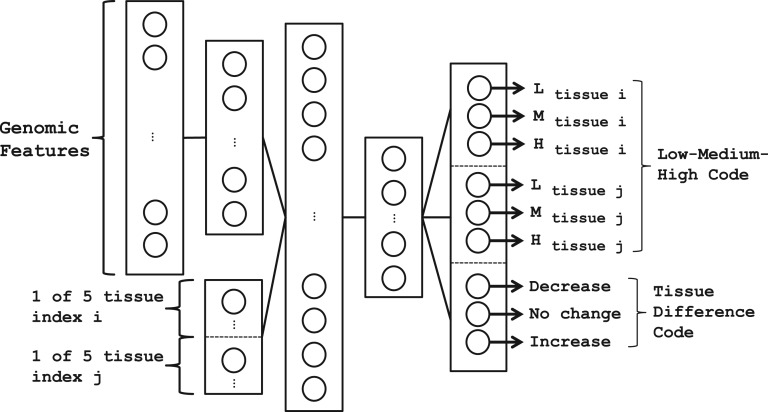
Methods: Using a deep neural network, we developed a model inferred from mouse RNA-Seq data that can predict splicing patterns in individual tissues and differences in splicing patterns across tissues. Our architecture uses hidden variables that jointly represent features in genomic sequences and tissue types when making predictions. A graphics processing unit was used to greatly reduce the training time of our models with millions of parameters.
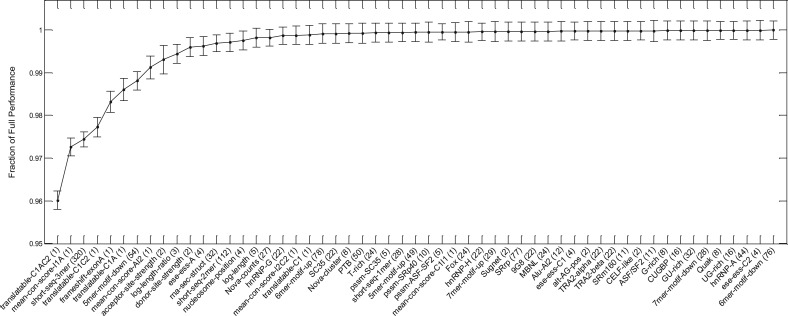
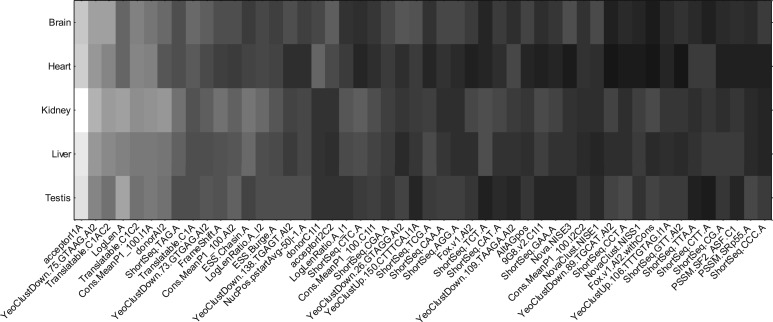
Results: We show that the deep architecture surpasses the performance of the previous Bayesian method for predicting AS patterns. With the proper optimization procedure and selection of hyperparameters, we demonstrate that deep architectures can be beneficial, even with a moderately sparse dataset. An analysis of what the model has learned in terms of the genomic features is presented.
© The Author 2014. Published by Oxford University Press.
Figures
References
-
- Ahn S, et al. Proceedings of the 29th International Conference on Machine Learning. 2012. Bayesian posterior sampling via stochastic gradient fisher scoring; pp. 1591–1598.
-
- Barash Y, et al. Deciphering the splicing code. Nature. 2010;465:53–59. - PubMed
-
- Barbosa-Morais NL, et al. The evolutionary landscape of alternative splicing in vertebrate species. Science. 2012;338:1587–1593. - PubMed
-
- Bengio Y. Learning deep architectures for AI. Foundations and Trends in Machine Learning. 2009;2:1–127.
Publication types
MeSH terms
Grants and funding
LinkOut - more resources
Full Text Sources
Other Literature Sources
Research Materials
