


Feedback-related negativity in children with two subtypes of attention deficit hyperactivity disorder
- PMID: 24932610
- PMCID: PMC4059686
- DOI: 10.1371/journal.pone.0099570
Feedback-related negativity in children with two subtypes of attention deficit hyperactivity disorder
Abstract
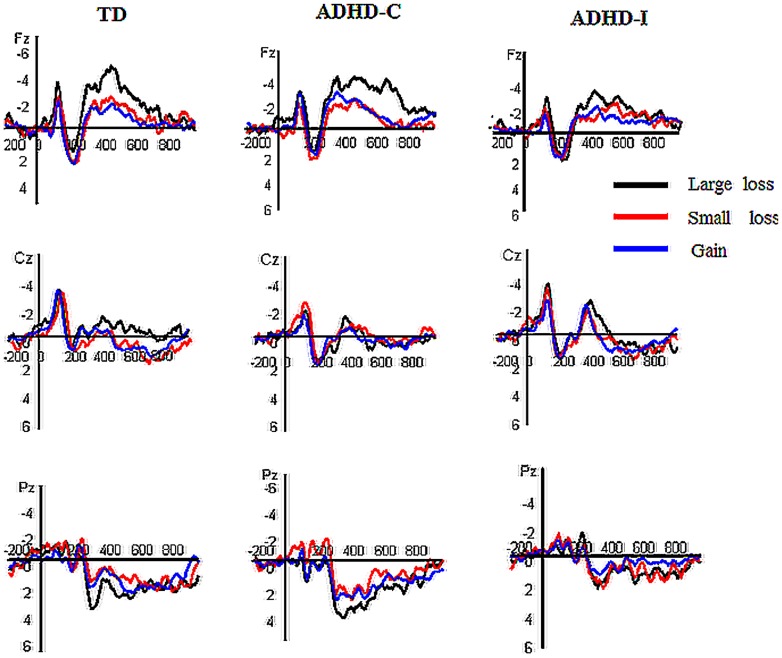
Objective: The current model of ADHD suggests abnormal reward and punishment sensitivity, although differences in ADHD subgroups are unclear. This study aimed to investigate the effect of feedback valence (reward or punishment) and punishment magnitude (small or large) on Feedback-Related Negativity (FRN) and Late Positive Potential (LPP) in two subtypes of ADHD (ADHD-C and ADHD-I) compared to typically developing children (TD) during a children's gambling task.
Methods: Children with ADHD-C (n = 16), children with ADHD-I (n = 15) and typically developing children (n = 15) performed a children's gambling task under three feedback conditions: large losses, small losses and gains. FRN and LPP components in brain potentials were recorded and analyzed.
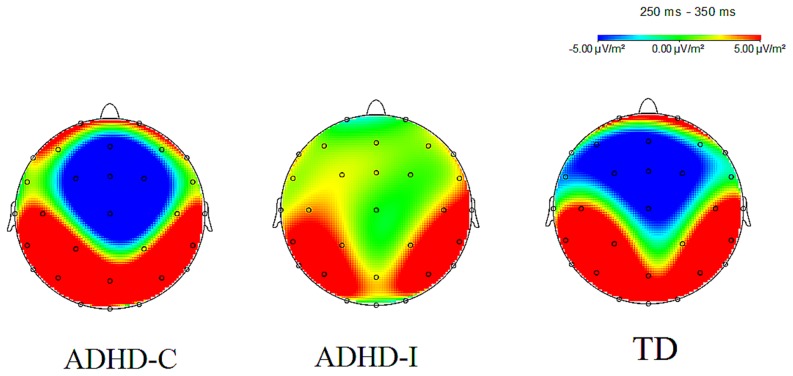
Results: In TD children and children with ADHD-C, large loss feedback evoked more negative FRN amplitudes than small loss feedback, suggesting that brain sensitivity to the punishment and its magnitude is not impaired in children with ADHD-C. In contrast to these two groups, the FRN effect was absent in children with ADHD-I. The LPP amplitudes were larger in children with ADHD-C in comparison with those with ADHD-I, regardless of feedback valence and magnitude.
Conclusion: Children with ADHD-C exhibit intact brain sensitivity to punishment similar to TD children. In contrast, children with ADHD-I are significantly impaired in neural sensitivity to the feedback stimuli and in particular, to punishment, compared to TD and ADHD-C children. Thus, FRN, rather than LPP, is a reliable index of the difference in reward and punishment sensitivity across different ADHD-subcategories.
Conflict of interest statement
Figures
References
-
- American Psychiatric Association (2000) Diagnostic and statistical manual of mental disorders. 4th ed., revised. Washington, DC: Author.
-
- Polanczyk G, de Lima MS, Horta BL, Biederman J, Rohde LA (2007) The worldwide prevalence of ADHD: A systematic review and metaregression analysis. Am J Psychiatry 164: 942–948. - PubMed
-
- Centers for Disease Control, National Center for Prevention Services (US), Division of Tuberculosis Elimination, National Center for HIV (2001) Reported tuberculosis in the United States. US Department of Health and Human Services, Public Health Service, Centers for Disease Control and Prevention, National Center for Prevention Services, Division of Tuberculosis Elimination.
-
- Gau SS, Chong MY, Chen TH, Cheng AT (2005) A 3-year panel study of mental disorders among adolescents in Taiwan. Am J Psychiatry 162: 1344–1350. - PubMed
-
- Woo BSC, Rey JM (2005) The validity of the DSM-IV subtypes of attention-deficit/hyperactivity disorder. Aust N Z J Psychiatry 39: 344–353. - PubMed
Publication types
MeSH terms
LinkOut - more resources
Full Text Sources
Other Literature Sources
Medical
