Review
. 2014 Aug;30(8):356-63.
doi: 10.1016/j.tig.2014.05.001. Epub 2014 Jun 3.

A rationale to target the SWI/SNF complex for cancer therapy

Affiliations
Review

A rationale to target the SWI/SNF complex for cancer therapy

Anja F Hohmann et al. Trends Genet. 2014 Aug.

Abstract

SWI/SNF is a multisubunit chromatin-remodeling complex that performs fundamental roles in gene regulation, cell lineage specification, and organismal development. Mutations that inactivate SWI/SNF subunits are found in nearly 20% of human cancers, which indicates that the proper functioning of this complex is necessary to prevent tumor formation in diverse tissues. Recent studies show that SWI/SNF-mutant cancers depend on residual SWI/SNF complexes for their aberrant growth, thus revealing synthetic lethal interactions that could be exploited for therapeutic purposes. Other studies reveal that certain acute leukemias and small cell lung cancers, which lack SWI/SNF mutations, can be vulnerable to inhibition of the SWI/SNF ATPase subunit BRG1, whereas several normal and malignant cell types do not show this sensitivity. Here, we review the emerging evidence that implicates SWI/SNF as a tumor-dependency and candidate drug target in human cancer.

Keywords: SWI/SNF; cancer therapy; synthetic lethality.


Figures

Figure 1
Figure 1
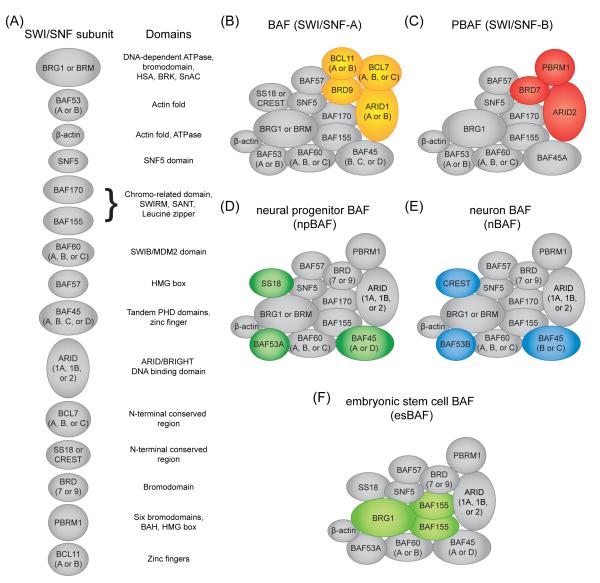
Overview of mammalian SWI/SNF complexes. A) Subunits that comprise the mammalian SWI/SNF complex. Protein domains present in each subunit are listed on the right. Subunit nomenclature was chosen based on prevailing usage in the literature. A full list of protein/gene names of each subunit can be found in reference [3]. B-F) Examples of known SWI/SNF subunit configurations. B & C) BAF and PBAF represent two alternative subunit arrangements for SWI/SNF that can exist in the same cell type. D-F) Examples of cell type-specific SWI/SNF subunit configurations. The different coloring is used to highlight the most well established subunits that distinguish these different assemblies. The position of individual subunits within the diagram is not intended to imply direct interactions within the complex. Owing to space limitations we are unable to provide a full list of references that provide evidence for these different configurations.
Figure 2
Figure 2
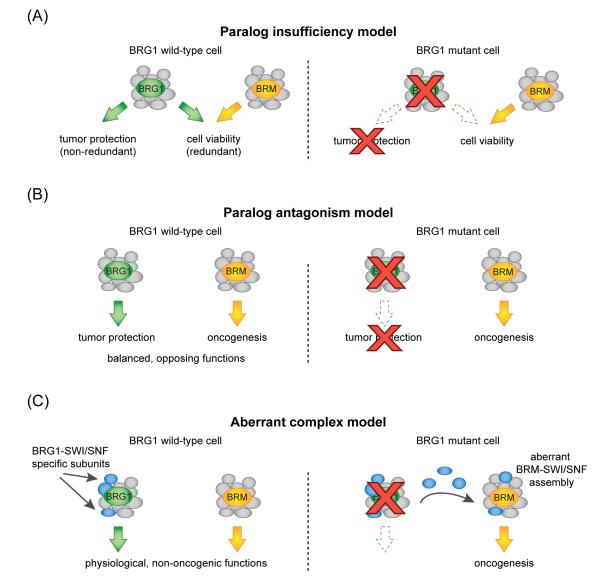
Hypothetical models for the function of residual BRM-SWI/SNF complexes in BRG1-mutant cancers. A) Paralog insufficiency model. In the cancer cell-of-origin, BRG1 and BRM perform redundant functions in supporting cell viability while BRG1 performs a non-redundant tumor suppressor function. Loss of BRG1 would lead to tumorigenic effects while simultaneously rendering BRM the sole ATPase subunit responsible for supporting tumor cell viability. B) Paralog antagonism model. In the cancer cell-of-origin, BRG1 performs a specific function in tumor protection while BRM promotes oncogenesis, resulting in a balanced state of SWI/SNF functions. Loss of BRG1 would result in unopposed BRM-driven proliferation and tumorigenesis. C) Aberrant complex model. Loss of BRG1 would release specific subunits of its dedicated protein complex, which would form aberrant associations with BRM that deregulate cancer-relevant transcriptional programs.

References

    1. Becker PB, Horz W. ATP-dependent nucleosome remodeling. Annual review of biochemistry. 2002;71:247–273. - PubMed
    1. Clapier CR, Cairns BR. The biology of chromatin remodeling complexes. Annual review of biochemistry. 2009;78:273–304. - PubMed
    1. Hargreaves DC, Crabtree GR. ATP-dependent chromatin remodeling: genetics, genomics and mechanisms. Cell research. 2011;21:396–420. - PMC - PubMed
    1. Neigeborn L, Carlson M. Genes affecting the regulation of SUC2 gene expression by glucose repression in Saccharomyces cerevisiae. Genetics. 1984;108:845–858. - PMC - PubMed
    1. Stern M, et al. Five SWI genes are required for expression of the HO gene in yeast. Journal of molecular biology. 1984;178:853–868. - PubMed

Publication types

MeSH terms

Substances