. 2014 Oct 1:272:46-54.
doi: 10.1016/j.bbr.2014.06.017. Epub 2014 Jun 13.

Experimenter effects on behavioral test scores of eight inbred mouse strains under the influence of ethanol

Affiliations

Experimenter effects on behavioral test scores of eight inbred mouse strains under the influence of ethanol

Martin Bohlen et al. Behav Brain Res. .

Abstract

Eight standard inbred mouse strains were evaluated for ethanol effects on a refined battery of behavioral tests in a study that was originally designed to assess the influence of rat odors in the colony on mouse behaviors. As part of the design of the study, two experimenters conducted the tests, and the study was carefully balanced so that equal numbers of mice in all groups and times of day were tested by each experimenter. A defect in airflow in the facility compromised the odor manipulation, and in fact the different odor exposure groups did not differ in their behaviors. The two experimenters, however, obtained markedly different results for three of the tests. Certain of the experimenter effects arose from the way they judged behaviors that were not automated and had to be rated by the experimenter, such as slips on the balance beam. Others were not evident prior to ethanol injection but had a major influence after the injection. For several measures, the experimenter effects were notably different for different inbred strains. Methods to evaluate and reduce the impact of experimenter effects in future research are discussed.

Keywords: Accelerating rotarod; Balance beam; Grip strength; Laboratory environment; Motor coordination; Open field activity.


Figures

Fig. 1
Fig. 1
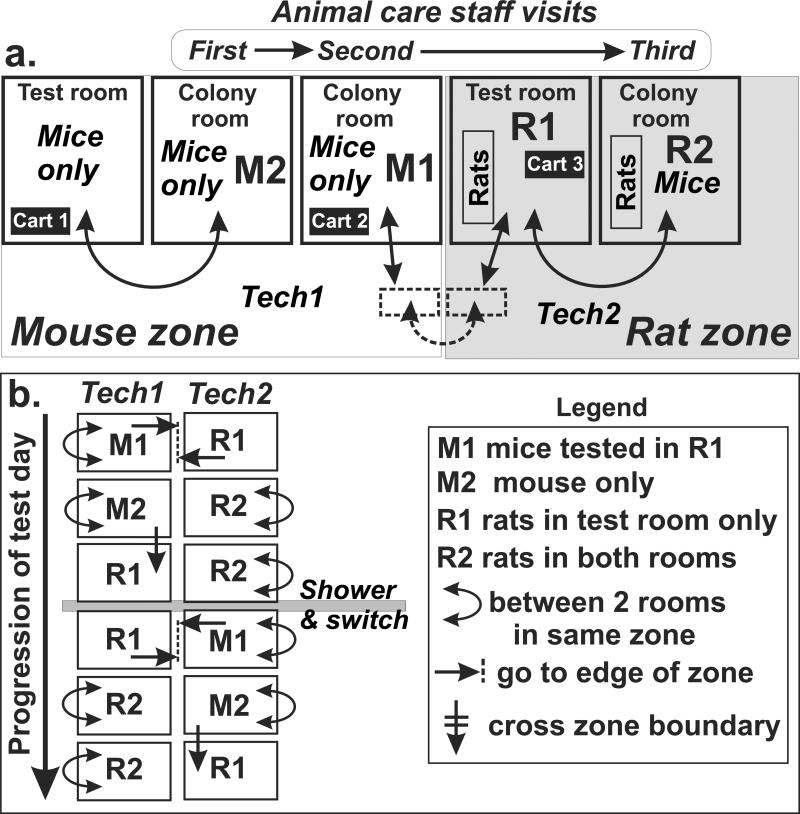
A. Arrangement of rooms used for housing and testing mice and rats. The rooms and hallway in the mouse zone never had rats housed or transported there, while the rat zone provided housing for rats and testing for mice that were to be exposed to rat odors. Mice to be tested in a room with rats were transferred from one cage to another on carts at the intersection of the zones. Colony rooms where animals were housed overnight did not contain test apparatus. B. Work flow for the two technicians during a day. The experimenters showered and put on clean clothing at mid-day before one who had been working near rats moved to rooms that contained mice not previously exposed to rats.
Fig. 2
Fig. 2
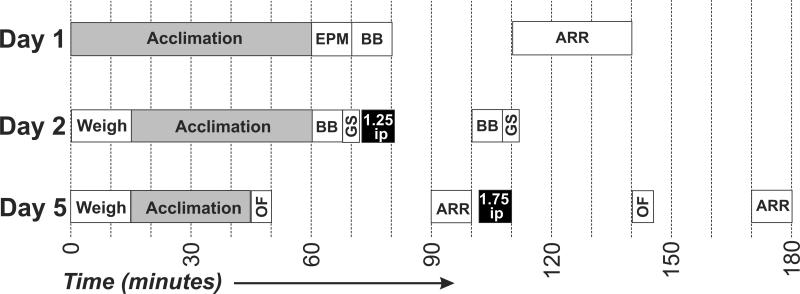
Schedule of testing a squad of mice within each of three test days. No alcohol was given on Day 1. On Day 2, mice were tested shortly before intraperitoneal (ip) injection of a 1.25g/Kg dose of alcohol and then again about 30 min after injection. On Day 3, the times between open field and accelerating rotarod are averages because there were always four mice in one squad tested at the same time on the rotarod, whereas mice were tested one at a time in the open field apparatus in a staggered pattern. Abbreviations: ARR, accelerating rotarod; BB, balance beam; EPM, elevated plus maze; GS, grip strength; OF, open field.
Fig. 3
Fig. 3
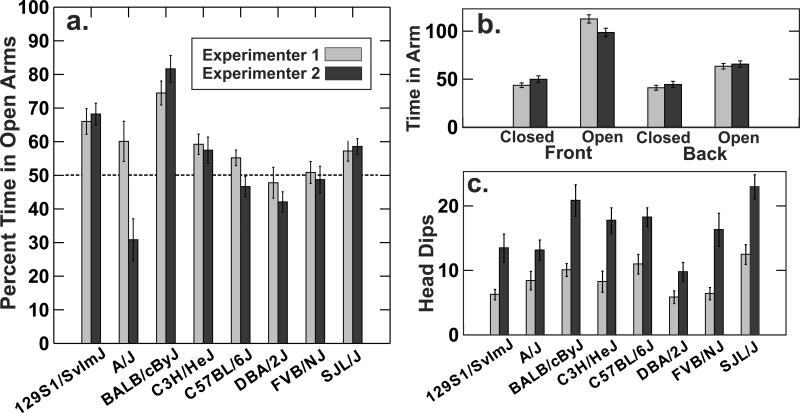
Results (means and standard errors) for eight strains tested by two experimenters on the elevated plus maze. A. There was a marked difference between experimenters only for strain A/J. b. Averaged over all strains and conditions, mice spent considerably more time in the open arms, especially the arm away from the nearest wall. C. The two experimenters made substantially different judgments about the frequency of head dips over the edges of the open arms for all strains.
Fig. 4
Fig. 4
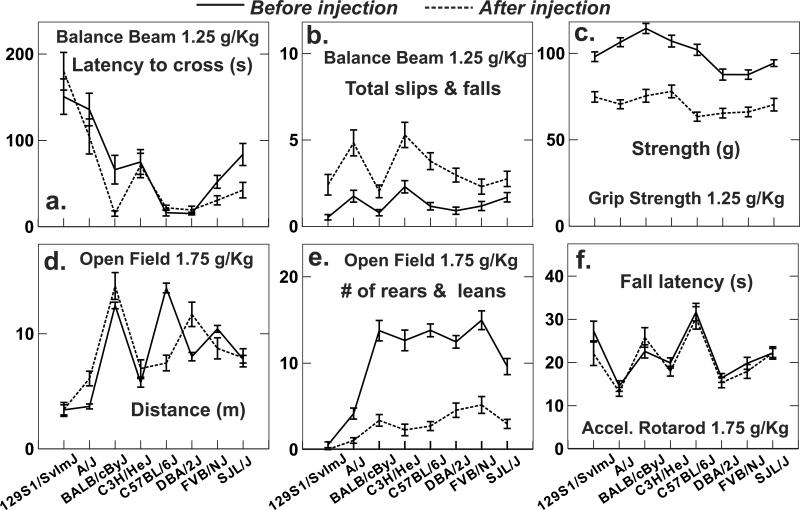
Strain mean scores (with standard error bars) before and after alcohol injection for four behavioral tests. A. Time required to traverse the balance beam was considerably lower after alcohol injection for strains BALB/cByJ and SJL/J but changed little for the other strains. B. Slips of a leg or the body from the beam were substantially more frequent after alcohol for all strains. Falls were included in the summary but were quite rare. C. Grip strength was markedly weaker after alcohol for all strains. D. Open field distance was unchanged for most strains but was influenced by alcohol in opposite directions for strains C57BL/6J and DBA/2J. e. Rearing and leaning against a wall were greatly reduced after the alcohol injection, except for strain 129S1/SvImJ that showed very little of these behaviors before injection. F. Fall latency from the accelerating rotarod was virtually unchanged after alcohol injection, although the pattern differed between experimenters (Fig. 5).
Fig. 5
Fig. 5
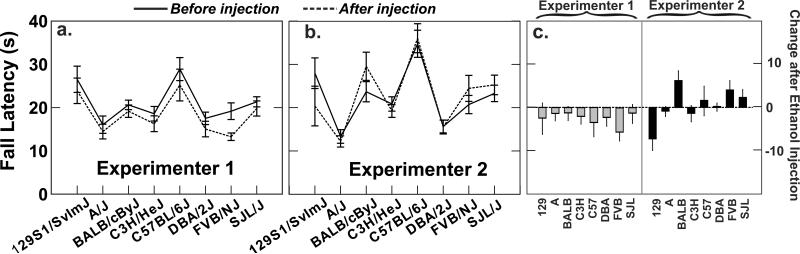
Effects of alcohol differed markedly between the two experimenters. A. For experimenter 1, fall latency was consistently decreased by a moderate amount. B. For experimenter 2, there was no alcohol effect at all for some strains, while others changed in opposite directions. C. The changes following alcohol were generally small, as indicated by the standard error bars. Detailed statistical analyses are presented in Table 1 and in the text.
Fig. 6
Fig. 6
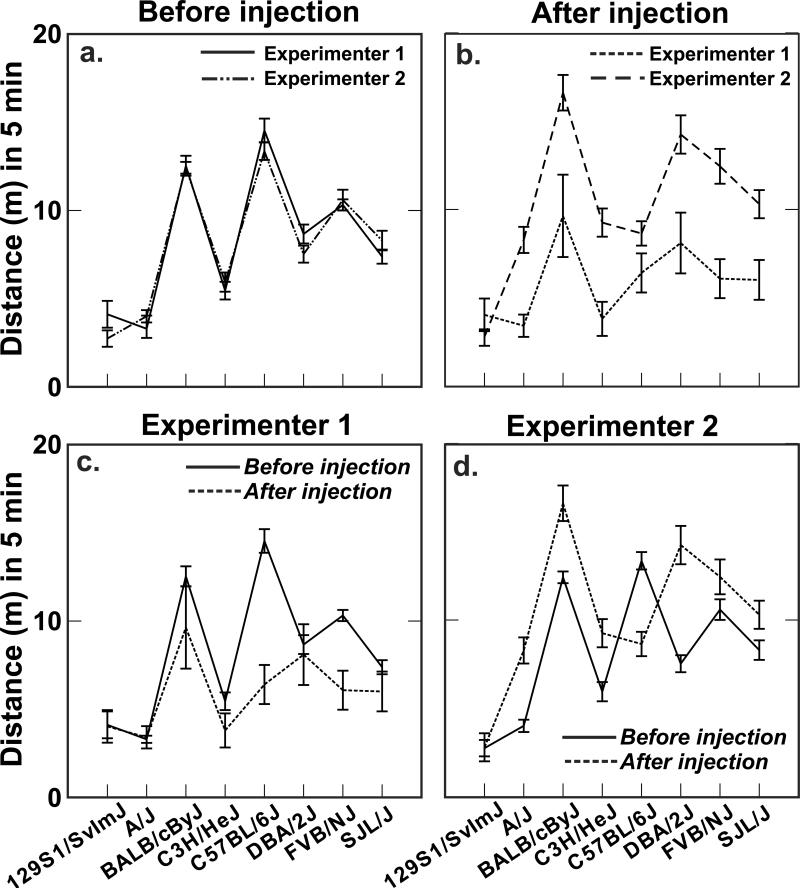
A. The pattern of strain differences in activity in the open field, a measure obtained with video tracking, was almost identical for the two experimenters before alcohol injection. B. The pattern of strains differences was similar for the two experimenters after injection, but activity generally decreased for experimenter 1 and increased for experimenter 2. C. The decrease for experimenter 1 is more clearly apparent when shown as before and after injection. D. Likewise the increase in activity after alcohol for experimenter 2 is evident for all but two strains.

References

    1. Crawley J. What's Wrong With My Mouse: Behavioral Phenotyping of Transgenic and Knockout Mice. 2[r]nd[/r] edn. Wiley-Liss; Hoboken, NJ: 2007.
    1. Crabbe JC, Wahlsten D, Dudek BC. Genetics of mouse behavior: interactions with laboratory environment. Science. 1999;284:1670–1672. - PubMed
    1. Wahlsten D, Metten P, Phillips TJ, Boehm SL, Burkhart-Kasch S, Dorow J, Doerksen S, Downing C, Fogarty J, Rodd-Henricks K, et al. Different data from different labs: lessons from studies of gene-environment interaction. J Neurobiol. 2003;54:283–311. - PubMed
    1. Chesler EJ, Wilson SG, Lariviere WR, Rodriguez-Zas SL, Mogil JS. Identification and ranking of genetic and laboratory environment factors influencing a behavioral trait, thermal nociception, via computational analysis of a large data archive. Neurosci. Biobehav. Rev. 2002;26:907–923. - PubMed
    1. Chesler EJ, Wilson SG, Lariviere WR, Rodriguez-Zas SL, Mogil JS. Influences of laboratory environment on behavior. Nat. Neurosci. 2002;5:1101–1102. - PubMed

Publication types