Employment status of people with mental illness: national survey data from 2009 and 2010
- PMID: 24933361
- PMCID: PMC4182106
- DOI: 10.1176/appi.ps.201300335
Employment status of people with mental illness: national survey data from 2009 and 2010
Abstract
Objective: The aim of this study was to describe employment according to mental illness severity in the United States during 2009 and 2010.
Methods: The sample included all working-age participants (ages 18-64) from the 2009 and 2010 National Survey on Drug Use and Health (N=77,326). Two well-established scales of mental health distinguished participants with none, mild, moderate, and serious mental illness. Analyses compared employment rate and income by mental illness severity. Employment status was estimated with logistic regression models that controlled for demographic characteristics and substance use disorders. In secondary analyses the relationship between mental illness and employment was assessed for variation by age and education status.
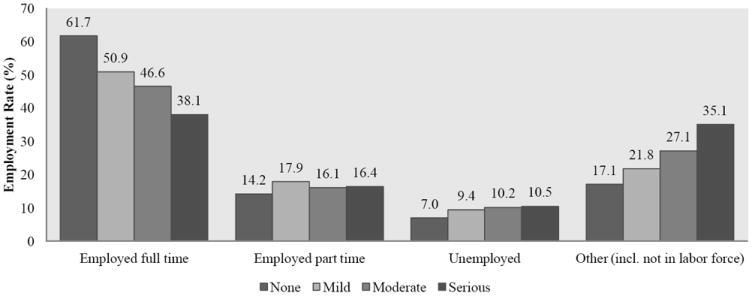
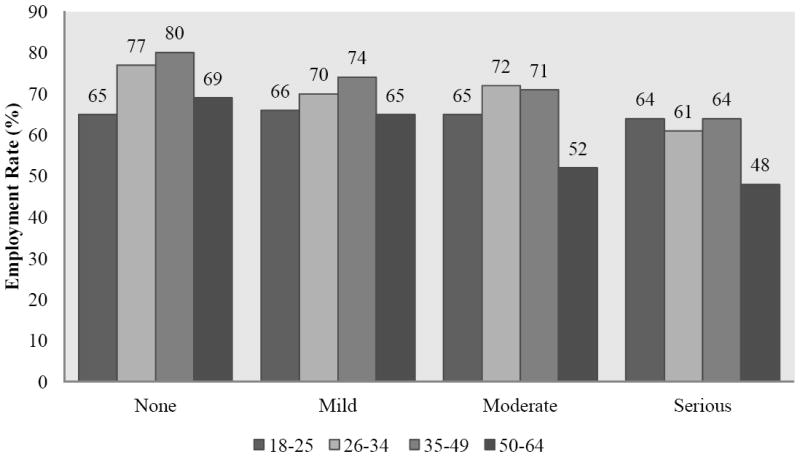
Results: Employment rates decreased with increasing mental illness severity (no mental illness, 75.9% employment; mild, 68.8%; moderate, 62.7%; and serious, 54.5%, p<.001). Over a third of people with serious mental illness, 38.5%, had incomes <$10,000 (compared with 23.1% of people with no mental illness, p<.001). The gap in adjusted employment rates comparing persons with serious versus no mental illness was 1% among people 18-25 years old versus 21% among people 50-64 (p<.001).
Conclusions: More severe mental illness was associated with lower employment rates in 2009 and 2010. People with serious mental illness are less likely than people with no, mild, or moderate mental illness to be employed after age 49.
Conflict of interest statement
Disclosure of Interest: None
Figures
References
-
- Frank RG, Koss C. Mental health and labor markets productivity loss and restoration. 2005 Contract No.: 38.
-
- Wu EQ, Birnbaum HG, Shi L, Ball DE, Kessler RC, Moulis M, et al. The economic burden of schizophrenia in the United States in 2002. Journal of Clinical Psychiatry. 2005;66(9):1122–9. - PubMed
-
- Baldwin ML, Marcus SC. Labor market outcomes of persons with mental disorders. Industrial Relations: A Journal of Economy and Society. 2007;46(3):481–510.
-
- Kessler RC, Heeringa S, Lakoma MD, Petukhova M, Rupp AE, Schoenbaum M, et al. The individual-level and societal-level effects of mental disorders on earnings in the United States: Results from the National Comorbidity Survey Replication. American Journal of Psychiatry. 2008;165(6):703–11. - PMC - PubMed
-
- Blyler CR. Employment and Major Depressive Episode. Substance Abuse and Mental Health Services Administration; 2009. - PubMed
Publication types
MeSH terms
Grants and funding
LinkOut - more resources
Full Text Sources
Other Literature Sources
Medical
Miscellaneous