Cerebellar ataxia and glutamic acid decarboxylase antibodies: immunologic profile and long-term effect of immunotherapy
- PMID: 24934144
- PMCID: PMC4841264
- DOI: 10.1001/jamaneurol.2014.1011
Cerebellar ataxia and glutamic acid decarboxylase antibodies: immunologic profile and long-term effect of immunotherapy
Abstract
Importance: Current clinical and immunologic knowledge on cerebellar ataxia (CA) with glutamic acid decarboxylase 65 antibodies (GAD65-Abs) is based on case reports and small series with short-term follow-up data.
Objective: To report the symptoms, additional antibodies, prognostic factors, and long-term outcomes in a cohort of patients with CA and GAD65-Abs.
Design, setting, and participants: Retrospective cohort study and laboratory investigations at a center for autoimmune neurologic disorders among 34 patients with CA and GAD65-Abs, including 25 with long-term follow-up data (median, 5.4 years; interquartile range, 3.1-10.3 years).
Main outcomes and measures: Analysis of clinicoimmunologic features and predictors of response to immunotherapy. Immunochemistry on rat brain, cultured neurons, and human embryonic kidney cells expressing GAD65, GAD67, α1-subunit of the glycine receptor, and a repertoire of known cell surface autoantigens were used to identify additional antibodies. Twenty-eight patients with stiff person syndrome and GAD65-Abs served as controls.
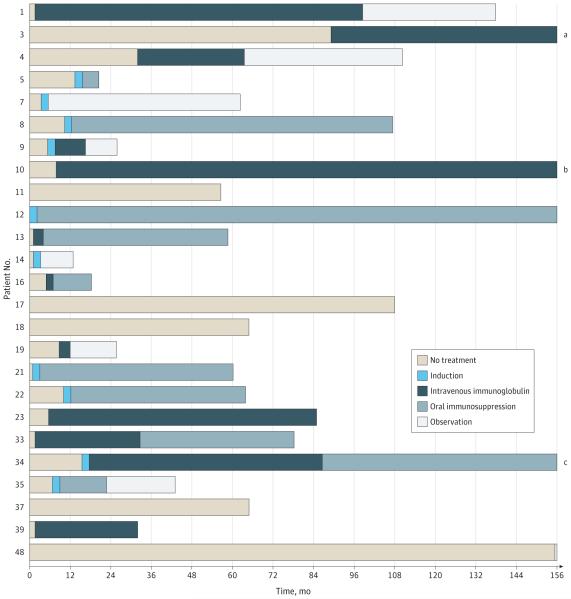
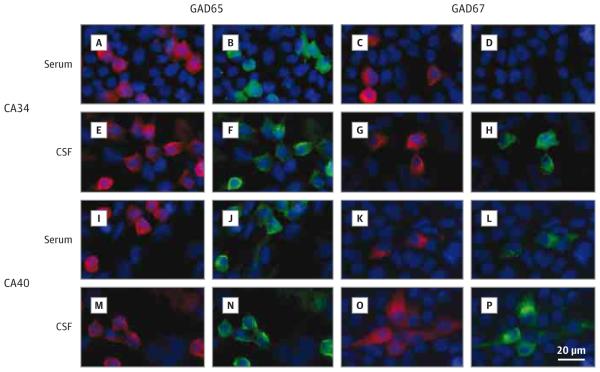
Results: The median age of patients was 58 years (range, 33-80 years); 28 of 34 patients (82%) were women. Nine patients (26%) reported episodes of brainstem and cerebellar dysfunction or persistent vertigo several months before developing CA. The clinical presentation was subacute during a period of weeks in 13 patients (38%). Nine patients (26%) had coexisting stiff person syndrome symptoms. Systemic organ-specific autoimmunities (type 1 diabetes mellitus and others) were present in 29 patients (85%). Twenty of 25 patients with long-term follow-up data received immunotherapy (intravenous immunoglobulin in 10 and corticosteroids and intravenous immunoglobulin or other immunosuppressors in 10), and 7 of them (35%) improved. Predictors of clinical response included subacute onset of CA (odds ratio [OR], 0.50; 95% CI, 0.25-0.99; P = .047) and prompt immunotherapy (OR, 0.98; 95% CI, 0.96-0.99; P = .01). Similar frequencies of serum GAD67-Abs were found in patients with CA (24 of 34 patients [71%]) and in patients with stiff person syndrome (20 of 28 patients [71%]). However, GAD67-Abs were found in all of the cerebrospinal fluid samples examined (22 samples from patients with CA and 17 samples from patients with stiff person syndrome). Glycine receptor antibodies but not other cell surface antibodies were identified in 4 patients with CA. The presence of glycine receptor antibodies did not correlate with any specific clinical feature.
Conclusions and relevance: In patients with CA and GAD65-Abs, subacute onset of symptoms and prompt immunotherapy are associated with good outcome. Persistent vertigo or brainstem and cerebellar episodes can herald CA and should lead to GAD65-Ab testing, particularly in patients with systemic organ-specific autoimmunities.
Figures
References
-
- Honnorat J, Saiz A, Giometto B, et al. Cerebellar ataxia with anti–glutamic acid decarboxylase antibodies: study of 14 patients. Arch Neurol. 2001;58(2):225–230. - PubMed
-
- Saiz A, Blanco Y, Sabater L, et al. Spectrum of neurological syndromes associated with glutamic acid decarboxylase antibodies: diagnostic clues for this association. Brain. 2008;131(pt 10):2553–2563. - PubMed
-
- Saiz A, Arpa J, Sagasta A, Casamitjana R, Zarranz JJ, Tolosa E. Autoantibodies to glutamic acid decarboxylase in three patients with dependent diabetes mellitus, and polyendocrine autoimmunity. Neurology. 1997;49(4):1026–1030. - PubMed
Publication types
MeSH terms
Substances
Grants and funding
LinkOut - more resources
Full Text Sources
Other Literature Sources