


Walking cadence and mortality among community-dwelling older adults
- PMID: 24934147
- PMCID: PMC4139514
- DOI: 10.1007/s11606-014-2926-6
Walking cadence and mortality among community-dwelling older adults
Abstract
Background: Older adults are encouraged to walk ≥100 steps∙minute(-1) for moderate-intensity physical activity (i.e., brisk walking). It is unknown if the ability to walk ≥100 steps∙minute(-1) predicts mortality.
Objective: To determine if the ability to walk ≥100 steps∙minute(-1) predicts mortality among older adults.
Design, setting, and patients: A population-based cohort study among 5,000 older adults from the Third National Health and Nutrition Survey (NHANES III; 1988-1994). Vital status and cause of death were collected through December 31, 2006. Median follow-up was 13.4 years. Average participant age was 70.6 years.
Measurements: Walking cadence (steps∙minute(-1)) was calculated using a timed 2.4-m walk. Walking cadence was dichotomized at 100 steps∙minute(-1) (≥100 steps∙minute(-1) versus <100 steps∙minute(-1)) to demarcate the lower threshold of absolutely defined moderate-intensity physical activity. Walking cadence was also analyzed as a continuous variable. Predicted survival was compared between walking cadence and gait speed. The primary outcome was all-cause mortality. Secondary outcomes included cardiovascular-specific and cancer-specific mortality and mortality from other causes.
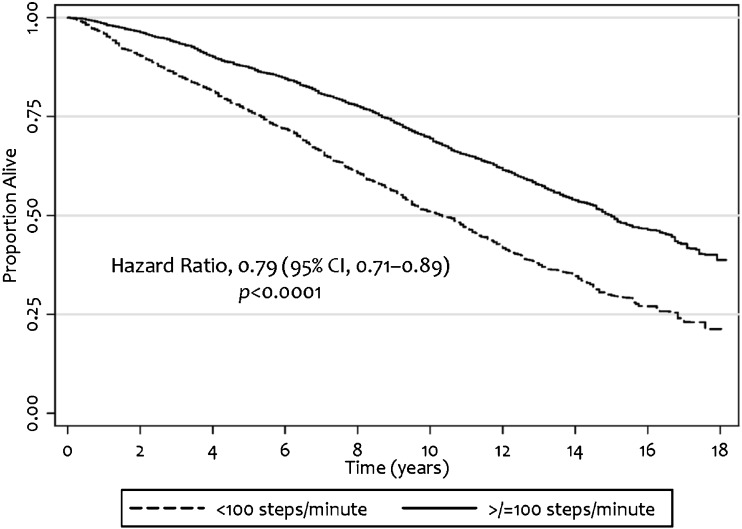
Results: Among 5,000 participants, 3,039 (61 %) walked ≥100 steps∙minute(-1). During follow-up, 3,171 subjects died. In multivariable-adjusted analysis, ability to walk ≥100 steps∙minute(-1) predicted a 21 % reduction in all-cause mortality (hazard ratio [HR], 0.79; 95 % confidence interval [95 % CI], 0.71-0.89, p < 0.001). Each ten-step increase in walking cadence predicted a 4 % reduction in all-cause mortality (HR, 0.96, [0.94-0.98], p < 0.001). In secondary analyses, ability to walk ≥100 steps∙minute(-1) predicted reductions in cardiovascular-specific mortality (HR, 0.79 [0.67-0.92], p = 0.002), cancer-specific mortality (HR, 0.76 [0.58-0.99], p = 0.050), and mortality from other causes (HR, 0.82 [0.68-0.97], p = 0.025). Predicted survival, adjusted for age and sex, was not different using walking cadence versus gait speed.
Limitations: Walking cadence was a cross-sectional measurement.
Conclusions: The ability to walk ≥100 steps∙minute(-1) predicts a reduction in mortality among a sample of community-dwelling older adults.
Figures
References
-
- Vincent GK, Velkoff VA. The Next Four Decades: The Older Population in the United States: 2010 to 2050. Current Population Reports. Washington, DC: US Department of Commerce, Economics and Statistics Administration, US Census Bureau; 2010. p. P25-1138.
-
- Walston J, Hadley EC, Ferrucci L, et al. Research agenda for frailty in older adults: toward a better understanding of physiology and etiology: summary from the american geriatrics Society/National institute on aging research conference on frailty in older adults. J Am Geriatr Soc. 2006;54(6):991–1001. doi: 10.1111/j.1532-5415.2006.00745.x. - DOI - PubMed
Publication types
MeSH terms
Grants and funding
LinkOut - more resources
Full Text Sources
Other Literature Sources
