


Presence of potentially pathogenic free-living amoebae strains from well water samples in Guinea-Bissau
- PMID: 24934796
- PMCID: PMC4069338
- DOI: 10.1179/2047773214Y.0000000143
Presence of potentially pathogenic free-living amoebae strains from well water samples in Guinea-Bissau
Abstract
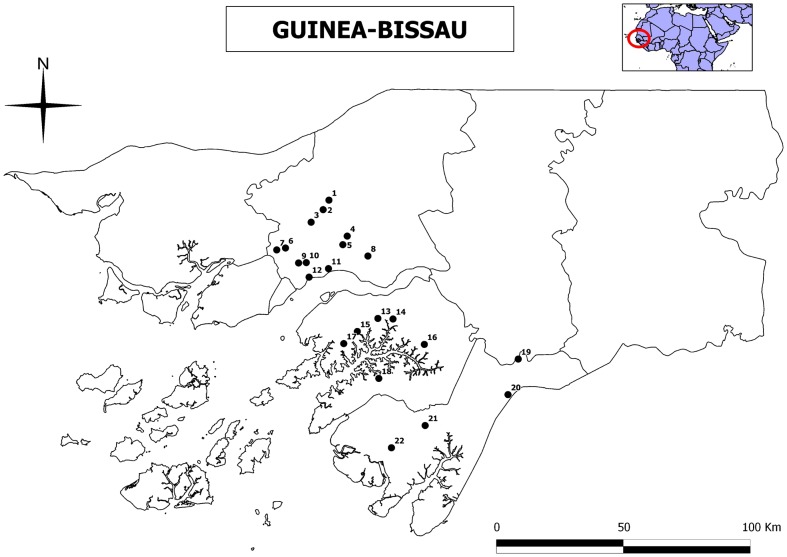
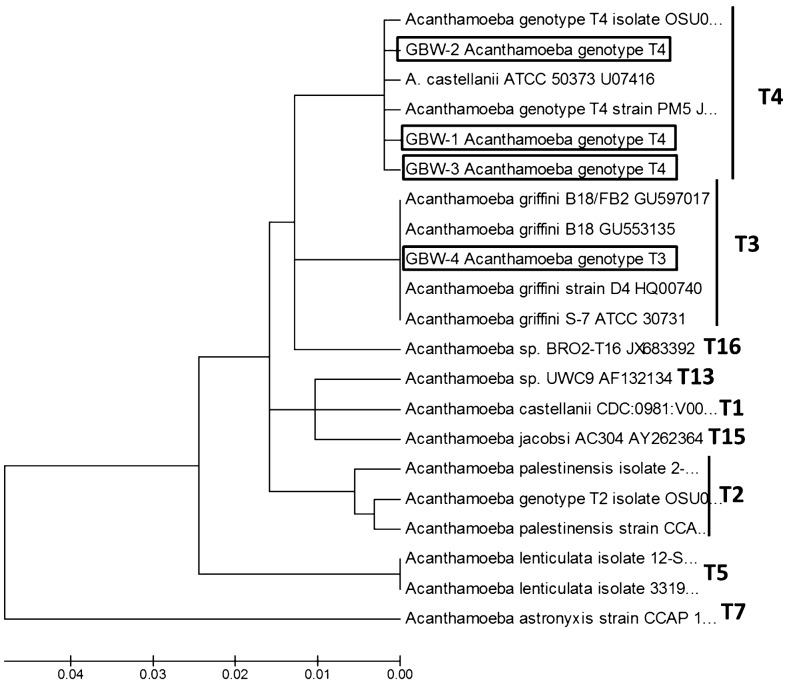
Free-living amoebae (FLA) include opportunistic pathogens such as Naegleria fowleri, Balamuthia mandrillaris, and the genera Sappinia and Acanthamoeba. In this study, a survey was conducted in order to evaluate the presence of potentially pathogenic amoebic strains in water samples collected from wells located in the western part of Guinea-Bissau. The samples were left to precipitate for 48 hours and then the sediments were seeded on non-nutrient agar plates containing Escherichia coli spread and cultures were checked daily for the presence of FLA. Identification of FLA strains was based on the morphological and polymerase chain reaction (PCR) using the 18S rDNA or 16S mitochondrial rDNA genes in the case of Naegleria and Balamuthia genera, respectively. In the case of positive samples of Acanthamoeba, strains were further classified at the genotype level by sequencing the diagnostic fragment 3 (DF3) region located in the 18S rDNA gene as previously described. Sappinia sp. was not isolated during the study and thus, no molecular analysis was performed for this genus. The obtained results revealed the presence of Acanthamoeba (genotypes T3 and T4), Naegleria fowleri, and Balamuthia mandrillaris. To the best of our knowledge, this is the first report demonstrating the presence of FLA in water bodies from Guinea-Bissau and the first report on the isolation of Balamuthia mandrillaris from environmental sources in Africa.
Keywords: Acanthamoeba,; Balamuthia mandrillaris,; Genotype,; Guinea-Bissau; Naegleria,; Well water,.
Figures
References
-
- Lorenzo-Morales J, Martín-Navarro CM, López-Arencibia A, Arnalich-Montiel F, Piñero JE, Valladares B. Acanthamoeba keratitis: an emerging disease gathering importance worldwide? Trends Parasitol. 2013;29:181–7. - PubMed
-
- Visvesvara GS, Moura H, Schuster FL. Pathogenic and opportunistic free-living amoebae: Acanthamoeba spp., Balamuthia mandrillaris, Naegleria fowleri, and Sappinia diploidea. FEMS Immunol Med Microbiol. 2007;50:1–26. - PubMed
-
- Lawande RV. Recovery of soil amoebae from the air during the harmattan in Zaria, Nigeria. Ann Trop Med Parasitol. 1983;77(1):45–9. - PubMed
Publication types
MeSH terms
Substances
LinkOut - more resources
Full Text Sources
Other Literature Sources
Medical
Molecular Biology Databases
