Review
. 2014 Jul;40(1):2163-82.
doi: 10.1111/ejn.12644. Epub 2014 Jun 17.

Neural and psychological mechanisms underlying compulsive drug seeking habits and drug memories--indications for novel treatments of addiction

Affiliations
Free PMC article
Review

Neural and psychological mechanisms underlying compulsive drug seeking habits and drug memories--indications for novel treatments of addiction

Barry J Everitt. Eur J Neurosci. 2014 Jul.
Free PMC article

Abstract

This review discusses the evidence for the hypothesis that the development of drug addiction can be understood in terms of interactions between Pavlovian and instrumental learning and memory mechanisms in the brain that underlie the seeking and taking of drugs. It is argued that these behaviours initially are goal-directed, but increasingly become elicited as stimulus-response habits by drug-associated conditioned stimuli that are established by Pavlovian conditioning. It is further argued that compulsive drug use emerges as the result of a loss of prefrontal cortical inhibitory control over drug seeking habits. Data are reviewed that indicate these transitions from use to abuse to addiction depend upon shifts from ventral to dorsal striatal control over behaviour, mediated in part by serial connectivity between the striatum and midbrain dopamine systems. Only some individuals lose control over their drug use, and the importance of behavioural impulsivity as a vulnerability trait predicting stimulant abuse and addiction in animals and humans, together with consideration of an emerging neuroendophenotype for addiction are discussed. Finally, the potential for developing treatments for addiction is considered in light of the neuropsychological advances that are reviewed, including the possibility of targeting drug memory reconsolidation and extinction to reduce Pavlovian influences on drug seeking as a means of promoting abstinence and preventing relapse.

Keywords: cocaine; compulsion; habits; reconsolidation; relapse; striatum.


Figures

FIG. 1
FIG. 1
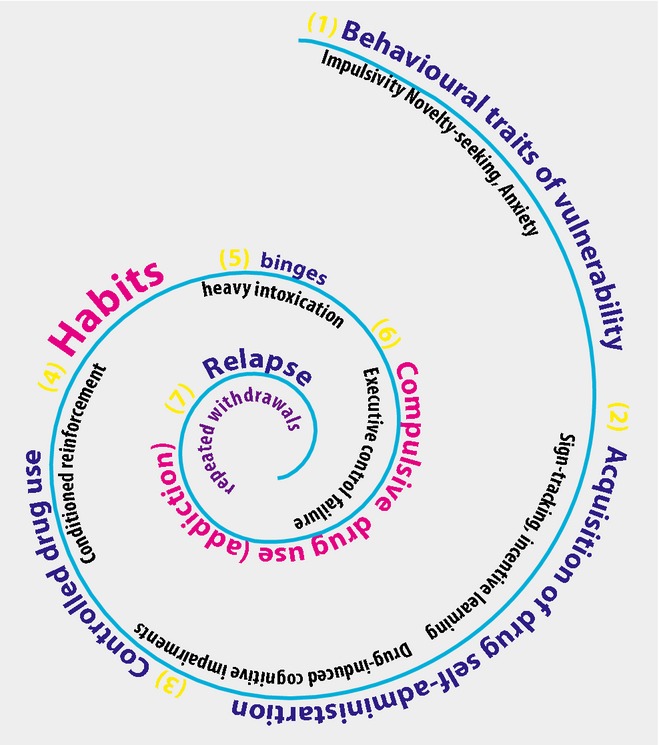
A schematic summary of the psychological processes that may underlie the transition from voluntary drug seeking, through loss of control over drug use to the emergence of compulsive drug seeking habits. Although depicted as a spiral (see Koob & Le Moal, 2001), these processes may also occur in parallel, as discussed in the text. The notion of vulnerability is also captured in the spiral, determining that some but not all individuals ultimately seek and take drugs compulsively, in part through the loss of inhibitory control over drug seeking habits. (Figure generously provided by David Belin, 2014).
FIG. 2
FIG. 2
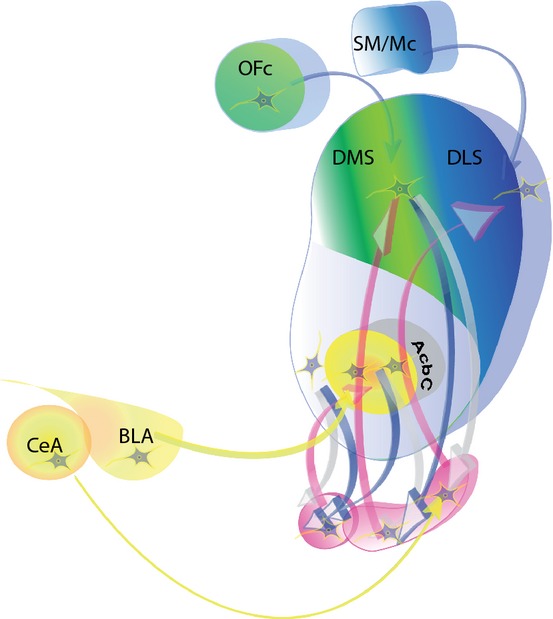
The neural circuitry of goal-directed (controlled by Action-Outcome associations) and habitual (controlled by stimulus–response associations) drug seeking behaviour. Basolateral amygdala (BLA) – nucleus accumbens core (AcbC) circuitry (yellow) mediates the impact of conditioned reinforcement on drug seeking behaviour, modulated by the actions of the mesolimbic DA system originating in the midbrain (pink). The dorsomedial striatum (DMS) with its orbitofrontal cortex (OFc) inputs (green), together with medial prefrontal cortex (not illustrated) mediate the acquisition and performance of the goal-directed seeking of drugs (cocaine) and ingestive rewards. The dorsolateral striatum (DLS) and its sensorimotor cortical afferents (SM/Mc) mediate the acquisition and performance of well-established drug seeking habits and stimulus–response control. Also illustrated is the serial connectivity linking the nucleus accumbens with the DMS and DLS via recurrent connections with the midbrain DA neurons (pink – interconnecting pink and blue arrows, after Haber et al., 2000) mediating intrastriatal shifts in the control over drug seeking from ventral to dorsal striatum. Substantia nigra neurons projecting to the DLS are also regulated by afferents from the central nucleus of the amygdala (CeN). (Figure generously provided by David Belin, 2014).
FIG. 3
FIG. 3
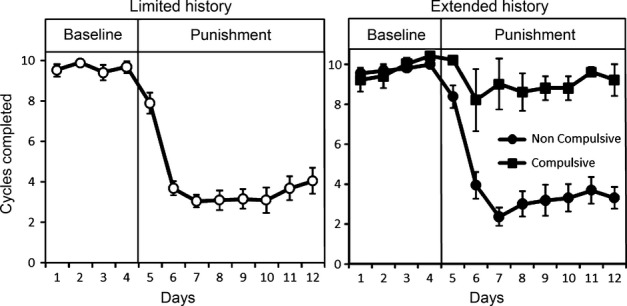
Compulsive cocaine seeking in 20% of vulnerable rats after an extended cocaine taking history. Rats were trained in a cocaine seeking-taking chained schedule of reinforcement, completing around 10 ‘cycles’ of seeking and taking per session (a cycle is comprised of a variable 2 minute interval of seeking responses, followed by the opportunity to self-administer cocaine by responding on the taking lever; see Pelloux et al., 2007). Shown in both left and right panels are seeking cycles on 4 baseline days, at which point intermittent and unpredictable punishment was introduced to terminate 50% of seeking cycles; on the remaining 50% of cycles, pressing the taking lever resulted in an i.v. infusion of cocaine. Left Panel: After a limited history of cocaine self-administration, all rats suppressed their cocaine seeking when the intermittent punishment contingency was introduced. Right Panel: A sub-group of rats, 20% of the population, persisted in seeking cocaine in the face of punishment, i.e. were compulsive, whereas the majority suppressed their cocaine seeking (Pelloux et al., 2007). This result has been replicated in different laboratories, using the same or slightly different procedures and in different strains of rats (Deroche-Gamonet et al., Pelloux et al., ; Belin et al., ; Cannella et al., ; Chen et al., 2007). Data from Pelloux et al., .
FIG. 4
FIG. 4
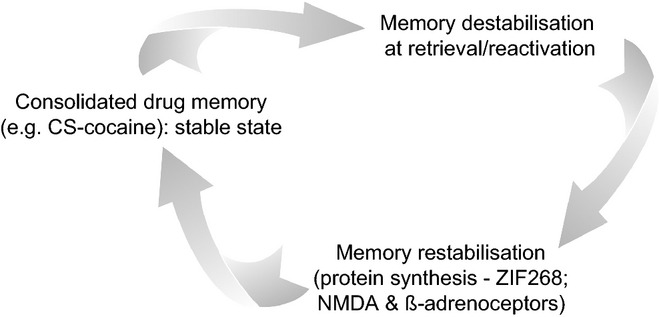
Illustration of the concept of memory reconsolidation. The consolidated drug memory, established by repeated Pavlovian association with an environmental stimulus (CS) and self-administered drug effect, is stored in a stable state. Brief presentations of the drug CS (called ‘reactivation’) can result in destabilization of the memory in the brain (in the case of a CS–drug memory, in the basolateral amygdala). The memory can persist in the brain if it is restabilized through de novo protein synthesis. The protein ZIF268 is a requirement of cued drug memory reconsolidation in the basolateral amygdala and is regulated by activation of NMDA receptors. Memory reconsolidation can be prevented by inhibiting protein synthesis in the amygdala, or knocking down ZIF268 by infusing zif268 antisense oligonucleotides, or by blocking NMDA or β-adrenoceptors. Systemic NMDA or β-adrenoceptor blockade also prevents drug memory reconsolidation. The result is drug memory ‘erasure’ with the consequence that the drug-associated CS can no longer support drug seeking and thereby prevents relapse (see Milton & Everitt, , for review).

References

    1. Adams CD, Dickinson A. Instrumental responding following reinforcer devaluation. Q. J. Exp. Psychol.-B. 1981;33:109–121.
    1. Ahmed SH, Kenny PJ, Koob GF, Markou A. Neurobiological evidence for hedonic allostasis associated with escalating cocaine use. Nat. Neurosci. 2002;5:625–626. - PubMed
    1. Ahmed SH, Lin D, Koob GF, Parsons LH. Escalation of cocaine self-administration does not depend on altered cocaine-induced nucleus accumbens dopamine levels. J. Neurochem. 2003;86:102–113. - PubMed
    1. Alderson HL, Parkinson JA, Robbins TW, Everitt BJ. The effects of excitotoxic lesions of the nucleus accumbens core or shell regions on intravenous heroin self-administration in rats. Psychopharmacology. 2001;153:455–463. - PubMed
    1. American Psychiatric Association. Diagnostic and Statistical Manual of Mental Disorders, Fifth Edition (DSM-5) Arlington, VA: APA; 2013.

Publication types