. 2014 Sep;65(17):4863-72.
doi: 10.1093/jxb/eru255. Epub 2014 Jun 16.

PEG-mediated osmotic stress induces premature differentiation of the root apical meristem and outgrowth of lateral roots in wheat

Affiliations

PEG-mediated osmotic stress induces premature differentiation of the root apical meristem and outgrowth of lateral roots in wheat

Hongtao Ji et al. J Exp Bot. 2014 Sep.

Abstract

Water stress is one of the major environmental stresses causing growth retardation and yield loss of plants. In the past decades, osmotic adjustment, antioxidant protection, and stomatal movement have been extensively studied, but much less attention has been paid to the study of root system reprogramming to maximize water absorption and survival under water stress. Here, it is shown that polyethylene glycol (PEG)-simulated mild and moderate osmotic stress induced premature differentiation of the root apical meristem (RAM). It is demonstrated that RAM premature differentiation is a conserved adaptive mechanism that is widely adopted by various plants to cope with osmotic stress simulated by PEG 8000, and the occurrence of RAM premature differentiation is directly related to stress tolerance of plants. It is shown that the osmotic stress-induced premature differentiation caused growth cessation of primary roots allowing outgrowth of lateral roots. This work has uncovered a key mechanism for controlling the plastic development of the root system by which plants are capable of survival, growth, or reproduction under water stress.

Keywords: Lateral roots; PEG 8000; osmotic stress; premature differentiation; root tip; wheat (Triticum aestivum)..


Figures

Fig. 1.
Fig. 1.
Effects of PEG 8000 treatments on 6-day-old wheat root tips. (A) Wheat seedlings (upper panel, scale bar=5cm) and root tips (lower panel, scale bar=0.5mm) were exposed to the indicated concentration of PEG 8000 solution for 72h. (B) Quantification of root tip width shown in (A). PEG 8000 at a 5% concentration was used for treatment at the indicated time in (C–G). (C) Tetrazolium Violet staining of wheat root tip. Scale bar=0.5mm. (D) Cross-sections of wheat root tip. Scale bar=0.4mm. (E) Scanning electron microscopy analysis of wheat root tip. Scale bar=0.5mm. (F) Longitudinal sections of root tip. The red arrows show the transition zone. Scale bar=0.5mm. (G) Phloroglucinol staining (reddish colour) of root cross-sections. Scale bar=0.2mm.
Fig. 2.
Fig. 2.
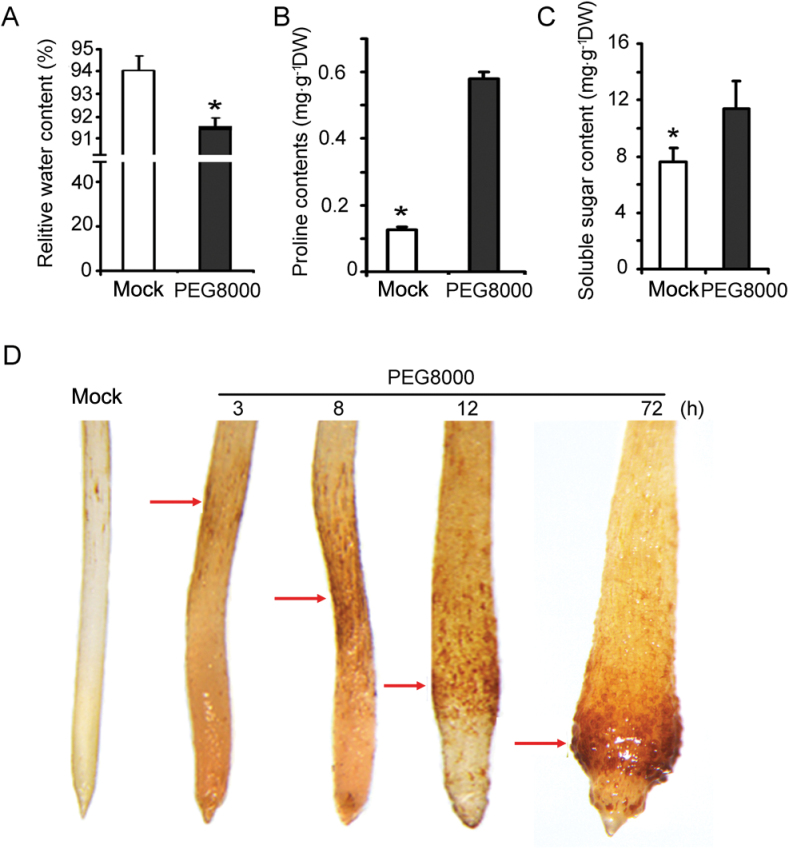
Physiological analysis of wheat RAM. (A) Relative water content (RWC); (B) proline content (mg g–1 DW); (C) soluble sugar content (mg g–1 DW). Data are presented as means ±SD, and columns marked with asterisks indicate significant differences in each treatment using Student’s t-test analysis (P<0.05). Experiments were repeated three times with similar results. (D) Detection of hydrogen peroxide by DAB (3,3’-diaminobenzidine) staining in the root tip at the indicated time point.
Fig. 3.
Fig. 3.
Root tip swelling causes cessation of primary root growth and promotes lateral root development. (A) Image of the whole root system (upper panel) under 5% PEG 8000 treatment for 0 (Mock), 3 (3), and 5 d (5), and removal of water stress for 2 d (Rewatered); the corresponding growth of root tips is shown in the lower panel. Scale bar=2cm. (B) Phloroglucinol staining (reddish colour) of the root tips with or without PEG 8000 treatment. Scale bar=0.5mm. (C) Tetrazolium Violet staining of wheat roots with or without 5% PEG 8000 treatment. Scale bar=0.5mm.
Fig. 4.
Fig. 4.
The premature differentiation of root tips is correlated with plant drought tolerance. Scale bar=2cm. In (A–F) 5% PEG 8000 was used. (A) Six-day-old seedlings (Mock) were transferred to PEG 8000 for 30 d (PEG 8000). (B) Comparison of the ratio of etiolated leaves of Sundor and SYN604. (C) Sundor and SYN604 were subjected to PEG 8000 treatment for 3 d. (D) Comparison of the percentage of swollen roots between Sundor and SYN604 at the indicated time point under PEG 8000 treatment. (E) Roots of Sundor and SYN604 under PEG 8000 treatment for 10 d. Arrowheads show the crown roots. (F) Quantification of the lateral root number of Sundor and SYN604 shown in (E). (G) Six-day-old seedlings were pre-treated (Pretreatment) or not (Mock) with 5% PEG 8000 for 3 d, and then exposed to 30% PEG 8000 treatment for 30 d. (This figure is available in colour at JXB online.)
Fig. 5.
Fig. 5.
Changes in gene expression and histone modifications in the RAM under 5% PEG 8000 treatment. (A) Hierarchical clustering analysis of the differentially expressed genes in wheat root tips treated with PEG 8000 at 0 (Mock), 8 (8), and 72 (72) h. Changes in gene expression are displayed from blue (down-regulated) to red (up-regulated). There were three biological replicates for each time point. (B) Venn diagrams showing up-regulated genes (upper panel) divided into the common genes (overlap region) parts and unique differentially expressed genes under 8h (red) and 72h (yellow) PEG 8000 treatment; the lower Venn diagrams show down-regulated genes divided into the common genes (overlap region) and unique differentially expressed genes under 8h (blue) and 72h (purple) PEG 8000 treatment. Real-time PCR analysis of the differentially expressed genes; four down-regulated genes (C) and four up-regulated genes (D) were tested. Wheat actin was used as an internal reference. There were three biological replicates for each time point. (E) H3 but not H4 modifications in wheat root were changed with PEG 8000 treatment. Equal amounts of total histones extracted from wheat root with or without PEG 8000 were immunoblotted with the indicated antibodies. (This figure is available in colour at JXB online.)
Fig. 6.
Fig. 6.
Swollen root tips induced by water stress were widely adopted in higher plants. (A) Ten-day-old Brachypodium distachyon (Brachypodium), rice, soybean, and maize were treated with 5% PEG 8000 for 3, 3, 5, and 10 d, respectively. Scale bar=1mm. (B) Five-day-old Arabidopsis (Col-0) seedlings were treated or not with PEG 8000 for 8h or 72h. Scale bar=0.1mm. (C) Quantification of root width shown in (B). (D) Quantification of root meristem size shown in (B). (E) Expression analysis of VND7 using VND7::GUS transgenic plants with or without 5% PEG 8000. Arrowheads indicate the cortex transition zone. Scale bar=0.1mm. (F) Expression analysis of CycB;1 using CycB;1::GUS transgenic plants with or without 5% PEG 8000. Arrowheads indicate the cortex transition zone. Scale bar=0.1mm.

References

    1. Arthur Thomas T. 1977. An automated procedure for the determination of soluble carbohydrates in herbage. Journal of the Science of Food and Agriculture 28, 639–642
    1. Bailey-Serres J, Mittler R. 2006. The roles of reactive oxygen species in plant cells. Plant Physiology 141, 311–311 - PMC - PubMed
    1. Bates L, Waldren R, Teare I. 1973. Rapid determination of free proline for water-stress studies. Plant and Soil 39, 205–207
    1. Bernstein BE, Mikkelsen TS, Xie X, Kamal M, Huebert DJ, Cuff J, Fry B, Meissner A, Wernig M, Plath K. 2006. A bivalent chromatin structure marks key developmental genes in embryonic stem cells. Cell 125, 315–326 - PubMed
    1. Chen CW, Yang YW, Lur HS, Tsai YG, Chang MC. 2006. A novel function of abscisic acid in the regulation of rice (Oryza sativa L.) root growth and development. Plant and Cell Physiology 47, 1–13 - PubMed

MeSH terms

Substances