


Embodied affectivity: on moving and being moved
- PMID: 24936191
- PMCID: PMC4047516
- DOI: 10.3389/fpsyg.2014.00508
Embodied affectivity: on moving and being moved
Abstract
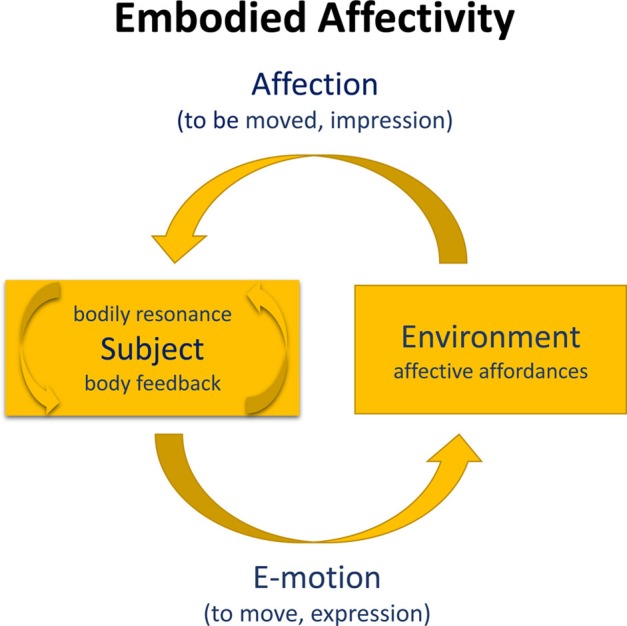
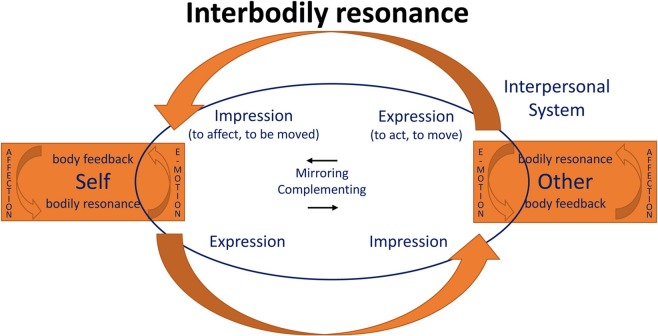
There is a growing body of research indicating that bodily sensation and behavior strongly influences one's emotional reaction toward certain situations or objects. On this background, a framework model of embodied affectivity is suggested: we regard emotions as resulting from the circular interaction between affective qualities or affordances in the environment and the subject's bodily resonance, be it in the form of sensations, postures, expressive movements or movement tendencies. Motion and emotion are thus intrinsically connected: one is moved by movement (perception; impression; affection) and moved to move (action; expression; e-motion). Through its resonance, the body functions as a medium of emotional perception: it colors or charges self-experience and the environment with affective valences while it remains itself in the background of one's own awareness. This model is then applied to emotional social understanding or interaffectivity which is regarded as an intertwinement of two cycles of embodied affectivity, thus continuously modifying each partner's affective affordances and bodily resonance. We conclude with considerations of how embodied affectivity is altered in psychopathology and can be addressed in psychotherapy of the embodied self.
Keywords: affect; body feedback; embodied intersubjectivity; embodied therapies; embodiment; emotion; interaffectivity; psychopathology.
Figures
References
-
- Boettinger B. (2012). Embodied Affectivity. Unpublished thesis, Heidelberg: Available online at: http://www.researchgate.net/profile/Boris_Boettinger/publication/2356358...
-
- Bourdieu P. (1990). Structures, habitus, practices, in The Logic of Practice, ed Bourdieu P. (Stanford, CA: Stanford University Press; ), 52–79
-
- Caldwell C. (2012). Sensation, movement and emotion. Explicit procedures for implicit memories, in Body Memory, Metaphor and Movement, eds Koch S. C., Fuchs T., Summa M., Müller C. (Amsterdam: John Benjamins; ), 255–265 10.1075/aicr.84.20cal - DOI
LinkOut - more resources
Full Text Sources
Other Literature Sources
