


Excimer laser refractive surgery versus phakic intraocular lenses for the correction of moderate to high myopia
- PMID: 24937100
- PMCID: PMC10726981
- DOI: 10.1002/14651858.CD007679.pub4
Excimer laser refractive surgery versus phakic intraocular lenses for the correction of moderate to high myopia
Abstract
Background: Myopia is a condition in which the focusing power (refraction) of the eye is greater than that required for clear distance vision. There are two main types of surgical correction for moderate to high myopia; excimer laser and phakic intraocular lenses (IOLs). Excimer laser refractive surgery for myopia works by removing corneal stroma to lessen the refractive power of the cornea and to bring the image of a viewed object into focus onto the retina rather than in front of it. Phakic IOLs for the treatment of myopia work by diverging light rays so that the image of a viewed object is brought into focus onto the retina rather than in front of the retina. They can be placed either in the anterior chamber of the eye in front of the iris or in the posterior chamber of the eye between the iris and the natural lens.
Objectives: To compare excimer laser refractive surgery and phakic IOLs for the correction of moderate to high myopia by evaluating postoperative uncorrected visual acuity, refractive outcome, potential loss of best spectacle corrected visual acuity (BSCVA) and the incidence of adverse outcomes.
Search methods: We searched CENTRAL (which contains the Cochrane Eyes and Vision Group Trials Register) (2014, Issue 1), Ovid MEDLINE, Ovid MEDLINE In-Process and Other Non-Indexed Citations, Ovid MEDLINE Daily, Ovid OLDMEDLINE (January 1946 to February 2014), EMBASE (January 1980 to February 2014), the metaRegister of Controlled Trials (mRCT) (www.controlled-trials.com), ClinicalTrials.gov (www.clinicaltrials.gov) and the World Health Organization (WHO) International Clinical Trials Registry Platform (ICTRP) (www.who.int/ictrp/search/en). We did not use any date or language restrictions in the electronic searches for trials. We last searched the electronic databases on 11 February 2014.
Selection criteria: We included randomised controlled trials (RCTs) comparing excimer laser refractive surgery and phakic IOLs for the correction of myopia greater than 6.0 diopters (D) spherical equivalent.
Data collection and analysis: Two authors independently assessed trial quality and extracted data. We performed data analysis. We summarised data for outcomes using odds ratios. We used a fixed-effect model as only three trials were included in the review.
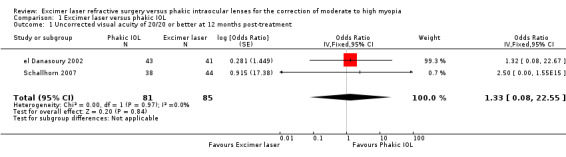
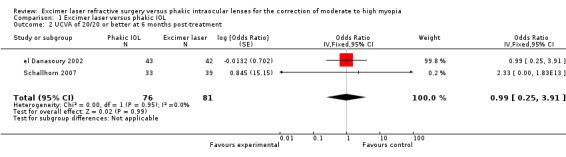
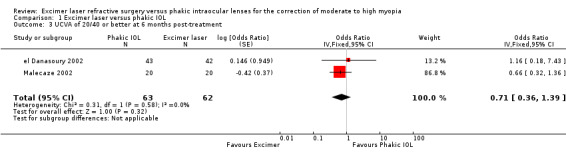
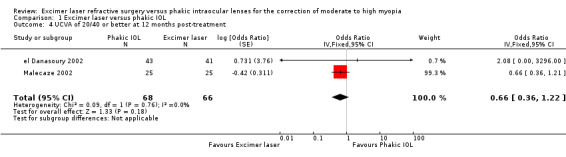
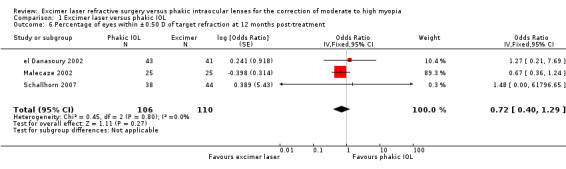
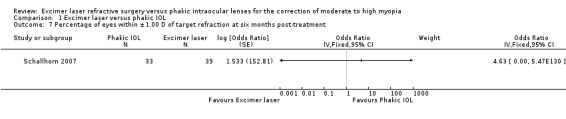
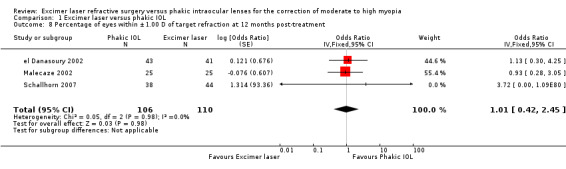
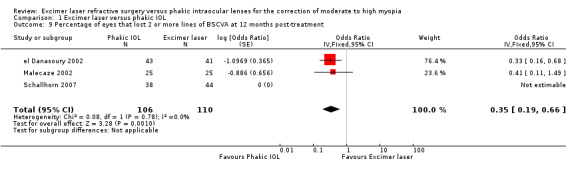
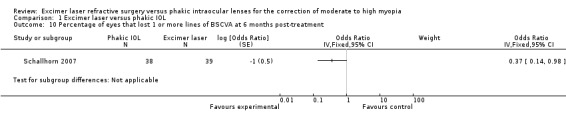
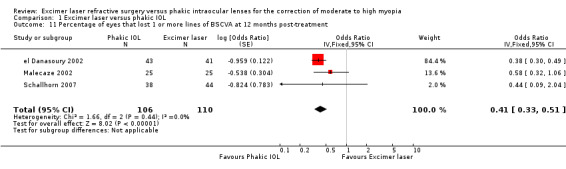
Main results: This review included three RCTs with a total of 228 eyes. The range of myopia of included patients was -6.0 D to -20.0 D of myopia with up to 4.0 D of myopic astigmatism. The percentage of eyes with uncorrected visual acuity (UCVA) of 20/20 or better at 12 months postoperative was not significantly different between the two groups. Phakic IOL surgery was safer than excimer laser surgical correction for moderate to high myopia as it results in significantly less loss of best spectacle corrected visual acuity (BSCVA) at 12 months postoperatively. However there is a low risk of developing early cataract with phakic IOLs. Phakic IOL surgery appears to result in better contrast sensitivity than excimer laser correction for moderate to high myopia. Phakic IOL surgery also scored more highly on patient satisfaction/preference questionnaires.
Authors' conclusions: The results of this review suggest that, at one year post surgery, phakic IOLs are safer than excimer laser surgical correction for moderate to high myopia in the range of -6.0 to -20.0 D and phakic IOLs are preferred by patients. While phakic IOLs might be accepted clinical practice for higher levels of myopia (greater than or equal to 7.0 D of myopic spherical equivalent with or without astigmatism), it may be worth considering phakic IOL treatment over excimer laser correction for more moderate levels of myopia (less than or equal to 7.0 D of myopic spherical equivalent with or without astigmatism). Further RCTs adequately powered for subgroup analysis are necessary to further elucidate the ideal range of myopia for phakic IOLs. This data should be considered alongside comparative data addressing long-term safety as it emerges.
Conflict of interest statement
None
Figures
Update of
-
Excimer laser refractive surgery versus phakic intraocular lenses for the correction of moderate to high myopia.Cochrane Database Syst Rev. 2012 Jan 18;1:CD007679. doi: 10.1002/14651858.CD007679.pub3. Cochrane Database Syst Rev. 2012. Update in: Cochrane Database Syst Rev. 2014 Jun 17;(6):CD007679. doi: 10.1002/14651858.CD007679.pub4. PMID: 22258972 Updated.
Comment in
-
December consultation #6.J Cataract Refract Surg. 2015 Dec;41(12):2777-8. doi: 10.1016/j.jcrs.2015.11.031. J Cataract Refract Surg. 2015. PMID: 26796465 No abstract available.
-
December consultation #7.J Cataract Refract Surg. 2015 Dec;41(12):2778. doi: 10.1016/j.jcrs.2015.11.032. J Cataract Refract Surg. 2015. PMID: 26796467 No abstract available.
-
December consultation #8.J Cataract Refract Surg. 2015 Dec;41(12):2778. doi: 10.1016/j.jcrs.2015.11.033. J Cataract Refract Surg. 2015. PMID: 26796468 No abstract available.
References
References to studies included in this review
el Danasoury 2002 {published data only}
-
- Danasoury MA, Maghraby A, Gamali TO. Comparison of iris‐fixed Artisan lens implantation with excimer laser in situ keratomileusis in correcting myopia between ‐9.00 and ‐19.50 diopters: a randomized study. Ophthalmology 2002;109(5):955‐64. - PubMed
Malecaze 2002 {published data only}
-
- Malecaze FJ, Hulin H, Bierer P, Fournie P, Grandjean H, Thalamas C, et al. A randomized paired eye comparison of two techniques for treating moderately high myopia: LASIK and artisan phakic lens. Ophthalmology 2002;109(9):1622‐30. - PubMed
Schallhorn 2007 {published data only}
-
- Schallhorn S, Tanzer D, Sanders DR, Sanders ML. Randomized prospective comparison of visian toric implantable collamer lens and conventional photorefractive keratectomy for moderate to high myopic astigmatism. Journal of Refractive Surgery 2007;23(9):853‐67. - PubMed
References to studies excluded from this review
Albarran‐Diego 2012 {published data only}
-
- Albarrán‐Diego C, Muñoz G, Ferrer‐Blasco T, García‐Lázaro S, Belda‐Salmerón L. Foldable iris‐fixated phakic intraocular lens vs femtosecond laser‐assisted LASIK for myopia between ‐6.00 and ‐9.00 diopters. Journal of Refractive Surgery 2012;28(6):380‐6. - PubMed
Kamiya 2008 {published data only}
-
- Kamiya K, Shimizu K, Igarashi A, Komatsu M. Comparison of Collamer toric contact lens implantation and wavefront‐guided laser in situ keratomileusis for high myopic astigmatism. Journal of Cataract and Refractive Surgery 2008;34(10):1687‐93. - PubMed
Morara 1999 {published data only}
-
- Morara M, Scorolli LG, Scorolli L, Meduri R, Ricci R. LASIK and ICL (posterior chamber phakic lenses) for the correction of extreme myopia: A comparative study. Annali Di Ottalmologia e Clinica Oculistica 1999;125(9‐10):293‐301.
Sanders 2003 {published data only}
-
- Sanders DR, Vukich JA. Comparison of implantable contact lens and laser assisted in situ keratomileusis for moderate to high myopia. Cornea 2003;22(4):324‐31. - PubMed
Soliman 1999 {published data only}
-
- Soliman H, Maghraby A. Phakic ICL versus LASIK in treating high myopia. American Academy of Ophthalmology 1999:245.
Additional references
Chang 2006
-
- Chang DH, Davis EA. Phakic intraocular lenses. Current Opinion in Ophthalmology 2006;17(1):99‐104. - PubMed
Chow 1990
-
- Chow YC, Dhillon B, Chew PT, Chew SJ. Refractive errors in Singapore medical students. Singapore Medical Journal 1990;31(5):472‐3. - PubMed
Deeks 2011
-
- Deeks JJ, Higgins JPT, Altman DG (editors). Chapter 9: Analysing data and undertaking meta‐analyses. In: Higgins JPT, Green S (editors). Cochrane Handbook for Systematic Reviews of Interventions Version 5.1.0 (updated March 2011). The Cochrane Collaboration, 2011. Available from www.cochrane‐handbook.org.
Duffey 2004
-
- Duffy RJ, Leaming D. Trends in refractive surgery in the United States. Journal of Cataract and Refractive Surgery 2004;30(8):1781‐5. - PubMed
el Danasoury 1998
-
- Danasoury MA. Prospective bilateral study of night glare after laser in situ keratomileusis with single zone and transition zone ablation. Journal of Refractive Surgery 1998;14(5):512‐6. - PubMed
Espandar 2008
-
- Espandar L, Meyer JJ, Moshirfar M. Phakic intraocular lenses. Current Opinion in Ophthalmology 2008;19(4):349‐56. - PubMed
FDA 1997
-
- FDA. Discussion points for expansion of the “Checklist of Information Usually Submitted in an Investigational Device Exemption (IDE) Application for Refractive Surgery Lasers” draft document. www.fda.gov/medicaldevices/deviceregulationandguidance/guidancedocuments... (accessed 18 November 2008).
Glanville 2006
Kempen 2004
-
- Kempen JH, Mitchell P, Lee KE, Tielsch JM, Broman AT, Taylor HR, et al. The prevalence of refractive errors among adults in the United States, Western Europe, and Australia. Archives of Ophthalmology 2004;122(4):495‐505. - PubMed
Knorz 1998
-
- Knorz MC, Wiesinger B, Liermann A, Seiberth V, Liesenhoff H. Laser In situ keratomileusis for moderate and high myopia and myopic astigmatism. Ophthalmology 1998;105(5):932‐40. - PubMed
Mutti 1996
-
- Mutti DO, Zadnik K, Adams AJ. Myopia. The nature versus nurture debate goes on. Investigative Ophthalmology and Visual Science 1996;37(6):952‐7. - PubMed
Pararajasegaram 1999
-
- Pararajasegaram R. Vision 2020‐the right to sight: from strategies to action. American Journal of Ophthalmology 1999;128(3):359‐60. - PubMed
Rajan 1995
-
- Rajan U, Tan FT, Chan TK. Increasing prevalence of myopia in Singapore school children. Proceedings of the Fifth International Conference on Myopia. New York: Myopia Research Foundation, 1995:41‐6.
Randleman 2008
-
- Randleman JB, Woodward M, Lynn MJ, Stulting RD. Risk assessment for ectasia after corneal refractive surgery. Ophthalmology 2008;115(1):37‐50. - PubMed
RevMan 2012 [Computer program]
-
- The Nordic Cochrane Centre, The Cochrane Collaboration. Review Manager (RevMan). Version 5.2. Copenhagen: The Nordic Cochrane Centre, The Cochrane Collaboration, 2012.
Seiler 1998
-
- Seiler T, Koufala K, Richter G. Iatrogenic keratectasia after laser in situ keratomileusis. Journal of Refractive Surgery 1998;14(3):312‐7. - PubMed
Sorsby 1960
Sperduto 1983
-
- Sperduto RD, Seigel D, Roberts J, Rowland M. Prevalence of myopia in the United States. Archives of Ophthalmology 1983;101(3):405‐7. - PubMed
Stulting 1999
-
- Stulting RD, Carr JD, Thompson KP, Waring GO 3rd, Wiley WM, Walker JG. Complications of laser in situ keratomileusis for the correction of myopia. Ophthalmology 1999;106(1):13‐20. - PubMed
Tay 1992
-
- Tay MT, Au Eong KG, Ng CY, Lim MK. Myopia and educational attainment in 421,116 young Singaporean males. Annals of the Academy of Medicine, Singapore 1992;21(6):785‐91. - PubMed
Wong 2000
-
- Wong TY, Foster PJ, Hee J, Ng TP, Tielsch JM, Chew SJ, et al. Prevalence and risk factors for refractive errors in an adult Chinese population in Singapore. Investigative Ophthalmology and Visual Science 2000;41(9):2486‐94. - PubMed
References to other published versions of this review
Barsam 2008
Publication types
MeSH terms
LinkOut - more resources
Full Text Sources
Other Literature Sources
Research Materials
