Comment
. 2014 Jul;124(7):2850-3.
doi: 10.1172/JCI76628. Epub 2014 Jun 17.

Cardiac fibroblasts in pressure overload hypertrophy: the enemy within?

Comment

Cardiac fibroblasts in pressure overload hypertrophy: the enemy within?

Nenad Bursac. J Clin Invest. 2014 Jul.

Abstract

Cardiac fibroblasts have been long recognized as active participants in heart disease; however, their exact physiological and pathological roles remain elusive, mainly due to the lack of specific markers. In this issue of the JCI, Moore-Morris and colleagues used a fibroblast-specific collagen1a1-GFP reporter to demonstrate that fibroblast accumulation after aortic banding in murine hearts arises almost exclusively from proliferation of resident fibroblasts originating from both the epicardium and a previously unrecognized source, the endocardium. Further characterization of fibroblast origin and function in different types and stages of heart disease could lead to development of improved fibroblast-targeted cardiac therapies.


Figures
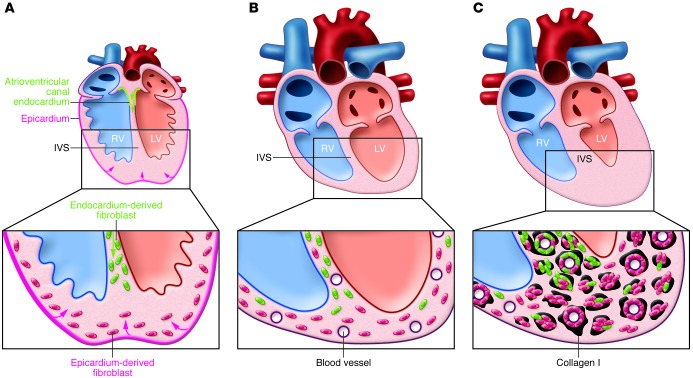
Figure 1
Figure 1. Cardiac fibroblasts in developing, adult, and pressure overloaded hearts.
(A) In the embryonic heart, most fibroblasts are derived from epicardium (pink). The fibroblast lineage described by Moore-Morris et al. is generated from the atrioventricular canal endocardium (green) and migrates down the IVS. (B) In the adult heart, the dominant fraction of fibroblasts (∼90%) in the RV and LV are of epicardial origin, while 64% of fibroblasts in the IVS derive from the endocardium. (C) In response to pressure overload, the heart becomes hypertrophic and undergoes fibrosis. In response to pressure overload, both epicardium-derived and endocardium-derived fibroblast lineages proliferate and accumulate in interstitial and perivascular regions along with collagen I (black). The LV undergoes more fibrosis than the RV. Endocardium-derived fibroblasts participate in perivascular fibrosis in the IVS but not in the LV or RV. These two resident lineages account for approximately 95% of fibroblasts in the healthy and pressure-overloaded ventricles.

Comment on

  • Resident fibroblast lineages mediate pressure overload-induced cardiac fibrosis.
    Moore-Morris T, Guimarães-Camboa N, Banerjee I, Zambon AC, Kisseleva T, Velayoudon A, Stallcup WB, Gu Y, Dalton ND, Cedenilla M, Gomez-Amaro R, Zhou B, Brenner DA, Peterson KL, Chen J, Evans SM. Moore-Morris T, et al. J Clin Invest. 2014 Jul;124(7):2921-34. doi: 10.1172/JCI74783. Epub 2014 Jun 17. J Clin Invest. 2014. PMID: 24937432 Free PMC article.

References

    1. Souders CA, Bowers SL, Baudino TA. Cardiac fibroblast: the renaissance cell. Circ Res. 2009;105(12):1164–1176. doi: 10.1161/CIRCRESAHA.109.209809. - DOI - PMC - PubMed
    1. Snider P, Standley KN, Wang J, Azhar M, Doetschman T, Conway SJ. Origin of cardiac fibroblasts and the role of periostin. Circ Res. 2009;105(10):934–947. doi: 10.1161/CIRCRESAHA.109.201400. - DOI - PMC - PubMed
    1. Biernacka A, Frangogiannis NG. Aging and cardiac fibrosis. Aging Dis. 2011;2(2):158–173. - PMC - PubMed
    1. Hirsch E, Nagai R, Thum T. Heterocellular signalling and crosstalk in the heart in ischaemia and heart failure. Cardiovasc Res. 2014;102(2):191–193. doi: 10.1093/cvr/cvu073. - DOI - PubMed
    1. Sadoshima J, Weiss JN. Cardiac fibroblasts: The good, the bad, the ugly, the beautiful. J Mol Cell Cardiol. 2014;70:1. doi: 10.1016/j.yjmcc.2014.03.009. - DOI - PMC - PubMed

Publication types
