. 2014 Aug 12;111(4):781-9.
doi: 10.1038/bjc.2014.337. Epub 2014 Jun 17.

DNA methylation status is more reliable than gene expression at detecting cancer in prostate biopsy

Affiliations

DNA methylation status is more reliable than gene expression at detecting cancer in prostate biopsy

A Paziewska et al. Br J Cancer. .

Abstract

Background: We analysed critically the potential usefulness of RNA- and DNA-based biomarkers in supporting conventional histological diagnostic tests for prostate carcinoma (PCa) detection.

Methods: Microarray profiling of gene expression and DNA methylation was performed on 16 benign prostatic hyperplasia (BPH) and 32 cancerous and non-cancerous prostate samples extracted by radical prostatectomy. The predictive value of the selected biomarkers was validated by qPCR-based methods using tissue samples extracted from the 58 prostates and, separately, using 227 prostate core biopsies.

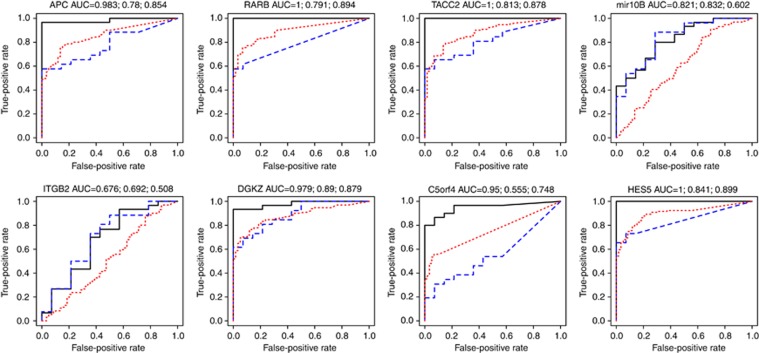
Results: HOXC6, AMACR and PCA3 expression showed the best discrimination between PCa and BPH. All three genes were previously reported as the most promising mRNA-based markers for distinguishing cancerous lesions from benign prostate lesions; however, none were sufficiently sensitive and specific to meet the criteria for a PCa diagnostic biomarker. By contrast, DNA methylation levels of the APC, TACC2, RARB, DGKZ and HES5 promoter regions achieved high discriminating sensitivity and specificity, with area under the curve (AUCs) reaching 0.95-1.0. Only a small overlap was detected between the DNA methylation levels of PCa-positive and PCa-negative needle biopsies, with AUCs ranging between 0.854 and 0.899.

Conclusions: DNA methylation-based biomarkers reflect the prostate malignancy and might be useful in supporting clinical decisions for suspected PCa following an initial negative prostate biopsy.


Figures
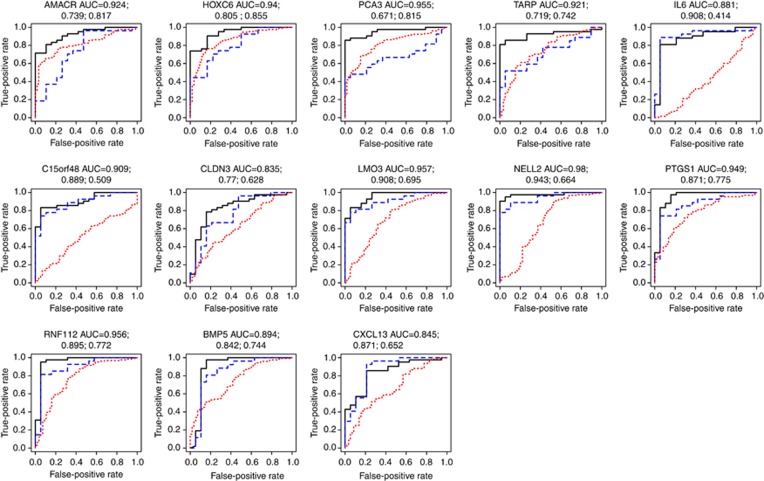
Figure 1
Figure 1
ROC (receiver operating characteristic) curves for classifiers based on single gene expression. A solid line was plotted for discovery phase sets comprising 19 BPH samples and 42 cancerous prostate samples (with low and high dysplastic cell content). A dashed blue line was plotted for BPH samples compared with 27 adjacent non-cancerous prostate samples. A dotted red line was plotted for a validation set of samples comprising 131 and 59 patients histologically diagnosed with PCa and BPH, respectively. AUC values are given in the same order. The full colour version of this figure is available at British Journal of Cancer online.
Figure 2
Figure 2
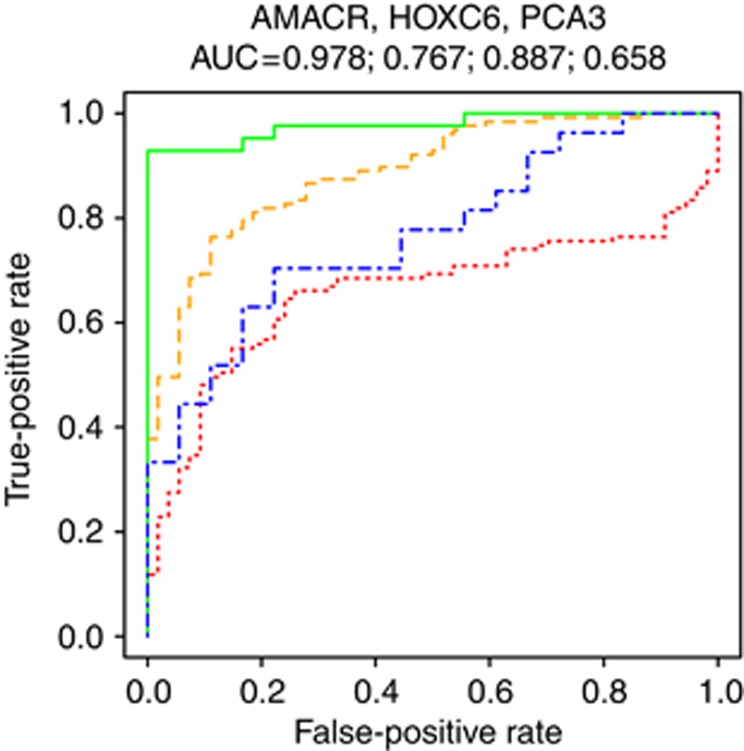
ROC (receiver operating characteristic) curves for classifiers based on linear combination of AMACR, HOXC6 and PCA3 expression. A solid green line was plotted for discovery phase sets comprising 19 BPH samples and 42 cancerous prostate samples (with low and high dysplastic cell content)—version 1. A dashed blue line was plotted for BPH samples compared with 27 adjacent non-cancerous prostate samples—version 2. A dashed yellow line was plotted for a validation set of samples comprising 131 and 59 patients histologically diagnosed with PCa and BPH, respectively, fitted with parameters from version 1 model. A dotted red line was plotted for validation set of samples fitted with parameters from version 2 model. AUC values are given in the same order.
Figure 3
Figure 3
ROC (receiver operating characteristic) curves for classifiers based on single gene methylation. A solid line was plotted for discovery phase sets comprising 14 BPH samples and 30 cancerous prostate samples (with low and high dysplastic cell content, respectively). A dashed blue line was plotted for BPH samples compared with 26 adjacent non-cancerous prostate samples. A dotted red line was plotted for a validation set of samples consisting of 131 and 59 patients histologically diagnosed with PCa and BPH, respectively. AUC values are given in the same order. The full colour version of this figure is available at British Journal of Cancer online.
Figure 4
Figure 4
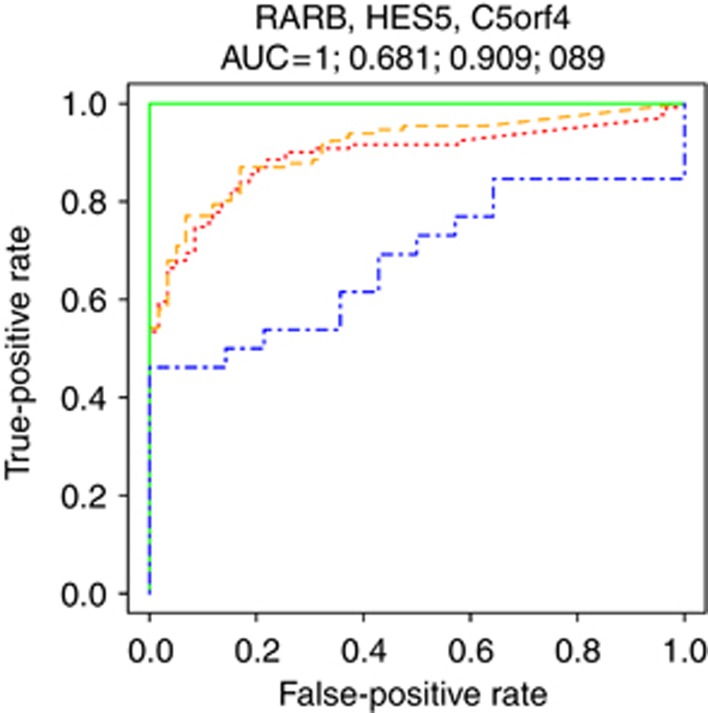
ROC (receiver operating characteristic) curves for classifiers based on linear combination of RARB, HES5 and C5orf4 methylation. A solid green line was plotted for discovery phase sets comprising 14 BPH samples and 30 cancerous prostate samples (with low and high dysplastic cell content)—version 1. A dashed blue line was plotted for BPH samples compared with 26 adjacent non-cancerous prostate samples—version 2. A dashed yellow line was plotted for a validation set of samples comprising 131 and 59 patients histologically diagnosed with PCa and BPH, respectively, fitted with parameters from version 1 model. A dotted red line was plotted for validation set of samples fitted with parameters from version 2 model. AUC values are given in the same order.

References

    1. Altintas DM, Allioli N, Decaussin M, de Bernard S, Ruffion A, Samarut J, Vlaeminck-Guillem V. Differentially expressed androgen-regulated genes in androgen-sensitive tissues reveal potential biomarkers of early prostate cancer. PLoS One. 2013;8:e66278. - PMC - PubMed
    1. Anastasiadis A, Zapała L, Cordeiro E, Antoniewicz A, Dimitriadis G, De Reijke T. Complications of prostate biopsy. Expert Rev Anticancer Ther. 2013;13:829–837. - PubMed
    1. Babaian RJ, Toi A, Kamoi K, Troncoso P, Sweet J, Evans R, Johnston D, Chen M. A comparative analysis of sextant and an extended 11-core multisite directed biopsy strategy. J Urol. 2000;163:152–157. - PubMed
    1. Bhavsar T, McCue P, Birbe R. Molecular diagnosis of prostate cancer: are we up to age. Semin Oncol. 2013;40:259–275. - PubMed
    1. Bradford TJ, Tomlins SA, Wang X, Chinnaiyan AM. Molecular markers of prostate cancer. Urol Oncol. 2006;24:538–551. - PubMed

Publication types

MeSH terms