


Cutaneous melanoma in the State of São Paulo: a spatial approach
- PMID: 24937818
- PMCID: PMC4056702
- DOI: 10.1590/abd1806-4841.20142722
Cutaneous melanoma in the State of São Paulo: a spatial approach
Abstract
Background: Cutaneous melanoma is a skin cancer with low incidence but high mortality rates. Several factors are associated with increased risk of melanoma, such as excessive sun exposure, fair skin, and family history, among others. Little is known about the spatial distribution of this cancer in Brazil.
Objective: To identify, through the use of geostatistical tools, spatial clusters of municipalities in the state of São Paulo based on their incidence of cutaneous melanoma.
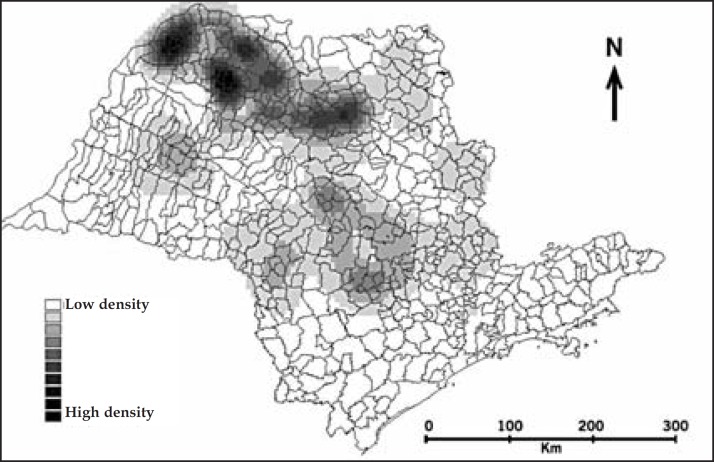
Methods: This was an ecological and exploratory study of data on new cases obtained from Fundação Oncocentro for the period 1 January 2006-31 December 2011. Cases were separated by gender and rates per 100,000 inhabitants were calculated and used to compile thematic maps, Moran maps and kernel maps, using TerraView software.
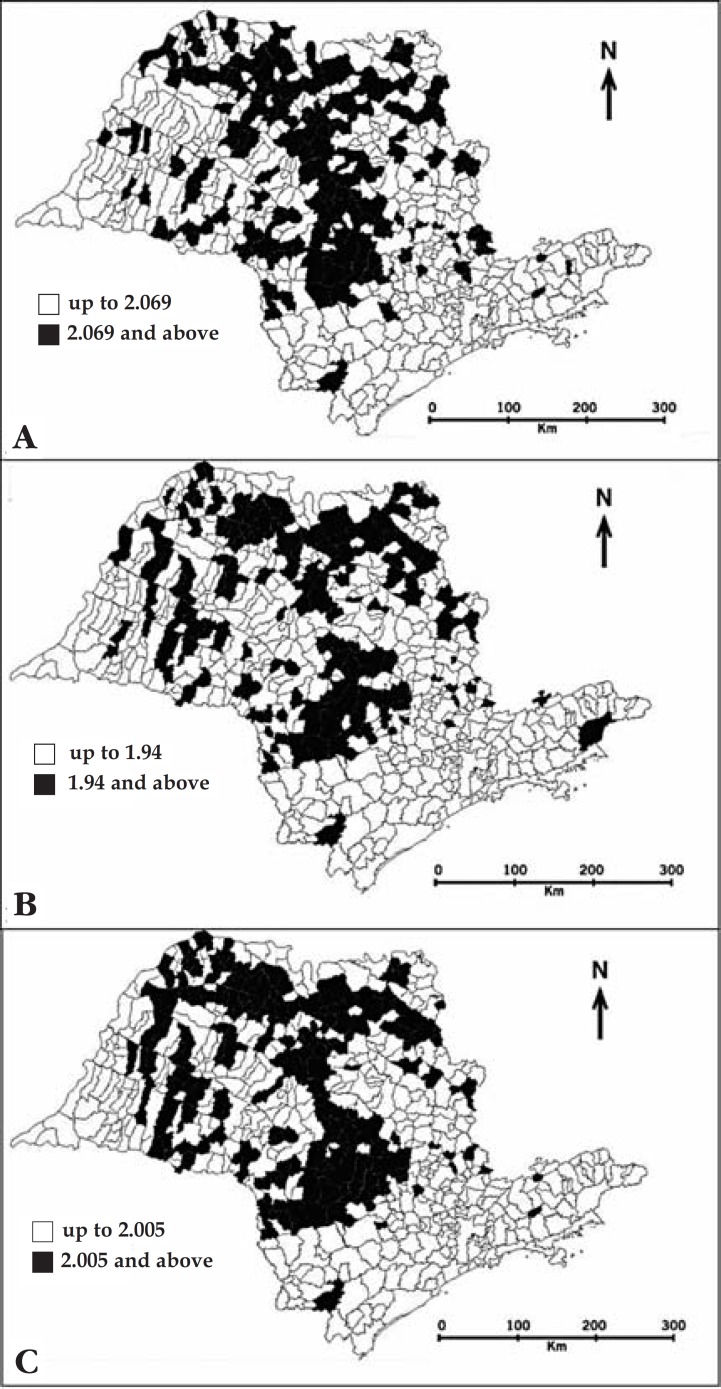
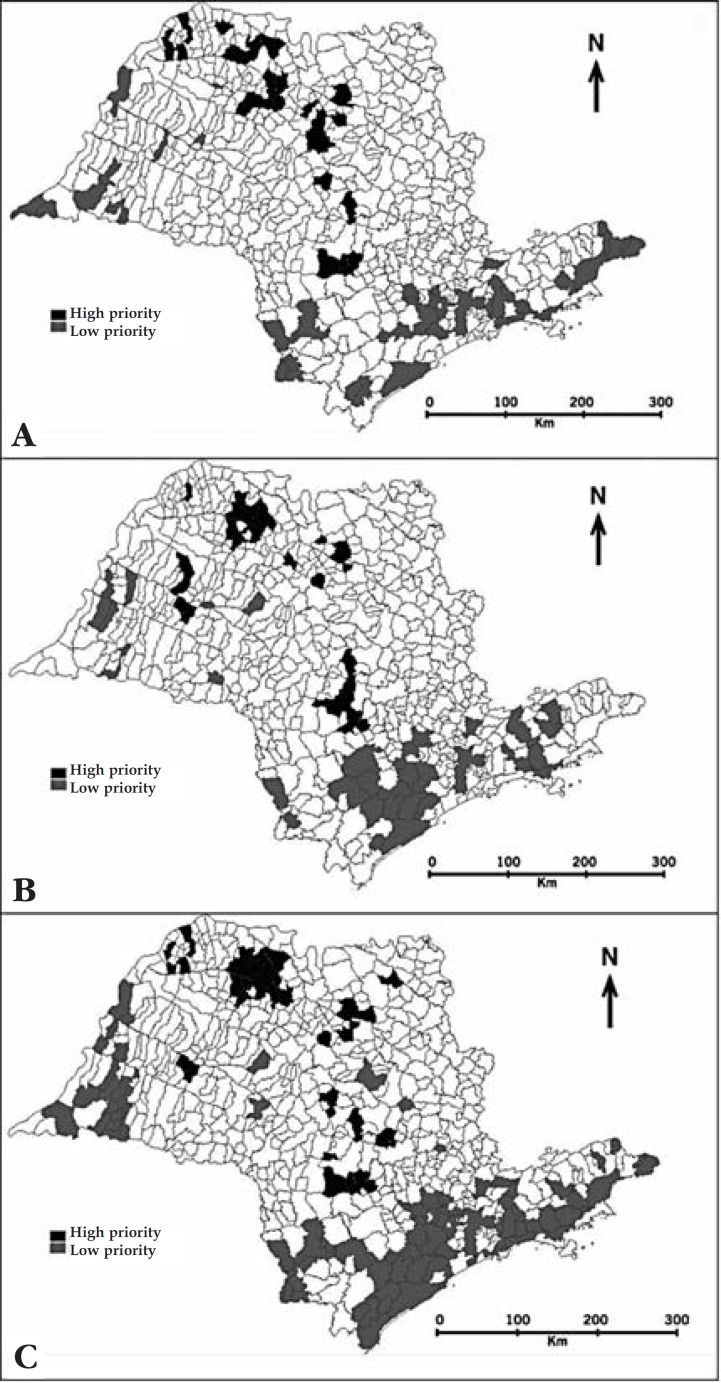
Results: There were 3,172 new cases of cutaneous melanoma in the study period. High rates were identified in the North, Northwest, Southwest, and Southeast regions of São Paulo state. Global Moran's I values were statistically significant (p<0.05) at 0.12, 0.08, and 0.16, respectively, for males, females, and all cases. Areas such as the Southeast, North, and Northwest of São Paulo were identified as being of high priority for intervention.
Conclusion: Spatial clusters of municipalities with high incidence rates of cutaneous melanoma in the state of São Paulo were identified. These data can serve as an important input for public health agencies.
Conflict of interest statement
Conflict of Interest: None
Figures
References
-
- Inca.gov.br [acesso 10 dez 2012];Ministério da Saúde. Instituto Nacional do Câncer. O que é. [Internet] Disponível em: http://www2.inca.gov.br/wps/wcm/connect/cancer/site/oquee.
-
- Datasus.gv.br [acesso 10 dez 2012];Informações de saúde. Epidemiológicas e Morbidade. ([Internet]). Disponível em: http://tabnet.datasus.gov.br/cgi/tabcgi.exe?sih/cnv/nrsp.def.
-
- Urist MM, Karnell LH. The national cancer data base -Report on melanoma. Cancer. 1994;74:782–788. - PubMed
-
- Inca.gov.br. Ministério da Saúde. Instituto Nacional do Câncer [acesso 10 Dez 2012];Estimativa 2012: Incidência de câncer no Brasil. [Internet] Disponível em: http://www.inca.gov.br/estimativa/2012/mapa.asp?ID=10.
-
- Pinheiro AMC, Friedman H, Cabral ALSV, Rodrigues HA. Melanoma: clinical, epidemiological and histopathological characteristics at the University Hospital of Brasília between January 1994 and April 1999. An Bras Dermatol. 2003;78:179–186.
MeSH terms
LinkOut - more resources
Full Text Sources
Other Literature Sources
Medical