Comparative Study
. 2014 Dec;15(6):1398-409.
doi: 10.1208/s12249-014-0167-y. Epub 2014 Jun 18.

Glass delamination: a comparison of the inner surface performance of vials and pre-filled syringes

Affiliations
Comparative Study

Glass delamination: a comparison of the inner surface performance of vials and pre-filled syringes

Jianxiu Zhao et al. AAPS PharmSciTech. 2014 Dec.

Abstract

The occurrence of glass delamination is a serious concern for parenteral drug products. Over the past several years, there has been a series of product recalls involving glass delamination in parenteral drugs stored in vials which has led to heightened industry and regulatory scrutiny. In this study, a two-pronged approach was employed to assess the inner surface durability of vials and pre-filled syringes. Non-siliconized syringes were used in order to directly compare glass to glass performance between vials and syringes. The vial and syringe performance was screened with pharmaceutically relevant formulation conditions. The influence of pH, buffer type, ionic strength, and glass type and source was evaluated. In addition, an aggressive but discriminating formulation condition (glutaric acid, pH 11) was used to ascertain the impact of syringe processing. Advanced analytical tools including inductively coupled plasma/mass spectrometry, scanning electron microscopy, atomic force microscopy, and dynamic secondary ion mass spectroscopy showed significant differences in glass performance between vials and syringes. Pre-filled syringes outperform vials for most tests and conditions. The manufacturing conditions for vials lead to glass defects, not found in pre-filled syringes, which result in a less chemically resistant surface. The screening methodology presented in this work can be applied to assess suitability of primary containers for specific drug applications.


Figures
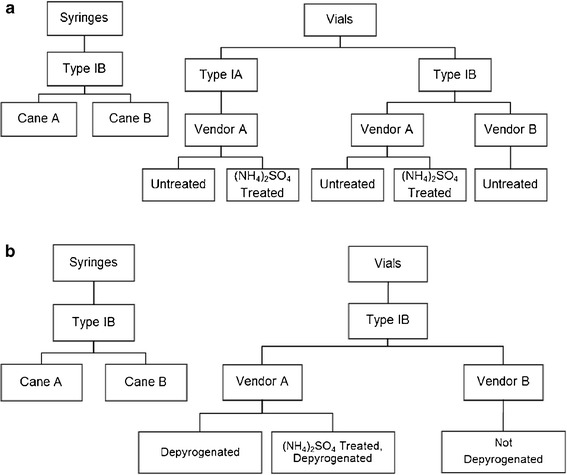
Fig. 1
Fig. 1
Container selection for the formulation study using 1-mL-long PFS and 2-mL vials (a) and the glutaric acid study using 1-mL-long PFS, 2-mL vials from Vendor A, and 6-mL vials from Vendor B (b)
Fig. 2
Fig. 2
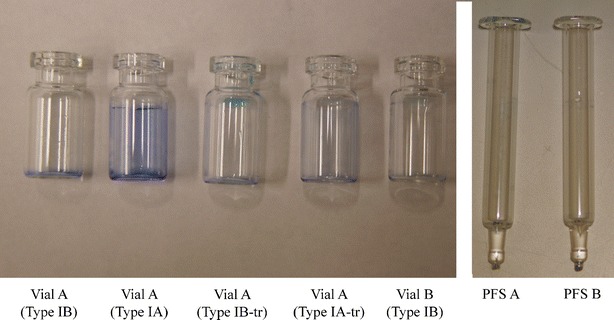
Representative methylene blue staining images of containers filled with pH 7.5 phosphate with NaCl and exposed to 3 autoclave cycles and 1-month storage at 40°C/75% RH
Fig. 3
Fig. 3
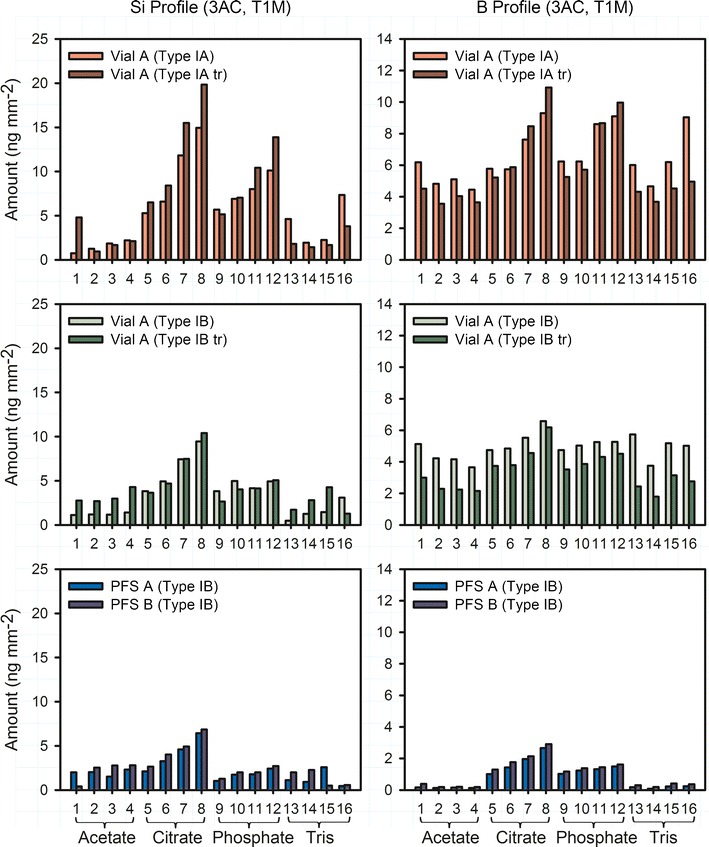
Profiles of dissolved Si and B for PFS and vials after 3 autoclave cycles and 1-month storage at 40°C/75% RH. The buffers used include (1) pH 4.5 acetate, (2) pH 4.5 acetate with NaCl, (3) pH 5.5 acetate, (4) pH 5.5 acetate with NaCl, (5) pH 5.5 citrate, (6) pH 5.5 citrate with NaCl, (7) pH 6.5 citrate, (8) pH 6.5 citrate with NaCl, (9) pH 6.5 phosphate, (10) pH 6.5 phosphate with NaCl, (11) pH 7.5 phosphate, (12) pH 7.5 phosphate with NaCl, (13) pH 7.5 Tris, (14) pH 7.5 Tris with NaCl, (15) pH 8.5 Tris, and (16) pH 8.5 Tris with NaCl
Fig. 4
Fig. 4
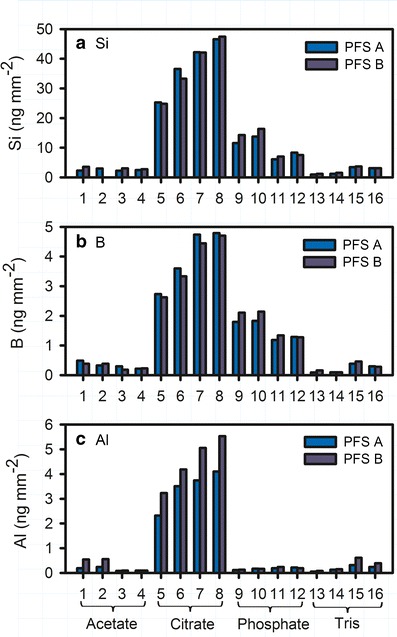
Profiles of dissolved Si (a), B (b), Al (c) for PFS after 1 autoclave cycle and 6-month storage at 40°C/75% RH. The buffers used include (1) pH 4.5 acetate, (2) pH 4.5 acetate with NaCl, (3) pH 5.5 acetate, (4) pH 5.5 acetate with NaCl, (5) pH 5.5 citrate, (6) pH 5.5 citrate with NaCl, (7) pH 6.5 citrate, (8) pH 6.5 citrate with NaCl, (9) pH 6.5 phosphate, (10) pH 6.5 phosphate with NaCl, (11) pH 7.5 phosphate, (12) pH 7.5 phosphate with NaCl, (13) pH 7.5 Tris, (14) pH 7.5 Tris with NaCl, (15) pH 8.5 Tris, and (16) pH 8.5 Tris with NaCl
Fig. 5
Fig. 5
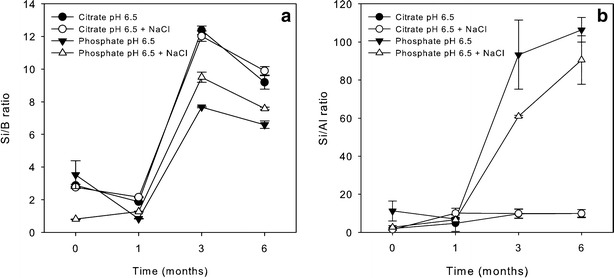
The Si/B ratio (a) and Si/Al ratio (b) over time for PFS stored at 40°C/75% RH after 1 cycle of autoclave
Fig. 6
Fig. 6
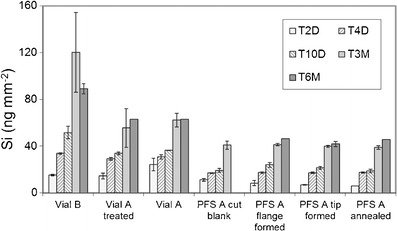
Profiles of dissolved Si for vials and PFS from different steps of the forming process after exposure to pH 11 glutaric acid at 40°C/75% RH
Fig. 7
Fig. 7
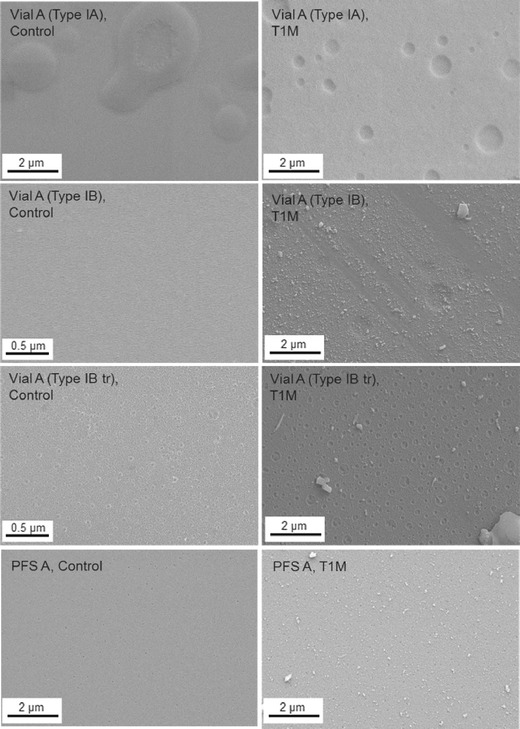
SEM images comparing Type IA and Type IB vials (treated and untreated) from Vendor A and PFS A before and after storage for 1 month at 40°C/75% RH with pH 7.5 phosphate buffer containing 150 mM NaCl. Filled samples were autoclaved for 3 cycles prior to storage
Fig. 8
Fig. 8
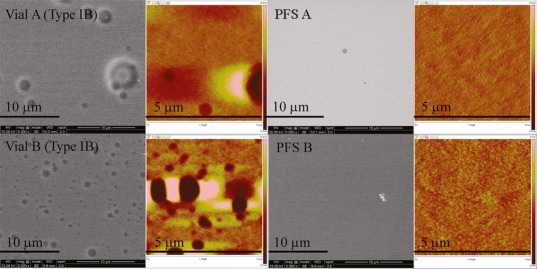
SEM (grayscale) and AFM images (color) of vials and PFS after exposure to pH 11 glutaric acid at 40°C/75% RH for 3 months. The depth scale for AFM images is from −20 to 20 nm for Vial A Type IB, −10 to 10 nm for Vial B Type IB, and −5 to 5 nm for PFS A and B
Fig. 9
Fig. 9
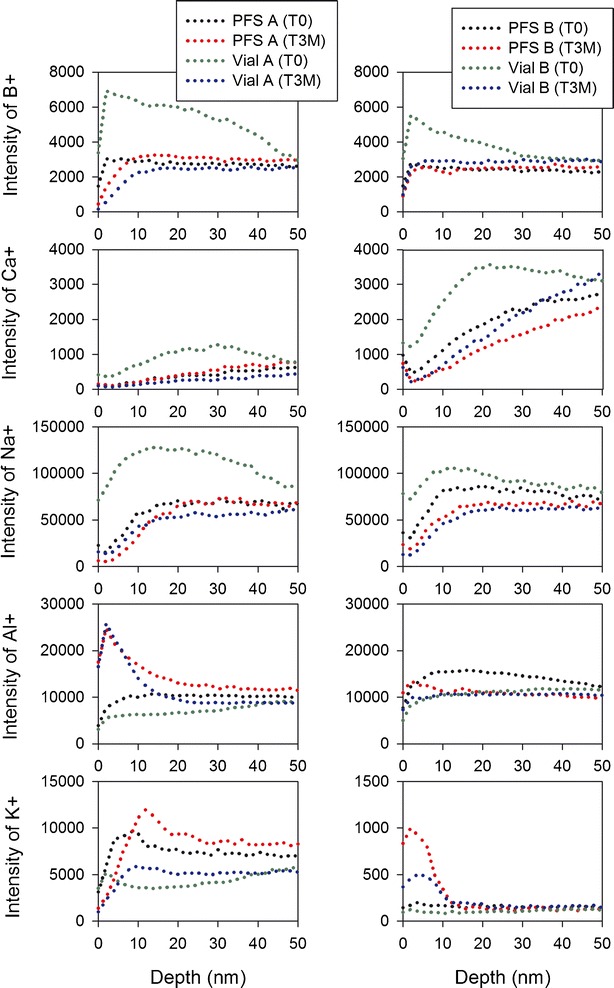
Comparison of elemental profiles for Type IB vials and PFS from both Vendor A (left) and B (right) glass prior to solution contact and after exposure to pH 11 glutaric acid at 40°C/75% RH for 3 months

References

    1. Iacocca RG, Allgeier M. Corrosive attack of glass by a pharmaceutical compound. J Mater Sci. 2007;42(3):801–811. doi: 10.1007/s10853-006-0156-y. - DOI
    1. Ennis RD, Pritchard R, Nakamura C, Coulon M, Yang TY, Visor GC, et al. Glass vials for small volume parenterals: influence of drug and manufacturing processes on glass delamination. Pharm Dev Technol. 2001;6(3):393–405. doi: 10.1081/PDT-100002248. - DOI - PubMed
    1. FDA. Advisory to drug manufacturers: formation of glass lamellae in certain injectable drugs. 2011. http://www.fda.gov/Drugs/DrugSafety/ucm248490.htm. Accessed 05 Nov 2013.
    1. Gin S, Godon N, Mestre JP, Vernaz EY. Experimental investigation of aqueous corrosion of R7T7 nuclear glass at 90°C in the presence of organic species. Appl Geochem. 1994;9(3):255–269. doi: 10.1016/0883-2927(94)90036-1. - DOI
    1. Fearn S, McPhail DS, Oakley V. Room temperature corrosion of museum glass: an investigation using low-energy SIMS. Appl Surf Sci. 2004;231–232:510–514. doi: 10.1016/j.apsusc.2004.03.205. - DOI

Publication types