


Early recognition and management of laryngeal fracture: a case report
- PMID: 24940139
- PMCID: PMC4052596
Early recognition and management of laryngeal fracture: a case report
Abstract
Background: Laryngeal fracture is a rare condition that can lead to significant problems with airway patency, voice production, and swallowing. Conflict in the literature exists regarding the most suitable way to manage this injury.
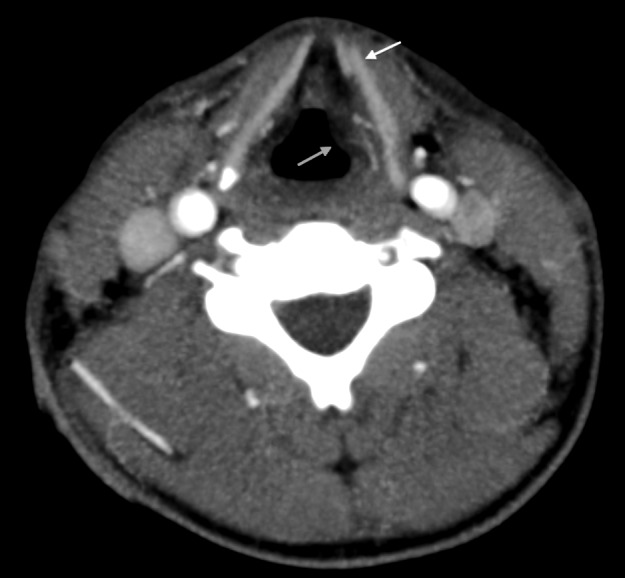
Case report: We present the case of a 29-year-old Caucasian man who sustained a displaced fracture of the thyroid cartilage due to blunt trauma. He reported no swallowing, breathing, or voice problems after 1 year, and his recovery can be attributed to the early recognition and proper management of his condition.
Conclusion: This case illustrates the importance of ensuring a high level of suspicion for laryngeal fracture in the acute trauma patient. Early identification of this injury allows early intervention that not only protects the airway but also improves long-term voice and airway outcomes.
Keywords: Intubation; laryngeal cartilages; larynx; tracheostomy; wounds–nonpenetration.
Conflict of interest statement
Figures
References
-
- Schaefer SD. The acute management of external laryngeal trauma. A 27-year experience. Arch Otolaryngol Head Neck Surg. 1992 Jun;118(6):598–604. - PubMed
-
- Bent JP 3rd, Silver JR, Porubsky ES. Acute laryngeal trauma: a review of 77 patients. Otolaryngol Head Neck Surg. 1993 Sep;109((3 Pt 1)):441–449. - PubMed
-
- Jalisi S, Zoccoli M. Management of laryngeal fractures—a 10-year experience. J Voice. 2011 Jul;25(4):473–479. Epub 2010 Mar 17. - PubMed
-
- Butler AP, Wood BP, O'Rourke AK, Porubsky ES. Acute external laryngeal trauma: experience with 112 patients. Ann Otol Rhinol Laryngol. 2005 May;114(5):361–368. - PubMed
-
- Mendelsohn AH, Sidell DR, Berke GS, John MS. Optimal timing of surgical intervention following adult laryngeal trauma. Laryngoscope. 2011 Oct;121(10):2122–2127. Epub 2011 Sep 6. - PubMed
Publication types
LinkOut - more resources
Full Text Sources