. 2014 Jun 18;15(1):485.
doi: 10.1186/1471-2164-15-485.

Identification of tubular injury microRNA biomarkers in urine: comparison of next-generation sequencing and qPCR-based profiling platforms

Affiliations

Identification of tubular injury microRNA biomarkers in urine: comparison of next-generation sequencing and qPCR-based profiling platforms

Rounak Nassirpour et al. BMC Genomics. .

Abstract

Background: MicroRNAs (miRNAs) are small, non-coding RNAs that regulate protein levels post-transcriptionally. miRNAs play important regulatory roles in many cellular processes and have been implicated in several diseases. Recent studies have reported significant levels of miRNAs in a variety of body fluids, raising the possibility that miRNAs could serve as useful biomarkers. Next-generation sequencing (NGS) is increasingly employed in biomedical investigations. Although concordance between this platform and qRT-PCR based assays has been reported in high quality specimens, information is lacking on comparisons in biofluids especially urine. Here we describe the changes in miRNA expression patterns in a rodent model of renal tubular injury (gentamicin). Our aim is to compare RNA sequencing and qPCR based miRNA profiling in urine specimen from control and rats with confirmed tubular injury.

Results: Our preliminary examination of the concordance between miRNA-seq and qRT-PCR in urine specimen suggests minimal agreement between platforms probably due to the differences in sensitivity. Our results suggest that although miRNA-seq has superior specificity, it may not detect low abundant miRNAs in urine samples. Specifically, miRNA-seq did not detect some sequences which were identified by qRT-PCR. On the other hand, the qRT-PCR analysis was not able to detect the miRNA isoforms, which made up the majority of miRNA changes detected by NGS.

Conclusions: To our knowledge, this is the first time that miRNA profiling platforms including NGS have been compared in urine specimen. miRNAs identified by both platforms, let-7d, miR-203, and miR-320, may potentially serve as promising novel urinary biomarkers for drug induced renal tubular epithelial injury.


Figures
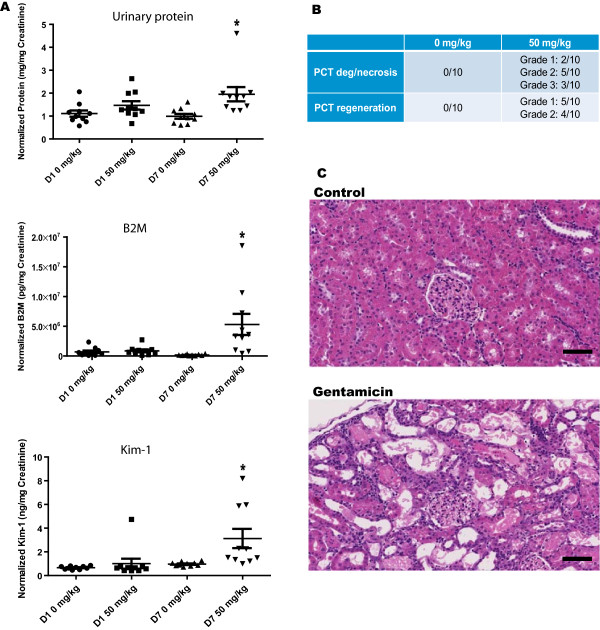
Figure 1
Figure 1
Gentamicin-induced nephrotoxicity in rats. (A) Urinary protein, β2-microglobulin (B2M), and Kim-1 (all normalized to urine creatinine), indicate tubular injury at D7 (Mean +/- SD; *denotes p value < 0.05). (B) Histopathology assessment of the kidneys revealed moderate degeneration and necrosis with evidence of regeneration of the PCT at day 7. (C) Section of kidney with moderate degeneration and necrosis of the PCT at day 7; Control (0 mg/kg/day), top and 50 mg/kg/day bottom. 10 X, H&E stain. Scale bar = 200 microns.
Figure 2
Figure 2
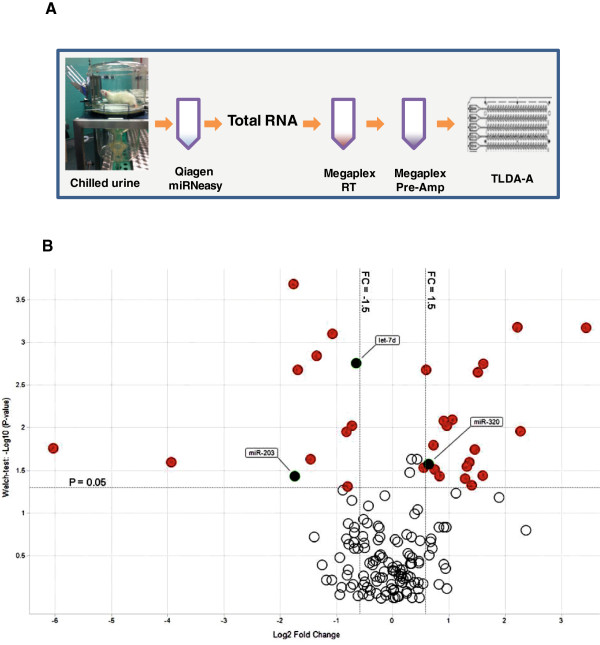
miRNA expression profiling using Taqman qRT-PCR reveals several significantly changed miRNAs in urine specimens following gentamicin induced renal injury. (A) Workflow of qRT-PCR analysis. (B) Volcano plot shows 32 miRNAs that are significantly regulated (red) at day 7 after gentamicin treatment (Welch test P-value < 0.05 and FC > 1.5 either direction). miRNAs also detected by NGS are labeled. Horizontal line: P-value 0.05; vertical lines: FC at -1.5 and 1.5. Data are normalized using lowess normalization.
Figure 3
Figure 3
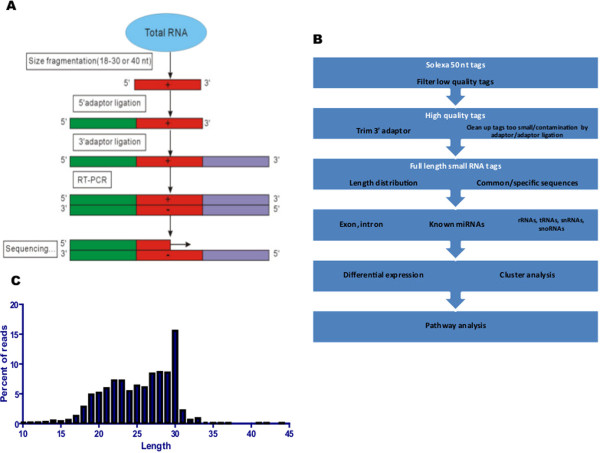
Workflow for sequencing and analysis of miRNA changes. (A) Flowchart depicting miRNA sample preparation and sequencing. After extracting the total RNA from the samples, gel select Small RNA (18 ~ 30 nt), 5' RNA adapter ligation and gel purification, 3' RNA adapter ligation and gel purification, and RT-PCR and gel purification, the library products were ready for sequencing analysis via Illumina HiSeqTM 2000. (B) Flowchart depicting bioinformatic processing and analysis. After sequencing, raw reads were cleaned by removing low quality reads and short reads. Reads were profiled by mapping them to miRBase v. 20 and other sequence databases. (C) Summary (percent) of size distribution of small RNA sequences in the urinary samples analyzed.
Figure 4
Figure 4
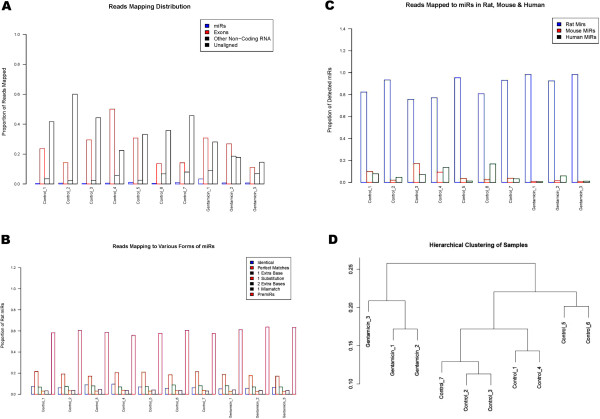
Characterization of miRNAs using NGS. (A) Y-axis represents proportion of total reads. Labels:”miRs”-Reads mapping to miRNAs from rat, mouse and human, “Exons”-Reads mapping to rat exons, “Other Non-Coding RNA”-Reads mapping to Non-coding RNA (except miRNAs), “Unaligned”-Reads that could not be aligned to rat genome. (B) Y-Axis represents proportion of the total reads that map to all rat miRNAs (mature + isomiRs). “Identical”-Reads that are identical to miRNAs, “Perfect Matches”- Reads that are shorter than miRNAs, “1 Extra Base”-Reads that have an extra base on 3’ and 5’, “1 Substitution”- Reads that have a substitution on 3’ and 5’, “2 Extra Bases”-Reads that have 2 extra bases on 3’ and 5’, “1 Mismatch”-Reads that have at most 1 mismatch (does not include the previous 1 substitution/deletion/insertion), “PremiRs”-Reads that map the precursor miRNA. (C) Y-Axis gives the proportion of all miRNAs (rat + human + mouse) with maximum value of 1. The rat, mouse and human miRNAs include mature + isomiRs including precursor miRNAs. (D) Hierarchical clustering of the samples. Spearman correlation coefficient was used and the method used was “complete”, using the maximal separation.
Figure 5
Figure 5
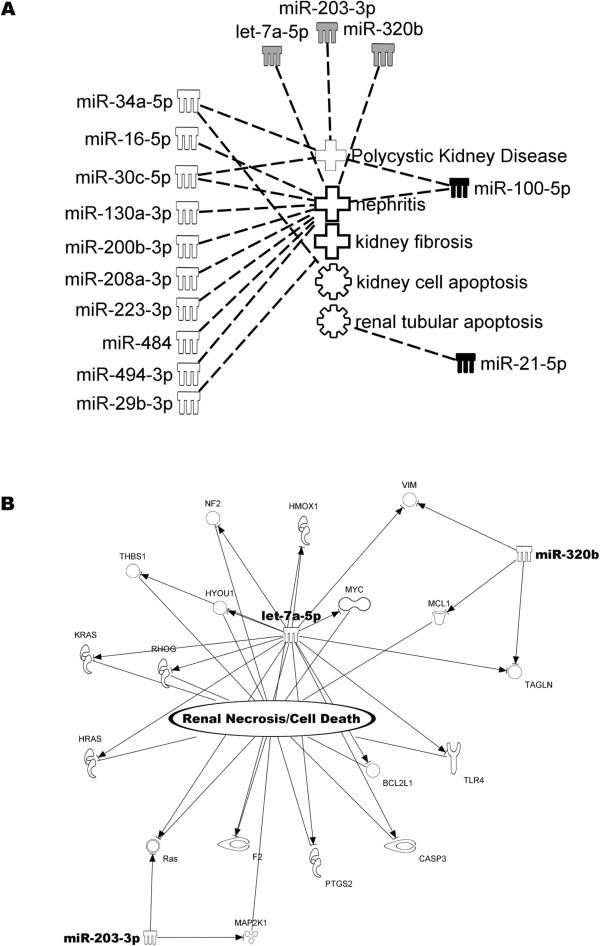
Prediction of renal functions for miRNA from qPCR and NGS. (A) Analysis of the urinary miRNAs with altered expression in gentamicin induced tubular injury reveals significant correlations with renal injury. Black filled symbols represent miRNAs identified by qPCR as significantly changed in renal injury. White filled symbols are miRNAs identified as significantly changed by NGS and the gray filled symbols are the miRNAs identified as changed in both approaches. Note that Ingenuity’s software combines miRNAs with a common seed sequence to a single identifier. (B) Potential renal disease related mRNA targets for Let-7d, miR-203, and miR-320 identified by IPA are shown.

References

    1. Vaidya VS, Ferguson MA, Bonventre JV. Biomarkers of acute kidney injury. Annu Rev Pharmacol Toxicol. 2008;48:463–493. doi: 10.1146/annurev.pharmtox.48.113006.094615. - DOI - PMC - PubMed
    1. Vaidya VS, Waikar SS, Ferguson MA, Collings FB, Sunderland K, Gioules C, Bradwin G, Matsouaka R, Betensky RA, Curhan GC, Bonventre JV. Urinary biomarkers for sensitive and specific detection of acute kidney injury in humans. Clin Translat Sci. 2008;1(3):200–208. doi: 10.1111/j.1752-8062.2008.00053.x. - DOI - PMC - PubMed
    1. Sasaki D, Yamada A, Umeno H, Kurihara H, Nakatsuji S, Fujihira S, Tsubota K, Ono M, Moriguch A, Watanabe K, Seki J. Comparison of the course of biomarker changes and kidney injury in a rat model of drug-induced acute kidney injury. Biomarkers. 2011;16(7):553–566. doi: 10.3109/1354750X.2011.613123. - DOI - PubMed
    1. Khella HWZ, Bakhet M, Lichner Z, Romaschin AD, Jewett MAS, Yousef GM. MicroRNAs in kidney disease: an emerging understanding. Am J Kidney Dis. 2013;61(5):798–808. doi: 10.1053/j.ajkd.2012.09.018. - DOI - PubMed
    1. Saal S, Harvey SJ. MicroRNAs and the kidney: coming of age. Curr Opin Nephrol Hyperten. 2009;18(4):317–323. doi: 10.1097/MNH.0b013e32832c9da2. - DOI - PubMed

MeSH terms