


Differential impact of methylphenidate and atomoxetine on sustained attention in youth with attention-deficit/hyperactivity disorder
- PMID: 24942409
- PMCID: PMC4272337
- DOI: 10.1111/jcpp.12272
Differential impact of methylphenidate and atomoxetine on sustained attention in youth with attention-deficit/hyperactivity disorder
Abstract
Background: This study examined the effects of atomoxetine (ATX) and OROS methylphenidate (MPH) on laboratory measures of inhibitory control and attention in youth with attention-deficit/hyperactivity disorder (ADHD). It was hypothesized that performance would be improved by both treatments, but response profiles would differ because the medications work via different mechanisms.
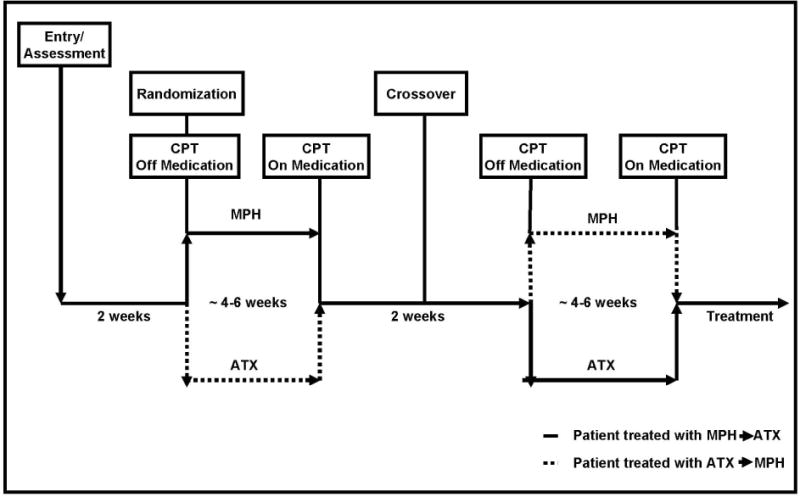
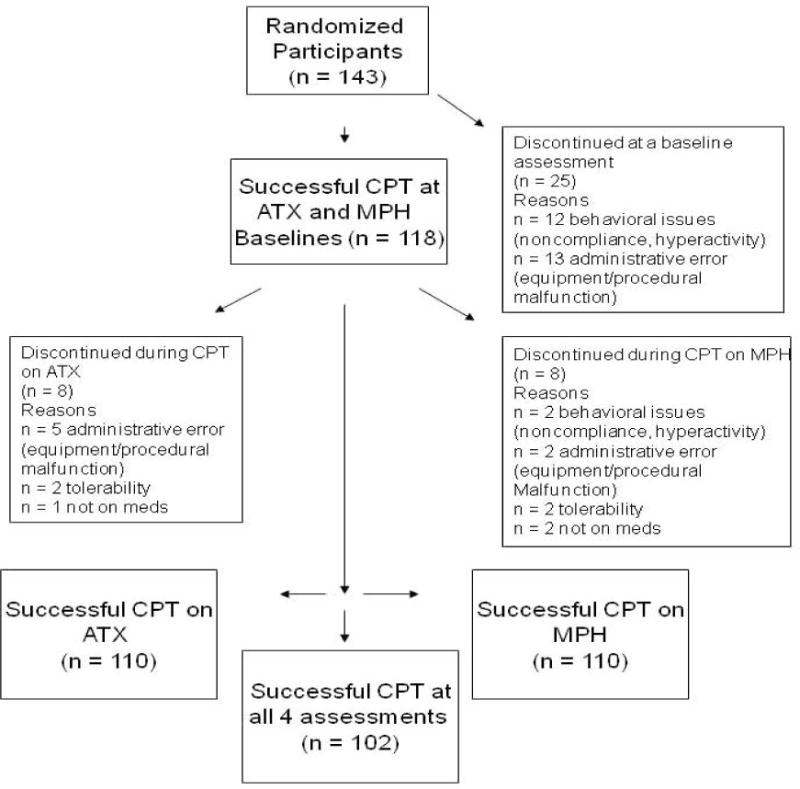
Methods: One hundred and two youth (77 male; mean age = 10.5 ± 2.7 years) with ADHD received ATX (1.4 ± 0.5 mg/kg) and MPH (52.4 ± 16.6 mg) in a randomized, double-blind, crossover design. Medication was titrated in 4-6-week blocks separated by a 2-week placebo washout. Inhibitory control and attention measures were obtained at baseline, following washout, and at the end of each treatment using Conners' Continuous Performance Test II (CPT-II), which provided age-adjusted T-scores for reaction time (RT), reaction time variability (RT variability), and errors. Repeated-measures analyses of variance were performed, with Time (premedication, postmedication) and Treatment type (ATX, MPH) entered as within-subject factors. Data from the two treatment blocks were checked for order effects and combined if order effects were not present.
Clinical trial registration: Clinicaltrials.gov: NCT00183391.
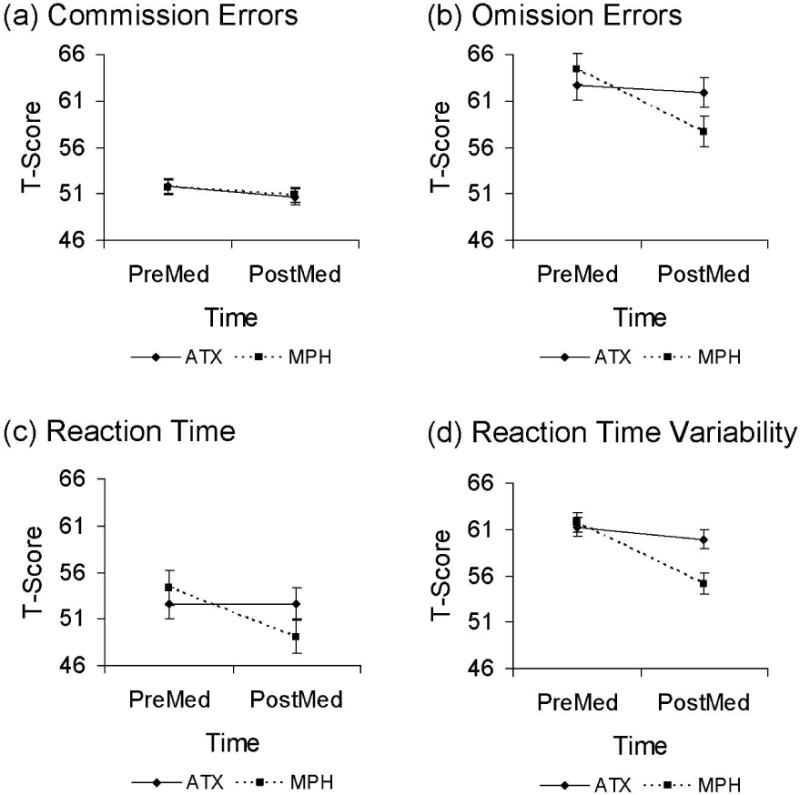
Results: Main effects for Time on RT (p = .03), RTSD (p = .001), and omission errors (p = .01) were significant. A significant Drug × Time interaction indicated that MPH improved RT, RTSD, and omission errors more than ATX (p < .05). Changes in performance with treatment did not correlate with changes in ADHD symptoms.
Conclusions: MPH has greater effects than ATX on CPT measures of sustained attention in youth with ADHD. However, the dissociation of cognitive and behavioral change with treatment indicates that CPT measures cannot be considered proxies for symptomatic improvement. Further research on the dissociation of cognitive and behavioral endpoints for ADHD is indicated.
Keywords: Attention-deficit/hyperactivity disorder; atomoxetine; attention; methylphenidate; vigilance.
© 2014 The Authors. Journal of Child Psychology and Psychiatry. © 2014 Association for Child and Adolescent Mental Health.
Conflict of interest statement
Conflict of interest statement: M.A.S. has received research support from Shire Pharmaceuticals, and is a consultant/advisor for Alcobra, GencoSciences, and Novartis. J.H.N. has received research support from Shire Pharmaceuticals; he is an advisor and/or consultant for Alcobra, BioBehavioral Diagnostics, Enzymotec, GencoSciences, Sunovion, and Shire Pharmaceuticals. The rest of the authors have declared that they have no potential or competing conflicts of interest.
Figures
References
-
- Barry RJ, Clarke AR, Hajos M, McCarthy R, Selikowitz M, Bruggemann JM. Acute atomoxetine effects on the EEG of children with attention-deficit/hyperactivity disorder. Neuropharmacology. 2009;57(7–8):702–707. doi: S0028-3908(09)00270-6 [pii] 10.1016/j.neuropharm.2009.08.003. - PubMed
-
- Bedard AC, Jain U, Johnson SH, Tannock R. Effects of methylphenidate on working memory components: influence of measurement. J Child Psychol Psychiatry. 2007;48(9):872–880. doi: JCPP1760 [pii] 10.1111/j.1469-7610.2007.01760.x. - PubMed
-
- Berridge CW, Devilbiss DM, Andrzejewski ME, Arnsten AF, Kelley AE, Schmeichel B, Spencer RC. Methylphenidate preferentially increases catecholamine neurotransmission within the prefrontal cortex at low doses that enhance cognitive function. Biol Psychiatry. 2006;60(10):1111–1120. doi: 10.1016/j.biopsych.2006.04.022. - DOI - PubMed
-
- Bolden-Watson C, Richelson E. Blockade by newly-developed antidepressants of biogenic amine uptake into rat brain synaptosomes. Life Sci. 1993;52(12):1023–1029. - PubMed
-
- Bymaster FP, Katner JS, Nelson DL, Hemrick-Luecke SK, Threlkeld PG, Heiligenstein JH, Perry KW. Atomoxetine increases extracellular levels of norepinephrine and dopamine in prefrontal cortex of rat: a potential mechanism for efficacy in attention deficit/hyperactivity disorder. Neuropsychopharmacology. 2002;27(5):699–711. doi: S0893133X02003469 [pii] 10.1016/S0893-133X(02)003469. - PubMed
Publication types
MeSH terms
Substances
Associated data
Grants and funding
LinkOut - more resources
Full Text Sources
Other Literature Sources
Medical
