


Review
doi: 10.1007/s00262-014-1568-1.
Epub 2014 Jun 19.
Engineered T cells for cancer therapy
Affiliations
- PMID: 24943274
- PMCID: PMC4142345
- DOI: 10.1007/s00262-014-1568-1
Item in Clipboard
Review
Engineered T cells for cancer therapy
Cancer Immunol Immunother.
2014 Sep.
Abstract
It is now well established that the immune system can control and eliminate cancer cells. Adoptive T cell transfer has the potential to overcome the significant limitations associated with vaccine-based strategies in patients who are often immune compromised. Application of the emerging discipline of synthetic biology to cancer, which combines elements of genetic engineering and molecular biology to create new biological structures with enhanced functionalities, is the subject of this focused research review.
Conflict of interest statement
The authors have intellectual property in this field that is owned by the University of Pennsylvania, and licensed by Novartis.
Figures
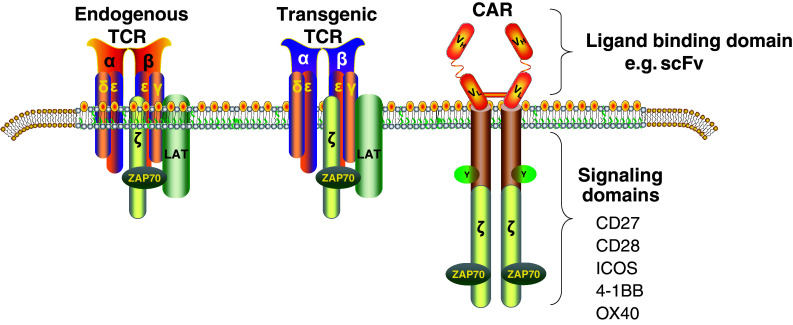
T cells with redirected receptor specificity that is currently under development for cancer and HIV. Dual recognition T cells are created by the introduction of genes that encode T cell receptors (TCR) or chimeric antigen receptors (CARs). The TCR combines TCR-alpha and TCR-beta genes and is MHC-restricted, while CARs are made from antibody-derived scFv, tied to intracellular signaling modules derived from T cell costimulatory proteins, and thus are MHC-independent, but require antigen expression on the surface of target cells
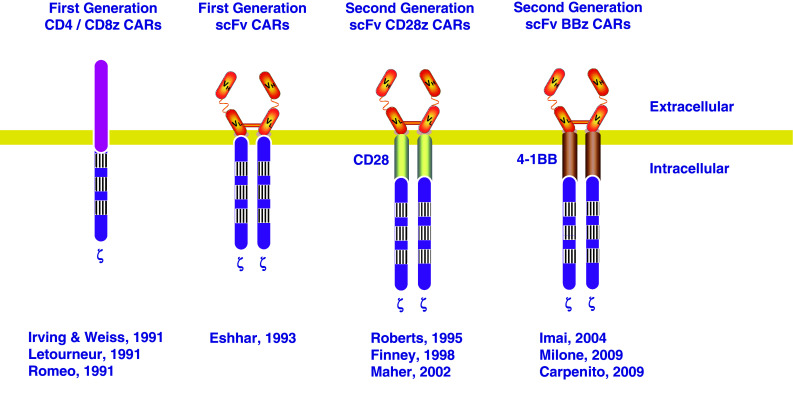
CAR development. Initial CARs were comprised of CD4 or CD8 linked to the CD3zeta molecule. Then, Eshhar attached scFv to the CDzeta molecule. Second-generation CARs using either CD28 or 4-1BB have now been developed by several groups and tested in clinical trials
References
-
- Drake CG, Jaffee E, Pardoll DM (2006) Mechanisms of immune evasion by tumors. Adv Immunol 90:51–81 - PubMed
-
- Johnson LA, Morgan RA, Dudley ME, Cassard L, Yang JC, Hughes MS, Kammula US, Royal RE, Sherry RM, Wunderlich JR, et al. Gene therapy with human and mouse T cell receptors mediates cancer regression and targets normal tissues expressing cognate antigen. Blood. 2009;114:535–546. doi: 10.1182/blood-2009-03-211714. - DOI - PMC - PubMed
Publication types
MeSH terms
Substances
Grants and funding
LinkOut - more resources
Full Text Sources
Other Literature Sources
