. 2014 Dec 15;210(12):1928-37.
doi: 10.1093/infdis/jiu347. Epub 2014 Jun 18.

Central memory CD4+ T cells are responsible for the recombinant Bacillus Calmette-Guérin ΔureC::hly vaccine's superior protection against tuberculosis

Affiliations

Central memory CD4+ T cells are responsible for the recombinant Bacillus Calmette-Guérin ΔureC::hly vaccine's superior protection against tuberculosis

Alexis Vogelzang et al. J Infect Dis. .

Abstract

Bacillus Calmette-Guérin (BCG) has been used for vaccination against tuberculosis for nearly a century. Here, we analyze immunity induced by a live tuberculosis vaccine candidate, recombinant BCG ΔureC::hly vaccine (rBCG), with proven preclinical and clinical safety and immunogenicity. We pursue in-depth analysis of the endogenous mycobacteria-specific CD4(+) T-cell population, comparing the more efficacious rBCG with canonical BCG to determine which T-cell memory responses are prerequisites for superior protection against tuberculosis. rBCG induced higher numbers and proportions of antigen-specific memory CD4(+) T cells than BCG, with a CXCR5(+)CCR7(+) phenotype and low expression of the effector transcription factors T-bet and Bcl-6. We found that the superior protection of rBCG, compared with BCG, correlated with higher proportions and numbers of these central memory T cells and of T follicular helper cells associated with specific antibody responses. Adoptive transfer of mycobacteria-specific central memory T cells validated their critical role in protection against pulmonary tuberculosis.

Keywords: BCG; Mycobacterium tuberculosis; VPM1002; memory T cells; vaccine; ΔureC::hly.


Figures

Figure 1.
Figure 1.
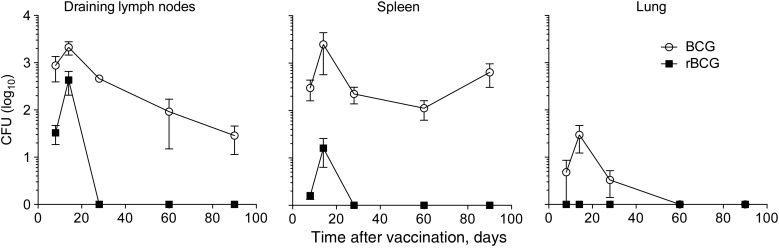
Kinetics of bacillus Calmette Guerin (BCG) and recombinant BCG (rBCG) clearance. Mice were vaccinated with either BCG or rBCG subcutaneously on day 0. Shown are mean colony-forming units (CFU; ± standard error of the mean) of 2 pooled experiments (n = 10).
Figure 2.
Figure 2.
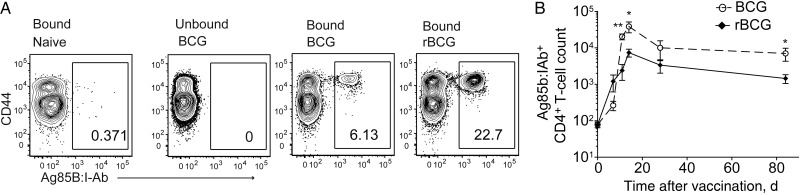
Kinetics of endogenous CD4+ T-cell responses in secondary lymphoid organs following BCG or rBCG vaccination. A, Flow cytometry of magnetic column–bound and unbound fractions following enrichment of Ag85B:I-Ab+ CD4+ T cells, gated on CD3+CD4+ T cells, from pooled lymph nodes and spleens obtained from individual naive controls or 14 days after vaccination, as described in Figure 1. B, Total numbers of Ag85B:I-Ab+ CD4+ T cells in pooled secondary lymphoid organs. Data are representative values (A) or pooled values from 3 independent experiments (B; n = 12). *P < .05 and **P < .01, by a 2-tailed Student t test.
Figure 3.
Figure 3.
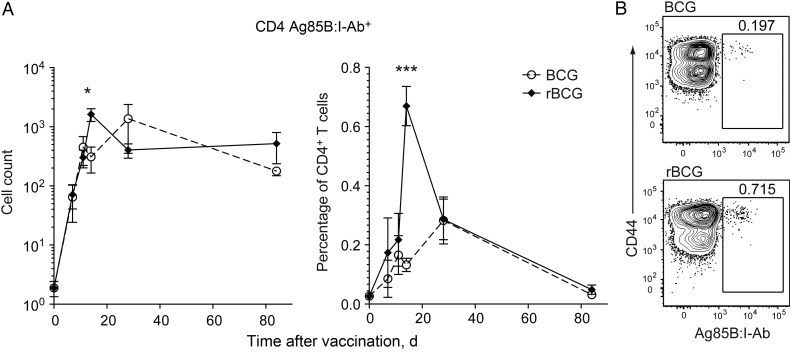
Antigen-specific CD4+ T cells migrate to the lung following subcutaneous BCG or rBCG vaccination. A, Numbers and frequencies of unenriched Ag85B:I-Ab+ CD4+ T cells in lung. B, Representative flow cytometry of the percentage of Ag85B:I-Ab+ CD4+ T cells in lung, gated on CD3+CD4+ T cells, 14 days after vaccination as described in Figure 1. Data are mean values (± standard error of the mean) of pooled samples (A) or representative values from individual mice from 2–3 experiments (B; n = 8–12). *P < .05 and ***P < .001, by a 2-tailed Student t test.
Figure 4.
Figure 4.
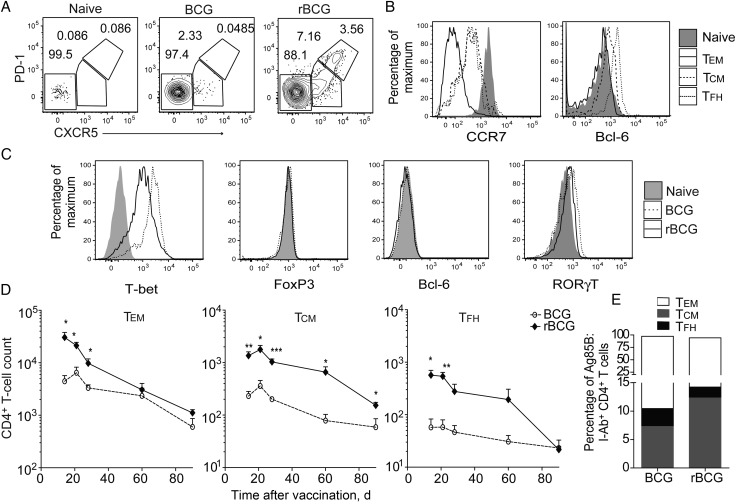
Vaccination with rBCG expands the central memory compartment of antigen (Ag)–specific CD4+ T cells. A–C, Data from pooled lymphoid organs from individual mice at day 14 after receipt of BCG or rBCG. A, Representative flow cytometry results showing memory markers gated on CD3+CD4+Ag85B:I-Ab+ T cells enriched from vaccinated or naive control mice. B, Surface CCR7 or nuclear Bcl-6 expression on representative naive CD3+CD4+Ag85B:I-Ab+ populations or CCR7CXCR5PD1 (TEM), CCR7+CXCR5+PD1 (TCM), and CCR7+CXCR5hiPD1hi (TFH) populations from rBCG recipients. C, Intracellular expression of transcription factors by CD3+CD4+Ag85B:I-Ab+ in naive mice, BCG recipients, or rBCG recipients. D, Mean total numbers (± standard error of the mean) of CD3+CD4+Ag85B:I-Ab+ TEM, TCM, and TFH gated as in panel B and enriched from pooled lymphoid organs from individual animals following vaccination. E, Mean frequency of effector populations among Ag85B:I-Ab+ CD4+ T cells gated as in panel B, 90 days after vaccination. Data are representative values from 3 independent experiments (AC) or pooled values from 2–3 experiments (D and E; n = 6–10). *P < .05, **P < .01, and ***P < .001, by a 2-tailed Student t test.
Figure 5.
Figure 5.
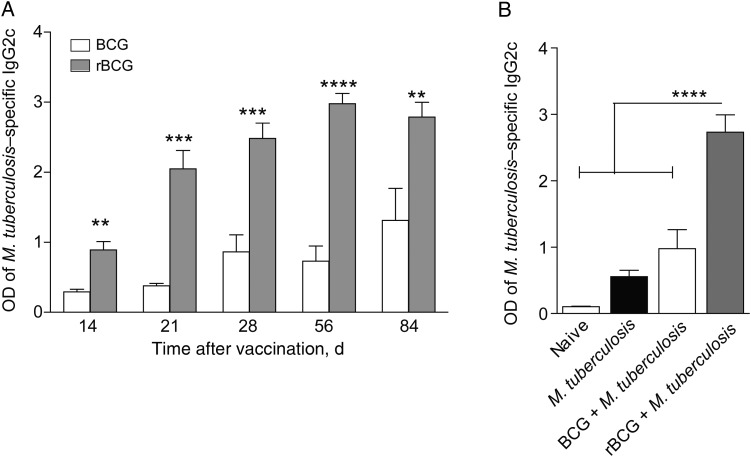
Vaccination with rBCG induces increased production of Mycobacterium tuberculosis–reactive antibody, compared with BCG. Mice were vaccinated with BCG or rBCG and were challenged 3 months later with a low dose of M. tuberculosis, alongside naive controls. The OD of M. tuberculosis–reactive immunoglobulin G2c (IgG2c) in sera, measured by enzyme-linked immunosorbent assay, in BCG and rBCG recipients (A) or in naive mice, M. tuberculosis recipients, BCG plus M. tuberculosis recipients, and rBCG plus M. tuberculosis recipients. Data show mean pooled values (± standard error of the mean) from 2 experiments (n = 10). **P < .01***P < .001, and ****P < .0001, by 1-tailed analysis of variance, followed by the Bonferroni posttest.
Figure 6.
Figure 6.
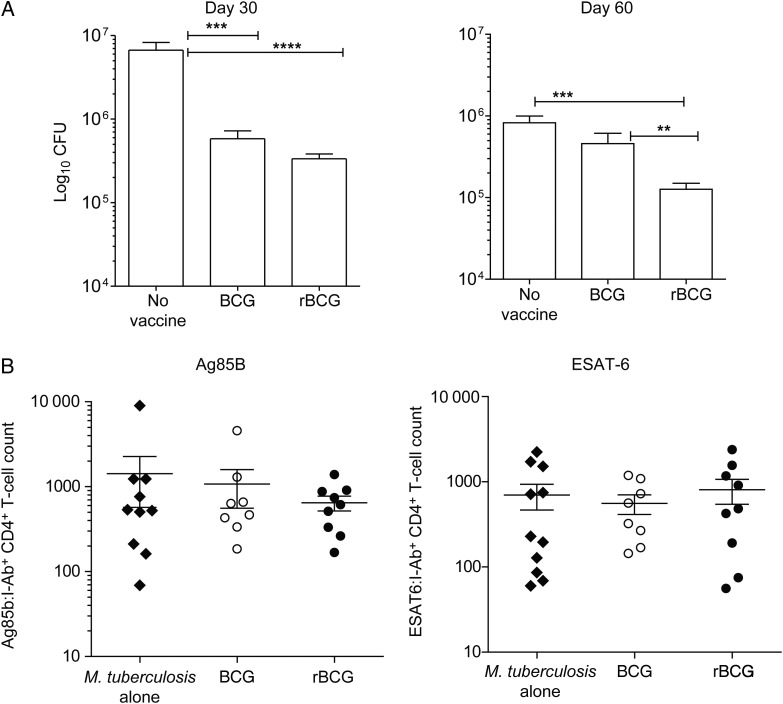
Vaccination with rBCG induces superior protection over BCG in the lung despite similar CD4+ T-cell recruitment at early time points after Mycobacterium tuberculosis infection. Mice were vaccinated and challenged with M. tuberculosis as described in Figure 5. A, M. tuberculosis colony-forming units (CFU) in lungs 30 and 60 days following M. tuberculosis challenge. B and C, Total numbers of memory Ag85B:I-Ab+ (B) and primary (C) ESAT6:I-Ab+ CD4+ T cells in lungs, quantified by flow cytometry, 14 days after M. tuberculosis infection. All graphs show mean ± standard error of the mean of pooled values from 2 experiments (n = 10). **P < .01, ***P < .001, and ****P < .0001, by the Mann–Whitney U test.
Figure 7.
Figure 7.
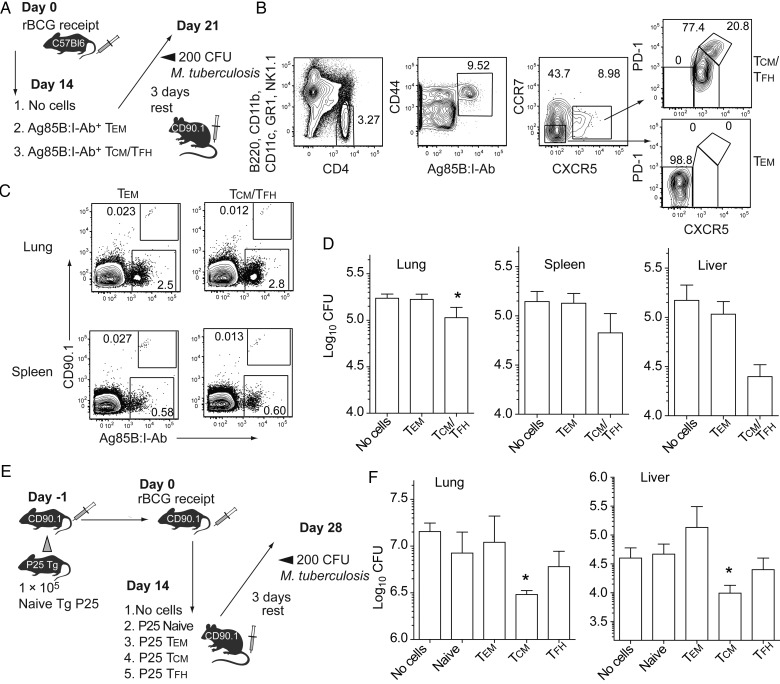
Adoptively transferred Ag85B-specific central memory CD4+ T cells (TCM) induced by rBCG protect against tuberculosis. A, Adoptive transfer strategy. Endogenous Ag85B-specific effector memory CD4+ T cells (TEM; CCR7CXCR5PD-1; 8000 per recipient) and TCM/T follicular helper T cells (TFH; CCR7+CXCR5+PD-1+; 3000 per recipient) were FACS purified from rBCG vaccinated, congenic CD90.1+ mice and then transferred into naive C57BL/6 recipients. After 3 days of rest, recipients and controls were infected with low-dose aerosolized Mycobacterium tuberculosis and analyzed 21 days after infection. B, Cell-sorting strategy to separate CD4+Ag85B:I-Ab+ cells into TEM and TCM/TFH subsets as in panel A, and postsort expression of TFH markers prior to transfer (right). C, Representative flow cytometry of CD90.1+ donor TEM or TCM/TFH after M. tuberculosis infection as in panel A, gated on total CD3+CD4+ cells in recipients of adoptive cell transfer. D, M. tuberculosis colony-forming units (CFU) after infection as in panel A. E, Second adoptive transfer strategy. A total of 1 × 10⁵ naive P25 Tg T cells were transferred into naive mice, which were then vaccinated with rBCG. Fourteen days later, donor cells were isolated by FACS and separated into TEM (CCR7CXCR5PD-1; 8000 per recipient), TCM (CCR7+CXCR5+PD-1; 3000 per recipient), and TFH (CCR7+CXCR5+PD-1+; 2000 per recipient) for transfer into naive mice. After 3 days of rest, recipients of adoptive cell transfer and controls were infected with low-dose aerosolized M. tuberculosis and analyzed 28 days after infection. F, CFU after M. tuberculosis infection as in panel E. Data show mean values (± standard error of the mean) representative of 2 experiments (n = 3–6). *P < .05, by the Mann–Whitney U test.

References

    1. Calmette A, Plotz H. Protective inoculation against tuberculosis with BCG. Am Rev Tuberc. 1929;19:567–72.
    1. Andersen P, Doherty TM. The success and failure of BCG - implications for a novel tuberculosis vaccine. Nat Rev Microbiol. 2005;3:656–62. - PubMed
    1. Kaufmann SH. Tuberculosis vaccines: time to think about the next generation. Semin Immunol. 2013;25:172–81. - PubMed
    1. Kaufmann SH. Fact and fiction in tuberculosis vaccine research: 10 years later. Lancet Infect Dis. 2011;11:633–40. - PubMed
    1. Orme IM. Characteristics and specificity of acquired immunologic memory to Mycobacterium tuberculosis infection. J Immunol. 1988;140:3589–93. - PubMed

Publication types