Review
. 2014 Mar 22;3(4):384-93.
doi: 10.1016/j.molmet.2014.03.004. eCollection 2014 Jul.

Osteopontin: A novel regulator at the cross roads of inflammation, obesity and diabetes

Affiliations
Review

Osteopontin: A novel regulator at the cross roads of inflammation, obesity and diabetes

Florian Kahles et al. Mol Metab. .

Abstract

Since its first description more than 20 years ago osteopontin has emerged as an active player in many physiological and pathological processes, including biomineralization, tissue remodeling and inflammation. As an extracellular matrix protein and proinflammatory cytokine osteopontin is thought to facilitate the recruitment of monocytes/macrophages and to mediate cytokine secretion in leukocytes. Modulation of immune cell response by osteopontin has been associated with various inflammatory diseases and may play a pivotal role in the development of adipose tissue inflammation and insulin resistance. Here we summarize recent findings on the role of osteopontin in metabolic disorders, particularly focusing on diabetes and obesity.

Keywords: Biomineralization; Diabetic nephropathy; Inflammation; Insulin resistance; Insulin sensitivity; Non-alcoholic fatty liver disease; Obesity; Osteopontin; Tissue remodeling.


Figures
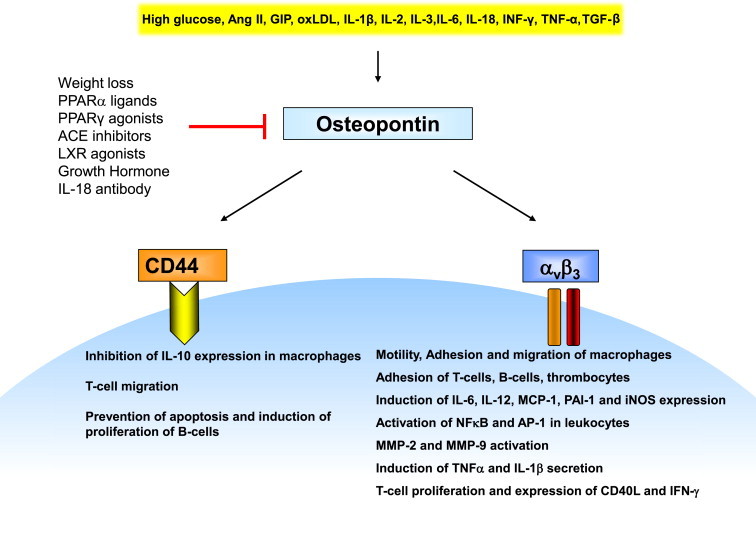
Figure 1
Figure 1
OPN is secreted by activated macrophages and T-cells and has been shown to be an important component of early cellular immune responses and inflammation. These proinflammatory effects of OPN are mediated through engagement of a number of receptors. Of particular interest are the integrin receptor αvβ3 and the CD44 receptor. Ligation to these receptors results in important proinflammatory functions allowing OPN to mediate the recruitment and activation of leukocytes at sites of inflammation.
Figure 2
Figure 2
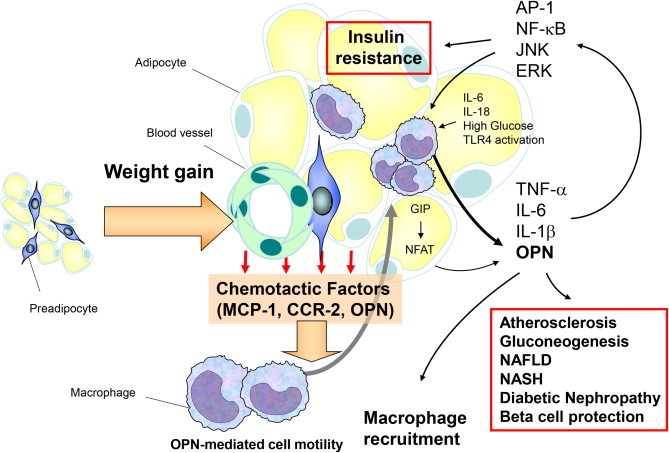
During diet-induced weight gain OPN is upregulated and mediates macrophage infiltration into adipose tissue. OPN expression in adipose tissue macrophages is enhanced by high glucose, TLR4 activation, IL-6 and IL-18. In adipocytes GIP increases OPN secretion. OPN itself activates several inflammatory signaling pathways leading to adipose tissue insulin resistance and type 2 diabetes. Furthermore, OPN was shown to directly increase atherosclerosis, NAFLD, NASH and diabetic nephropathy.

References

    1. Franzen A., Heinegard D. Isolation and characterization of two sialoproteins present only in bone calcified matrix. Biochemical Journal. 1985;232:715–724. - PMC - PubMed
    1. Reinholt F.P., Hultenby K., Oldberg A., Heinegard D. Osteopontin – a possible anchor of osteoclasts to bone. Proceedings of the National Academy of Sciences of the United States of America. 1990;87:4473–4475. - PMC - PubMed
    1. Kadkol S.S., Lin A.Y., Barak V., Kalickman I., Leach L., Valyi-Nagy K. Osteopontin expression and serum levels in metastatic uveal melanoma: a pilot study. Investigative Ophthalmology & Visual Science. 2006;47:802–806. - PMC - PubMed
    1. Scatena M., Liaw L., Giachelli C.M. Osteopontin: a multifunctional molecule regulating chronic inflammation and vascular disease. Arteriosclerosis, Thrombosis, and Vascular Biology. 2007;27:2302–2309. - PubMed
    1. Reza S., Shaukat A., Arain T.M., Riaz Q.S., Mahmud M. Expression of osteopontin in patients with thyroid dysfunction. PloS One. 2013;8:e56533. - PMC - PubMed