


Catecholamine autotoxicity. Implications for pharmacology and therapeutics of Parkinson disease and related disorders
- PMID: 24945828
- PMCID: PMC4591072
- DOI: 10.1016/j.pharmthera.2014.06.006
Catecholamine autotoxicity. Implications for pharmacology and therapeutics of Parkinson disease and related disorders
Abstract
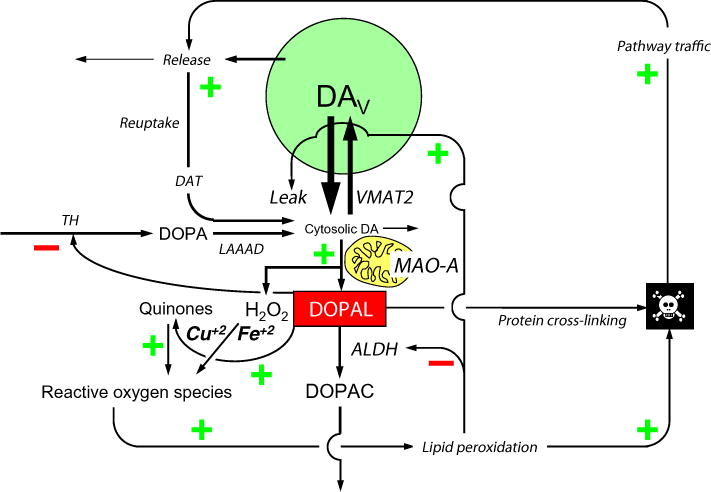
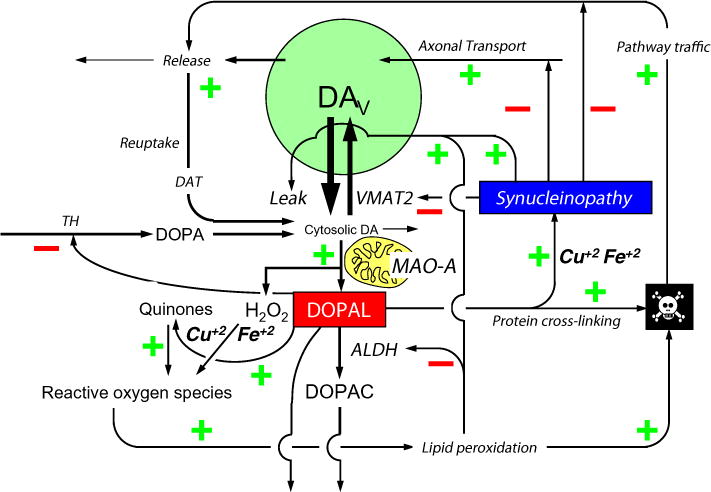
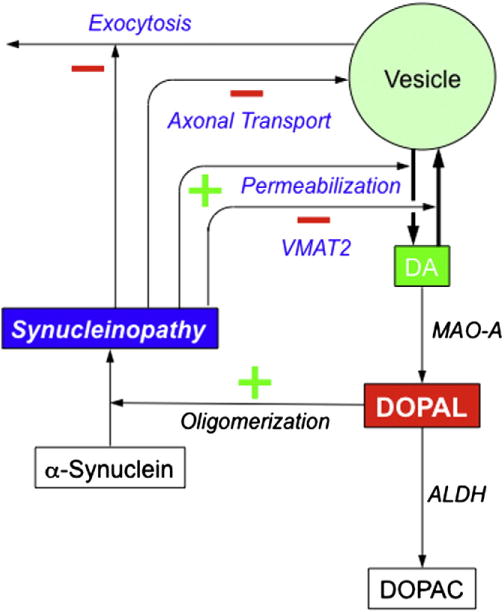
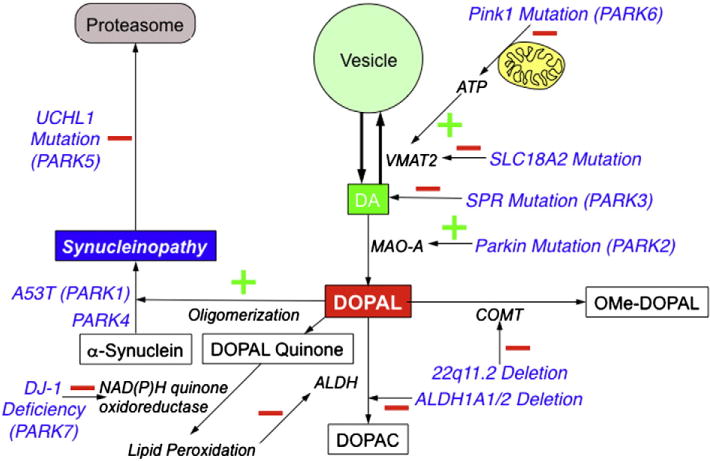
Several neurodegenerative diseases involve loss of catecholamine neurons-Parkinson disease is a prototypical example. Catecholamine neurons are rare in the nervous system, and why they are vulnerable in PD and related disorders has been mysterious. Accumulating evidence supports the concept of "autotoxicity"-inherent cytotoxicity of catecholamines and their metabolites in the cells in which they are produced. According to the "catecholaldehyde hypothesis" for the pathogenesis of Parkinson disease, long-term increased build-up of 3,4-dihydroxyphenylacetaldehyde (DOPAL), the catecholaldehyde metabolite of dopamine, causes or contributes to the eventual death of dopaminergic neurons. Lewy bodies, a neuropathologic hallmark of PD, contain precipitated alpha-synuclein. Bases for the tendency of alpha-synuclein to precipitate in the cytoplasm of catecholaminergic neurons have also been mysterious. Since DOPAL potently oligomerizes and aggregates alpha-synuclein, the catecholaldehyde hypothesis provides a link between alpha-synucleinopathy and catecholamine neuron loss in Lewy body diseases. The concept developed here is that DOPAL and alpha-synuclein are nodes in a complex nexus of interacting homeostatic systems. Dysfunctions of several processes, including decreased vesicular sequestration of cytoplasmic catecholamines, decreased aldehyde dehydrogenase activity, and oligomerization of alpha-synuclein, lead to conversion from the stability afforded by negative feedback regulation to the instability, degeneration, and system failure caused by induction of positive feedback loops. These dysfunctions result from diverse combinations of genetic predispositions, environmental exposures, stress, and time. The notion of catecholamine autotoxicity has several implications for treatment, disease modification, and prevention. Conversely, disease modification clinical trials would provide key tests of the catecholaldehyde hypothesis.
Keywords: Alpha-synuclein; Autotoxicity; Catecholamine; DOPAL; Parkinson disease.
Published by Elsevier Inc.
Conflict of interest statement
The authors affirm that they all have no actual or potential conflict of interest.
Figures
References
-
- Adamczyk A, Kazmierczak A, Strosznajder JB. Alpha-synuclein and its neurotoxic fragment inhibit dopamine uptake into rat striatal synaptosomes. Relationship to nitric oxide. Neurochem Int. 2006;49:407–412. - PubMed
-
- Adeyemo OM, Youdim MB, Markey SP, Markey CJ, Pollard HB. L-Deprenyl confers specific protection against MPTP-induced Parkinson’s disease-like movement disorder in the goldfish. Eur J Pharmacol. 1993;240:185–193. - PubMed
Publication types
MeSH terms
Substances
Grants and funding
LinkOut - more resources
Full Text Sources
Other Literature Sources
Medical
