


Predicting use of ineffective vegetable parenting practices with the Model of Goal Directed Behavior
- PMID: 24946833
- PMCID: PMC4506792
- DOI: 10.1017/S1368980014001220
Predicting use of ineffective vegetable parenting practices with the Model of Goal Directed Behavior
Abstract
Objective: Increasing a parent's ability to influence a child's vegetable intake may require reducing the parent's use of ineffective vegetable parenting practices. The present study was designed to understand the psychosocial influences on ineffective vegetable parenting practices.
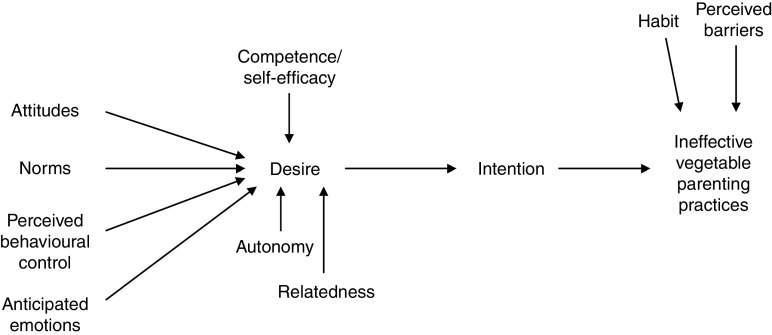
Design: A cross-sectional web-based survey was conducted to model use of ineffective vegetable parenting practices using validated scales from a Model of Goal Directed Vegetable Parenting Practices.
Setting: The dependent variable was a composite ineffective vegetable parenting practices index. The independent variables included validated subscales of intention, habit, perceived barriers, desire, competence, autonomy, relatedness, attitudes, norms, perceived behavioural control and anticipated emotions. Models were analysed using block regression with backward deletion.
Subjects: Parents of 307 pre-school children (3-5 years old).
Results: Variables significantly positively related to ineffective vegetable parenting practices in order of relationship strength included habit of controlling vegetable practices (standardized β=0·349, P<0·0001) and desire (standardized β=0·117, P=0·025). Variables significantly negatively related to ineffective vegetable parenting practices in order of relationship strength included perceived behavioural control of negative parenting practices (standardized β=-0·215, P<0000), the habit of active child involvement in vegetable selection (standardized β=-0·142, P=0·008), anticipated negative parent emotional response to child vegetable refusal (standardized β=-0·133, P=0·009), autonomy (standardized β=-0·118, P=0.014), attitude about negative effects of vegetables (standardized β=-0·118, P=0·015) and descriptive norms (standardized β=-0·103, P=0·032). The model accounted for 40·5 % of the variance in use of ineffective vegetable parenting practices.
Conclusions: The present study is the first report of psychometrically tested scales to predict use of ineffective vegetable parenting practices. Innovative intervention procedures will need to be designed and tested to reduce ineffective vegetable parenting practices.
Keywords: Controlling parenting practices.
Figures
References
-
- Ledoux T, Hingle M & Baranowski T (2011) Relationship of fruit and vegetable intake with adiposity: a systematic review. Obes Rev 12, e143–e150. - PubMed
-
- Resnicow K, Smith M, Baranowski T et al. (1998) 2-year tracking of children’s fruit and vegetable intake. J Am Diet Assoc 98, 785–789. - PubMed
-
- Birch LL (1998) Development of food acceptance patterns in the first years of life. Proc Nutr Soc 57, 617–624. - PubMed
-
- Kudlova E & Schneidrova D (2012) Dietary patterns and their changes in early childhood. Cent Eur J Public Health 20, 126–134. - PubMed
Publication types
MeSH terms
Grants and funding
LinkOut - more resources
Full Text Sources
Other Literature Sources
Medical
