. 2014 Jun 19;15(6):R79.
doi: 10.1186/gb-2014-15-6-r79.

Genome-wide identification and functional analysis of Apobec-1-mediated C-to-U RNA editing in mouse small intestine and liver

Genome-wide identification and functional analysis of Apobec-1-mediated C-to-U RNA editing in mouse small intestine and liver

Valerie Blanc et al. Genome Biol. .

Abstract

Background: RNA editing encompasses a post-transcriptional process in which the genomically templated sequence is enzymatically altered and introduces a modified base into the edited transcript. Mammalian C-to-U RNA editing represents a distinct subtype of base modification, whose prototype is intestinal apolipoprotein B mRNA, mediated by the catalytic deaminase Apobec-1. However, the genome-wide identification, tissue-specificity and functional implications of Apobec-1-mediated C-to-U RNA editing remain incompletely explored.

Results: Deep sequencing, data filtering and Sanger-sequence validation of intestinal and hepatic RNA from wild-type and Apobec-1-deficient mice revealed 56 novel editing sites in 54 intestinal mRNAs and 22 novel sites in 17 liver mRNAs, all within 3' untranslated regions. Eleven of 17 liver RNAs shared editing sites with intestinal RNAs, while 6 sites are unique to liver. Changes in RNA editing lead to corresponding changes in intestinal mRNA and protein levels for 11 genes. Analysis of RNA editing in vivo following tissue-specific Apobec-1 adenoviral or transgenic Apobec-1 overexpression reveals that a subset of targets identified in wild-type mice are restored in Apobec-1-deficient mouse intestine and liver following Apobec-1 rescue. We find distinctive polysome profiles for several RNA editing targets and demonstrate novel exonic editing sites in nuclear preparations from intestine but not hepatic apolipoprotein B RNA. RNA editing is validated using cell-free extracts from wild-type but not Apobec-1-deficient mice, demonstrating that Apobec-1 is required.

Conclusions: These studies define selective, tissue-specific targets of Apobec-1-dependent RNA editing and show the functional consequences of editing are both transcript- and tissue-specific.


Figures
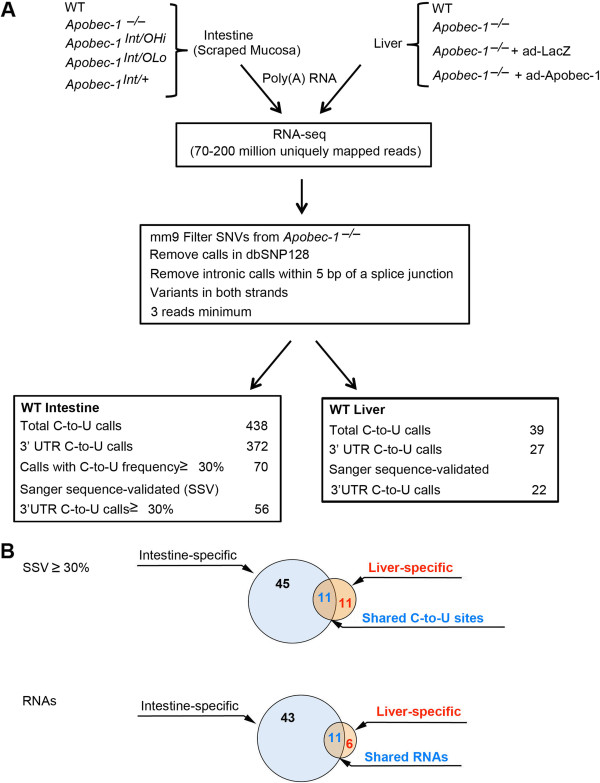
Figure 1
Figure 1
RNA-seq identification of Apobec-1-dependent RNA-editing targets. (A) RNA-seq procedure and analyses of 3' UTR C-to-U calls identified in wild-type (WT) small intestine and liver. Five murine lines with distinctive Apobec-1 expression profiles were used for intestinal transcriptome analysis. Apobec-1-/- mice exhibit no intestinal or hepatic apoB RNA editing. Apobec-1Int/+, intestine-specific Apobec-1 transgenic mice [15], were crossed with Apobec-1-/- mice generating Apobec-1Int/OHi and Apobec-1Int/OLo transgenic mice, with high (Hi) and low (Lo) levels of Apobec-1 expression [15]. WT hepatic transcriptomes were compared to Apobec-1-/- mice. Apobec-1-/- + ad-Apobec-1 or ad-LacZ indicates Apobec-1-/- mice injected with adenovirus expressing Apobec-1 or Lac Z. Overexpression of Apobec-1 in the liver restores apoB RNA editing. Uniquely mapped reads were aligned to the C57BL/6 mouse genome (NCBI37/mm9) containing 23,334 reference genes. To minimize false positive calls, sites identified in both WT and Apobec-1-/- mice, known SNPs from dbSNP128 and sites lying outside the gene boundaries were excluded. The remaining sites were corrected for strand sense and qualified when supported by 3 minimum non-identical reads, a minimum frequency of 10% with a minimum coverage of 10 reads. An arbitrary cutoff of 30% editing frequency was set to sequence-validate calls identified in the intestine. Due to the low number of calls identified in WT liver, all calls (27) were sequenced. (B) Numbers of C-to-U editing events and RNAs Sanger-sequence-validated (SSV). Blue circles represent the 56 3' UTR C-to-U calls identified in 54 WT intestine RNAs. Red circles show the 22 validated C-to-U sites identified in 17 hepatic RNAs. The shaded regions represent the 11 C-to-U sites or RNAs identified in both small intestine and liver. Forty-five sites were specific to the intestine, 11 were liver-specific.
Figure 2
Figure 2
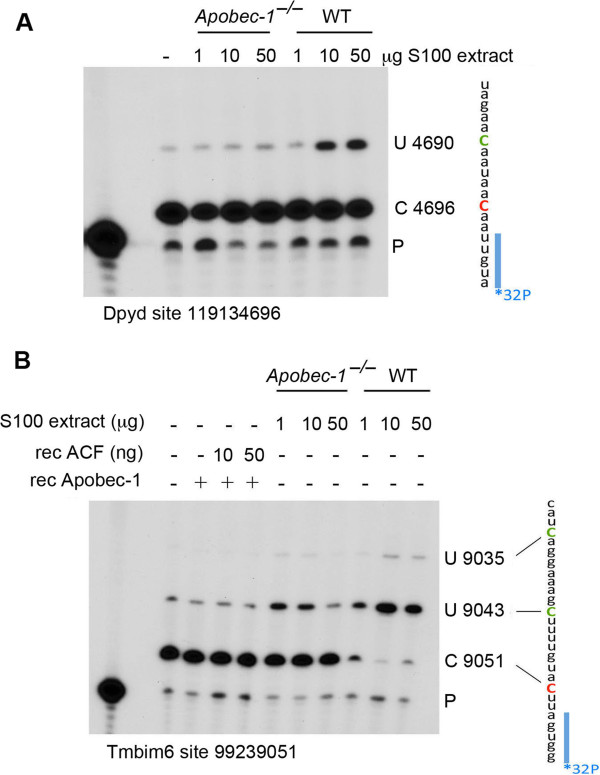
In vitro editing assay of 3' UTR targets. Total hepatic RNA from Apobec-1-/- mice was incubated with increasing amounts of WT hepatic S100 extract. RNA was used for cDNA synthesis followed by PCR amplification of Apobec-1 3′ UTR targets using specific targets. (A) Endogenous Dpyd RNA editing of cytidine 119134696 was determined by poisoned primer extension. The relative mobility of the unedited (C 4696) and edited product (U 4690) is indicated to the right. Vertically is shown the sequence surrounding the editing site. The targeted cytidine is indicated in red. Upon editing, the primer extension reaction proceeds until the next C (represented in green). The 32P-labeled primer is shown in blue. (B) Endogenous Tmbim6 RNA editing of cytidine 99239051. Total hepatic RNA from Apobec-1-/- mice was incubated with recombinant Apobec-1 and ACF or with increasing amounts of hepatic WT S100 extract. C-to-U editing of cytidine 9051 was determined by poisoned primer extension. To the right is shown the sequence surrounding the editing site. The edited cytidine (9051) is shown in red. Cytidine 9043 also appears to be targeted, resulting in an extension product terminating at cytidine 9035.
Figure 3
Figure 3
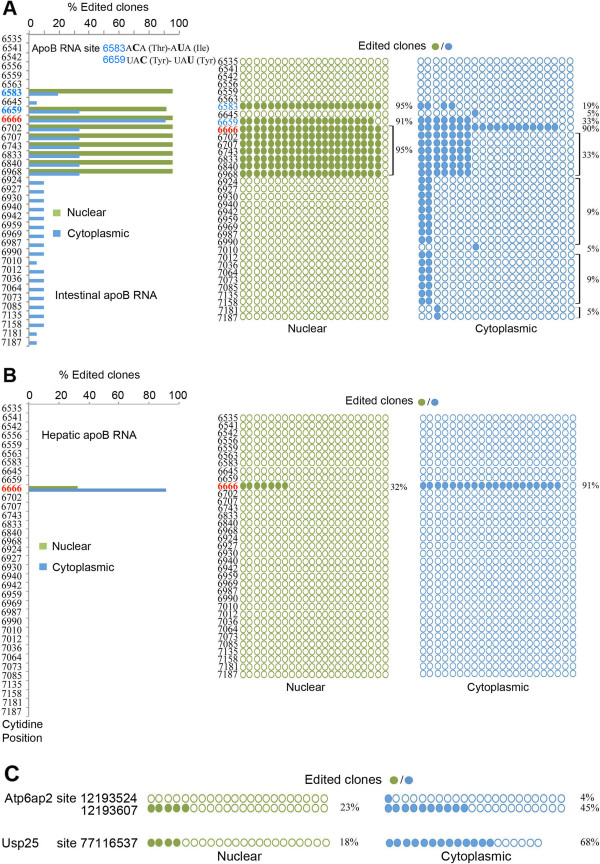
Nucleo-cytoplasmic distribution of Apobec-1-dependent mRNA editing targets. (A,B) Distribution of WT small intestine (A) and hepatic (B) edited apoB RNA. A 738 bp amplicon (nucleotides 6,508 to 7,246) from nuclear and cytoplasmic apoB mRNA was cloned and sequenced. Twenty-two clones from each subcellular fraction (from three independent nuclear-cytoplasmic isolations) were analyzed. Left panel: graphic representation of percentage of edited clones in nuclear and cytoplasmic apoB RNA. Right panel: targeted cytidines identified in nuclear apoB RNA are indicated with green circles; cytidines identified in cytoplasmic apoB RNA are represented by blue circles. All cytidines are aligned with the nucleotide position to the left. (C) Nuclear-cytoplasmic distribution of intestinal Apobec-1 3′ UTR targets identified by RNA-seq and validated by Sanger sequencing. A 550 bp (ATP6ap2) and a 667 bp (Usp25) amplicon were generated from nuclear and cytoplasmic RNA and analyzed by sequencing 19 to 22 clones. For both ATP6Ap2 and Usp25 RNAs, the edited RNA is predominantly exported to the cytoplasm.
Figure 4
Figure 4
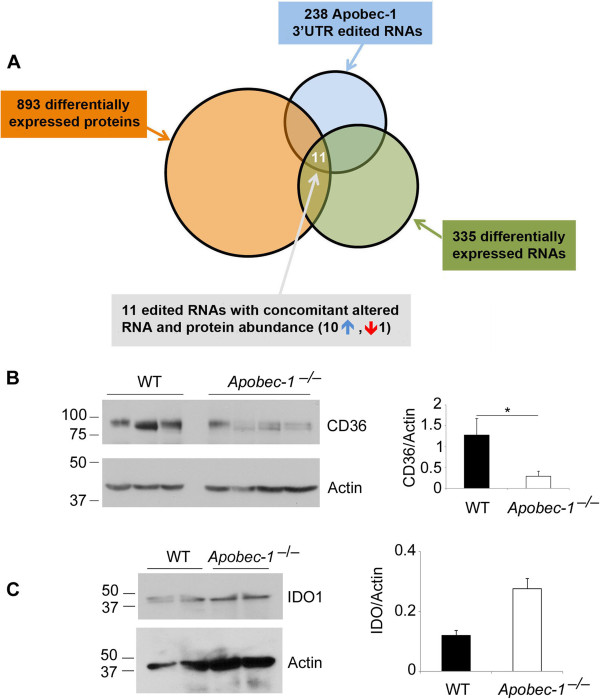
Apobec-1 editing targets in relation to RNA and protein expression. (A) Schematic representation of Apobec-1-dependent editing targets in relation to RNA and protein expression. Total proteins were extracted from WT Apobec-1-/- intestine and submitted for proteomic analysis (Materials and methods). The relative expression and editing status of the RNAs encoding the differentially expressed proteins were analyzed in parallel. Data comparison between WT and Apobec-1-/- data sets revealed 238 Apobec-1 RNA editing targets (blue circle), 335 differentially expressed RNAs (green circle) and 893 differentially expressed proteins (orange circle). Overlapping these three groups led to the identification of only 11 edited RNAs showing altered expression concomitant with altered protein level: 10 RNAs and proteins were up-regulated in WT (blue upward arrow) and one RNA and its protein product were down-regulated in WT compared to Apobec-1-/- (red downward arrow). (B) Reduced expression of Cd36 in intestinal extracts from Apobec-1-/- mice. Total cell lysates from three individual WT mice and four individual Apobec-1-/- animals were separated by SDS-PAGE probed with an anti-Cd36 and anti-α-actin antibody. * Indicates p < 0.05 for difference in protein abundance (C) Trend to increased expression of Ido1 protein expression in western blots of intestinal extracts from two individual Apobec-1-/- mice and two individual WT mice, normalized to α-actin as a loading control. Error bars represent mean ± se of relative protein abundance by genotype.
Figure 5
Figure 5
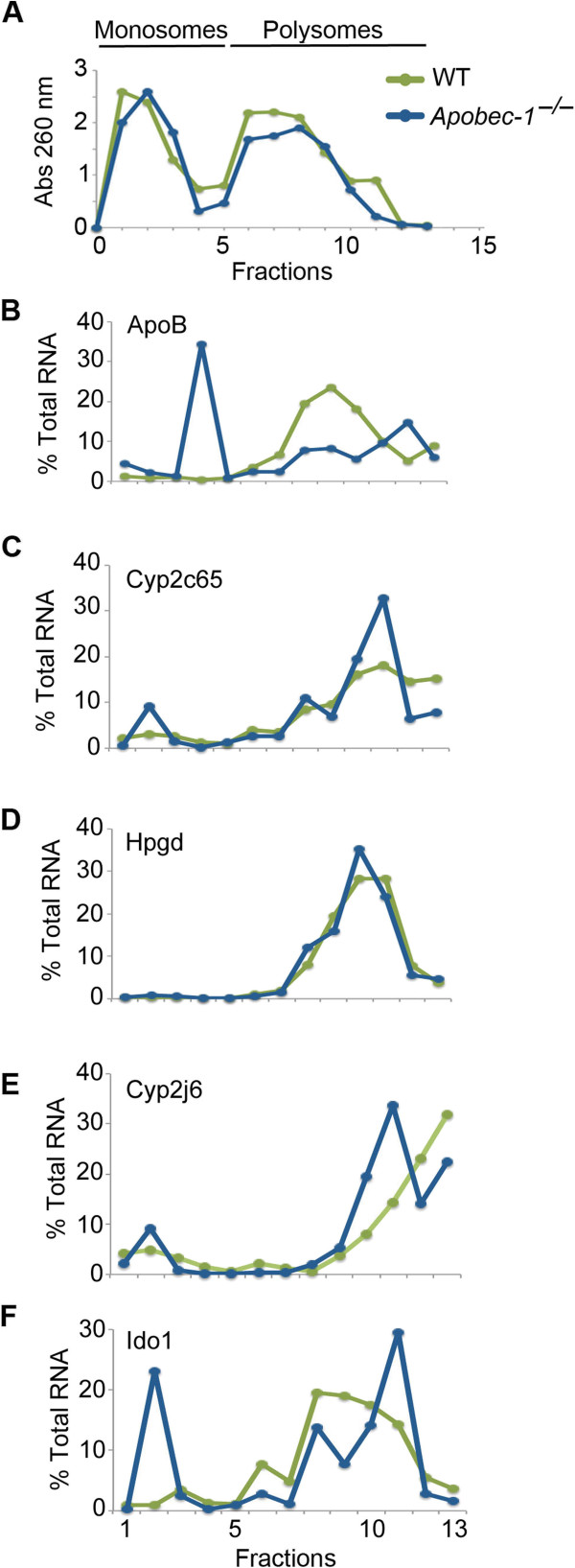
Polysomal distribution of Apobec-1 mRNA editing targets. (A) Absorbance profile (A260) of fractions harvested from WT (green) and Apobec-1-/- (blue) mouse small intestine cytoplasmic extracts separated on sucrose gradients. Cytoplasmic extracts (two to five preparations) were prepared, each with three to four animals per genotype. (B) Sucrose gradient fractionation of apoB RNA from WT (green) and Apobec-1-/- small intestine cytoplasmic extracts (blue). ApoB RNA content in each fraction was analyzed in triplicate by quantitative PCR. Data were normalized to the expression of 18S mRNA and expressed as percentage of total apoB RNA. Data represent the mean of four to five separate isolations. (C-F) Polysomal distributions of Cyp2c65, Hpgd, Cyp2j6 and Ido1 RNAs, respectively, evaluated by quantitative PCR as described above. WT distribution (green), Apobec-1-/- distribution (blue).

References

    1. Gu T, Buaas FW, Simons AK, Ackert-Bicknell CL, Braun RE, Hibbs MA. Canonical A-to-I and C-to-U RNA editing is enriched at 3′UTRs and microRNA target sites in multiple mouse tissues. PLoS One. 2012;7:e33720. - PMC - PubMed
    1. Lagarrigue S, Hormozdiari F, Martin LJ, Lecerf F, Hasin Y, Rau C, Hagopian R, Xiao Y, Yan J, Drake TA, Ghazalpour A, Eskin E, Lusis AJ. Limited RNA editing in exons of mouse liver and adipose. Genetics. 2013;193:1107–1115. - PMC - PubMed
    1. Bahn JH, Lee JH, Li G, Greer C, Peng G, Xiao X. Accurate identification of A-to-I RNA editing in human by transcriptome sequencing. Genome Res. 2012;22:142–150. - PMC - PubMed
    1. Danecek P, Nellaker C, McIntyre RE, Buendia-Buendia JE, Bumpstead S, Ponting CP, Flint J, Durbin R, Keane TM, Adams DJ. High levels of RNA-editing site conservation amongst 15 laboratory mouse strains. Genome Biol. 2012;13:26. - PMC - PubMed
    1. Peng Z, Cheng Y, Tan BC, Kang L, Tian Z, Zhu Y, Zhang W, Liang Y, Hu X, Tan X, Guo J, Dong Z, Liang Y, Bao L, Wang J. Comprehensive analysis of RNA-Seq data reveals extensive RNA editing in a human transcriptome. Nat Biotechnol. 2012;30:253–260. - PubMed

Publication types