. 2014 May;16(5):413-21.
doi: 10.1016/j.neo.2014.05.002. Epub 2014 Jun 16.

Snail1 expression is required for sarcomagenesis

Affiliations

Snail1 expression is required for sarcomagenesis

Lorena Alba-Castellón et al. Neoplasia. 2014 May.

Abstract

Snail1 transcriptional repressor is a major inducer of epithelial-to mesenchymal transition but is very limitedly expressed in adult animals. We have previously demonstrated that Snail1 is required for the maintenance of mesenchymal stem cells (MSCs), preventing their premature differentiation. Now, we show that Snail1 controls the tumorigenic properties of mesenchymal cells. Increased Snail1 expression provides tumorigenic capabilities to fibroblastic cells; on the contrary, Snail1 depletion decreases tumor growth. Genetic depletion of Snail1 in MSCs that are deficient in p53 tumor suppressor downregulates MSC markers and prevents the capability of these cells to originate sarcomas in immunodeficient SCID mice. Notably, an analysis of human sarcomas shows that, contrarily to epithelial tumors, these neoplasms display high Snail1 expression. This is particularly clear for undifferentiated tumors, which are associated with poor outcome. Together, our results indicate a role for Snail1 in the generation of sarcomas.


Figures

Figure 1
Figure 1
Snail1 increases the tumorigenic capability of fibroblasts in nude mice. Cells (3T3-L1, C2C12, or 1BR3.G) were stably transfected with pcDNA3 Snail1-HA or control plasmid. (A) Expression of Snail1 and S100A4 was determined by Western blot analysis. Four millions of cells were subcutaneously injected in the flanks of nude mice. (B) The presence of the tumors was determined after 30 (3T3-L1 and 1BR3.G) or 60 days (C2C12). The number of tumors relative to the number of injections is indicated for the different cell populations. A histologic analysis of a tumor obtained from ·3T3-L1 Snail1 cells is presented (C); higher magnifications of the micrographs are also shown. (D) Immunostaining with the mAb anti-Snail1 of one of these tumors is also shown. (E and F) Snail1 down-regulation inhibits the tumorigenesis of mesenchymal cell lines. (E) Expression of Snail1 or other markers of fibroblast activation in NIH-3T3.5 fibroblasts transfected with control or Snail1 shRNAs is shown. (F) NIH-3T3.5 transduced with a control or Snail1-specific shRNA were injected in the flanks of nude mice. Tumor size was measured every 4 days.
Figure 2
Figure 2
Effect of Snail1 depletion on gene expression in WT or p53-deficient MSCs. (A and B) The expression of Snail1 and the indicated markers was determined by quantitative reverse transcription–PCR (A) or Western blot analysis (B) in control or p53-deficient MSCs either WT or KO for Snail1. (C) Cells (103) were seeded on 10-cm diameter plates in DME plus 10% FBS medium; 10 days later, they were washed with phosphate-buffered saline, fixed with 4% p-formaldehyde, and stained with crystal violet. The figure shows a representative experiment of two performed and the average ± range of the colony number, referred to the value obtained with WT MSCs.
Figure 3
Figure 3
Snail1 prevents the generation of sarcomas by p53-deficient MSCs. Five million of p53-deficient MSCs, either WT or KO for Snail1, were injected into SCID mice either in subcutaneous or i.m. locations; presence of the tumors was determined 60 days later. A histologic analysis of a tumor obtained is presented in A; details of the micrographs are also shown in rows 2 and 4. The number of tumors relative to the number of injections is indicated for the two implantation locations (B). (C) Immunohistochemical analysis of Snail1 expression in the tumors obtained with p53-deficient MSCs injected either subcutaneously or i.m. Bars indicate magnification.
Figure 4
Figure 4
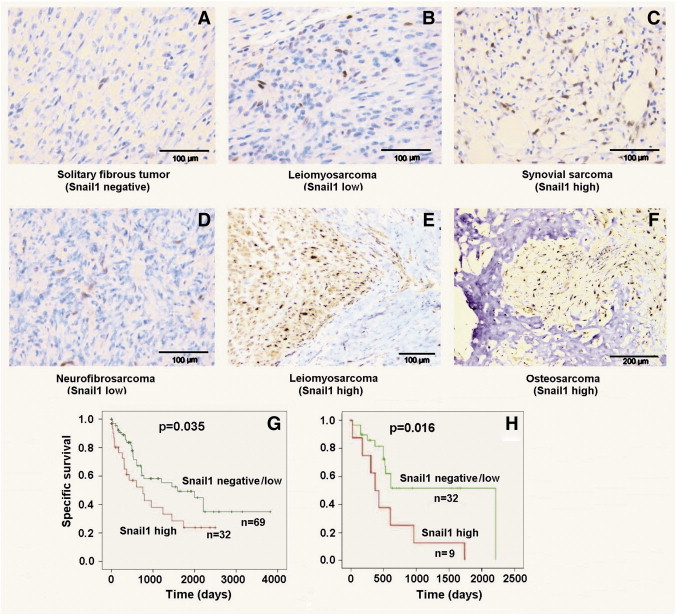
Snail1 expression is associated to a lower specific survival in human sarcomas. Expression of Snail1 was determined as indicated in Materials and Methods section in samples from human sarcomas. Micrographs of several representative stained sections corresponding to Snail1 (A–F) are shown. Bars indicate magnification. Kaplan-Meier analyses of specific survival with respect to Snail1 expression (high vs low or null) in 109 sarcomas or in 33 visceral, thoracic, retroperitoneum, and intrabdominal (trunk) sarcomas are presented in G and H. The P values are indicated.
Figure 5
Figure 5
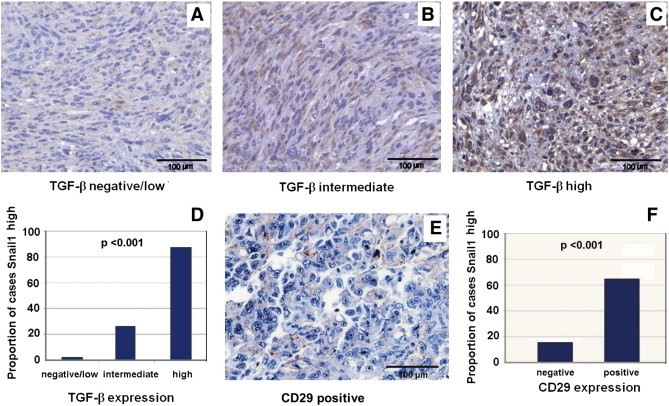
Snail1 expression correlates with that of TGF-β and CD29 and is associated to a lower specific survival in human sarcomas. Expression of TGF-β and CD29 was determined as indicated in Materials and Methods section in samples from human sarcomas. Micrographs of several representative stained sections corresponding to TGF-β are shown in A to C, and a representative staining of a CD29-positive tumor is shown in E. Bars indicate magnification. The correlation between the expression in tumors of TGF-β and Snail1 is presented in D; that of CD29 and Snail1 is presented in F. The P values are indicated.

References

    1. Thiery J.P., Acloque H., Huang R.Y., Nieto A.M. Epithelial-mesenchymal transition in development and disease. Cell. 2009;139:871–890. - PubMed
    1. García de Herreros A., Baulida J. Cooperation, amplification, and feed-back in epithelial-mesenchymal transition. Biochim Biophys Acta. 2012;1825:223–228. - PubMed
    1. Sánchez-Tilló E., Liu Y., de Barrios O., Siles L., Fanlo L., Cuatrecasas M., Darling D.S., Dean D.C., Castells A., Postigo A. EMT-activating factors in cancer: beyond EMT and tumor invasiveness. Cell Mol Life Sci. 2012;69:3429–3456. - PMC - PubMed
    1. Francí C., Takkunen M., Dave N., Alameda F., Gómez S., Rodríguez R., Escrivà M., Montserrat-Sentís B., Baró T., Garrido M. Expression of Snail protein in tumor-stroma interface. Oncogene. 2006;25:5134–5144. - PubMed
    1. DeCraene B., Berx G. Regulatory networks defining EMT during cancer initiation and progression. Nat Rev Cancer. 2013;13:97–110. - PubMed

Publication types

MeSH terms

Substances