. 2014 Sep;79(6):981-92.
doi: 10.1111/tpj.12600. Epub 2014 Aug 5.

The low-recombining pericentromeric region of barley restricts gene diversity and evolution but not gene expression

Affiliations
Free PMC article

The low-recombining pericentromeric region of barley restricts gene diversity and evolution but not gene expression

Katie Baker et al. Plant J. 2014 Sep.
Free PMC article

Abstract

The low-recombining pericentromeric region of the barley genome contains roughly a quarter of the genes of the species, embedded in low-recombining DNA that is rich in repeats and repressive chromatin signatures. We have investigated the effects of pericentromeric region residency upon the expression, diversity and evolution of these genes. We observe no significant difference in average transcript level or developmental RNA specificity between the barley pericentromeric region and the rest of the genome. In contrast, all of the evolutionary parameters studied here show evidence of compromised gene evolution in this region. First, genes within the pericentromeric region of wild barley show reduced diversity and significantly weakened purifying selection compared with the rest of the genome. Second, gene duplicates (ohnolog pairs) derived from the cereal whole-genome duplication event ca. 60MYa have been completely eliminated from the barley pericentromeric region. Third, local gene duplication in the pericentromeric region is reduced by 29% relative to the rest of the genome. Thus, the pericentromeric region of barley is a permissive environment for gene expression but has restricted gene evolution in a sizeable fraction of barley's genes.

Keywords: Hordeum vulgare; barley; genome evolution; heterochromatin; pericentromeric.


Figures

Figure 1
Figure 1
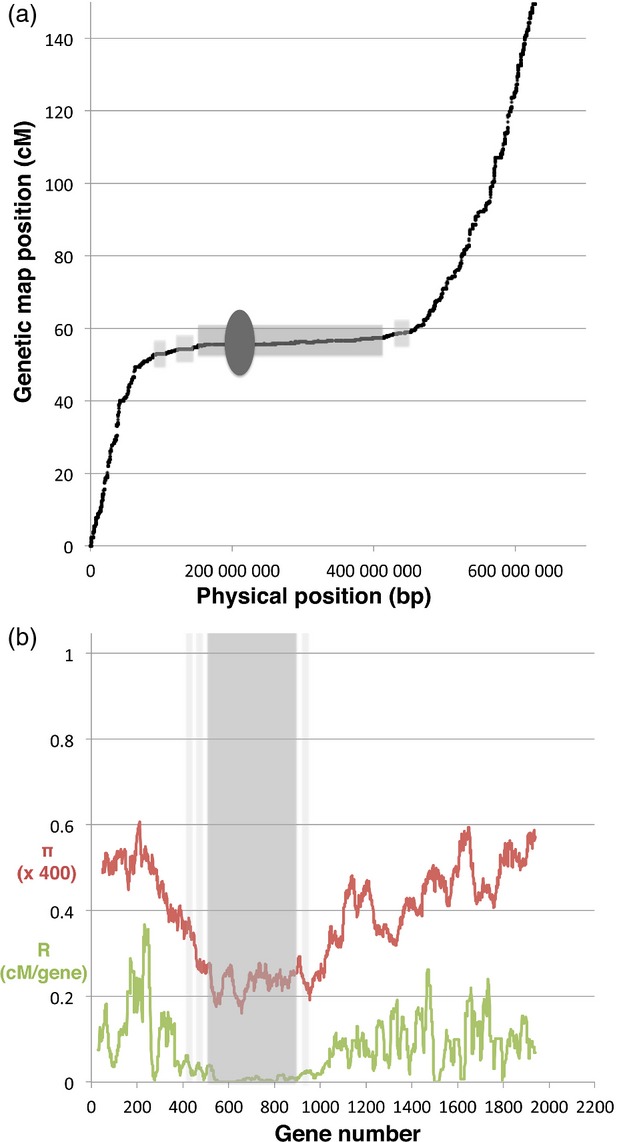
The LR-PC region of barley – definition, diversity and recombination. (a) Genetic versus physical map locations of genes on barley chromosome 2H. The centromere (dark grey oval) is surrounded by a continuous LR-PCH region (mid-grey bar), with flanking LR regions shown in light grey. (b) Diversity and recombination statistics for chromosome 2H. Rolling averages for gene nucleotide diversity (π, red) are plotted with recombination rate (cM/gene, green) against gene order. The LR-PCH regions (grey shading) correspond to the regions in (a).
Figure 2
Figure 2
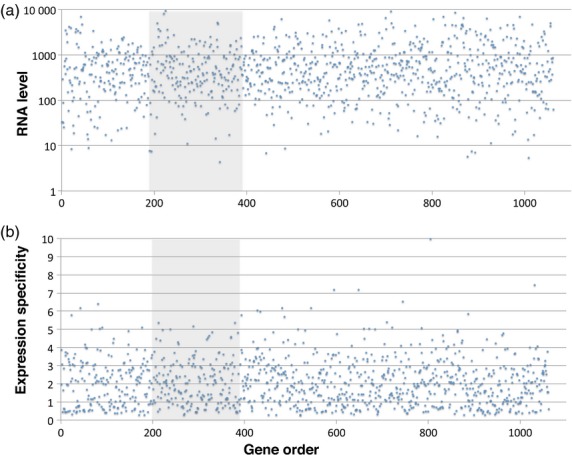
Gene expression level and developmental specificity are independent of LR-PC region residency in barley. Expression parameters for barley genes (Y axes) are plotted against their linear order (X axes) on barley chromosome 1H. The continuous LR-PCH is shaded grey. (a) Average RNA levels (arbitrary units), taken across 15 tissue types and developmental stages (Druka et al., 2006). (b) Developmental and/or tissue specificity quotients (= data from (a) divided by their corresponding standard deviations).
Figure 3
Figure 3
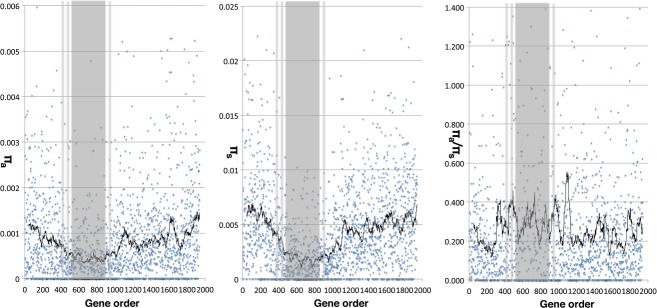
Gene selection is less effective in the LR-PC region than the HR genome compartment of H. spontaneum. πa, πs and πas values per gene among 14 diverse H. spontaneum lines (Y axes) are plotted against their corresponding linear gene orders (X axes) on barley chromosome 2H. Black lines indicate rolling averages (50 genes) and the LR-PC regions are indicated by shading.
Figure 4
Figure 4
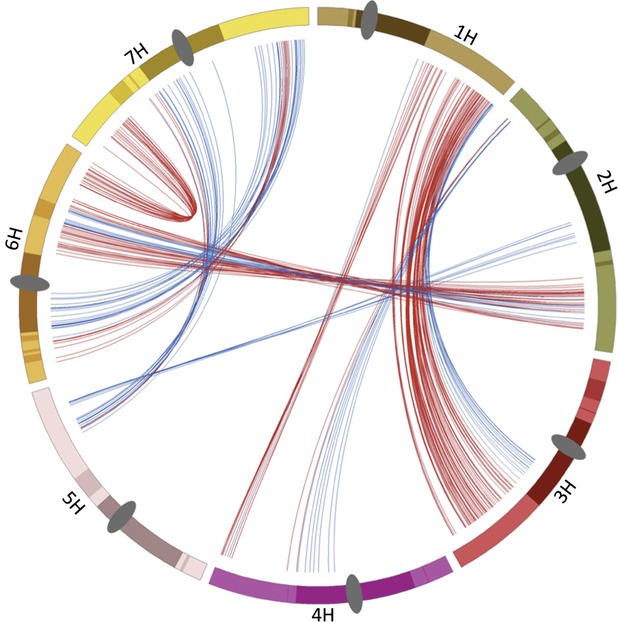
Barley ohnolog pairs and the LR-PC region. Barley chromosomes 1H–7H are indicated by different coloured bars, LR-PCH regions are indicated by dark shading, flanking LR by light shading and centromeres by dark grey ovals. All features are scaled by pseudo-physical map position (IBGSC, 2012). Ohnolog gene pairs are connected by colour-coded lines to indicate HR–HR pairs (red) and LR–HR pairs (blue). There are no LR–LR pairs.

References

    1. Begun DJ, Aquadro CF. Levels of naturally occurring DNA polymorphism correlate with recombination rates in D. melanogaster. Nature. 1992;356:519–520. - PubMed
    1. Berchowitz LE, Hanlon SE, Lieb JD, Copehnaver GP. A positive but complex association between meiotic double-strand break hotspots and open chromatin in Saccharomyces cerevisiae. Genome Res. 2009;19:2245–2257. - PMC - PubMed
    1. Carchilan M, Delgado M, Ribeiro T, Costa-Nunes P, Caperta A, Morais-Cecílio L, Jones RN, Viegas W, Houben A. Transcriptionally active heterochromatin in rye B chromosomes. Plant Cell. 2007;19:1738–1749. - PMC - PubMed
    1. Charlesworth B, Betancourt AJ, Kaiser VB, Gordo I. Genetic recombination and molecular evolution. Cold Spring Harbor Symp. Quant. Biol. 2009;74:1–10. - PubMed
    1. Chen J, Huang Q, Gao D, et al. Whole-genome sequencing of Oryza brachyantha reveals mechanisms underlying Oryza genome evolution. Nat. Commun. 2013;4:1595. - PMC - PubMed

Publication types

Substances

LinkOut - more resources